Category
page 1Gene expression

standard genetic code
rules by which information encoded within genetic material is translated into proteins

messenger RNA
large family of RNA molecules that convey genetic information from DNA to the ribosome, where they specify the amino acid sequence of the protein products of gene expression

transcription
biosynthesis of RNA carried out on a template of DNA

protein biosynthesis
cellular metabolic process in which a protein is formed, using the sequence of a mature mRNA or circRNA molecule to specify the sequence of amino acids in a polypeptide chain

translation
in biology, the creation of proteins using information from nucleic acids

gene expression
conversion of a gene's sequence into a mature gene product or products

intron
An intron is any nucleotide sequence within a gene that is not expressed or operative in the final RNA product. The word intron is derived from the term intragenic region, i.e., a region inside a gene. The term intron refers to both the DNA sequence within a gene and the corresponding RNA sequence in RNA transcripts. The non-intron sequences that become joined by this RNA processing to form the mature RNA are called exons.
promoter
region of DNA that initiates transcription of a particular gene

RNA polymerase
class of enzymes that synthesize RNA from a DNA template
RNA interference
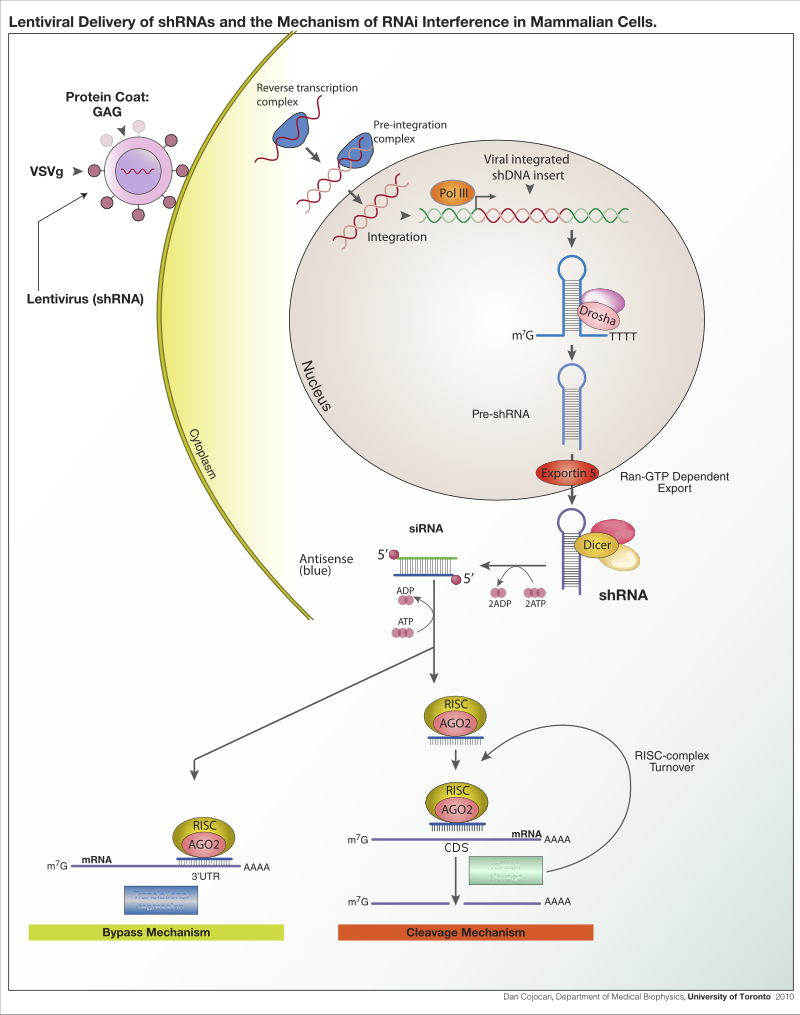
any process of posttranscriptional gene inactivation mediated by small RNA molecules that may trigger mRNA degradation or down-regulate translation

operon
thumb|350px|right|A typical operon
In genetics, an operon is a functioning unit of DNA containing a cluster of genes under the control of a single promoter. The genes are transcribed together into an mRNA strand and either translated together in the cytoplasm, or undergo splicing to create monocistronic mRNAs that are translated separately, i.e. several strands of mRNA that each encode a single gene product. The result of this is that the genes contained in the operon are either expressed together or not at all. Several genes must be co-transcribed to define an operon.
transcription factor
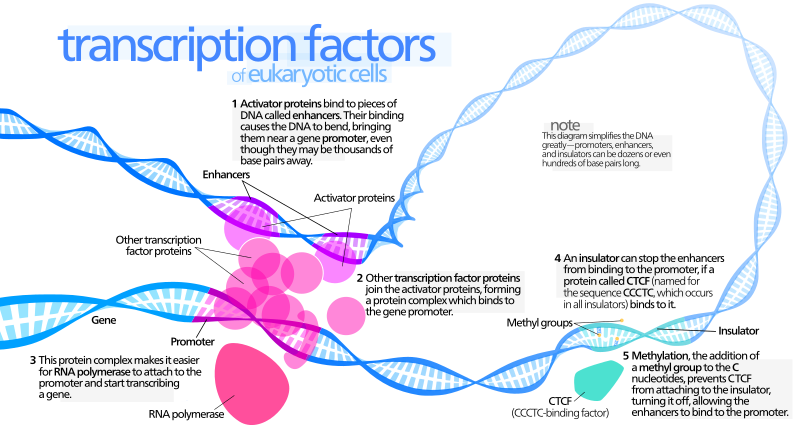
protein that binds to DNA and regulates gene expression by promoting or suppressing transcription

RNA splicing
the process of removing sections of the primary RNA transcript to remove sequences not present in the mature form of the RNA and joining the remaining sections to form the mature form of the RNA

microRNA
thumb|400px|Pre-miRNA instead of Pri-miRNA in the first point of mechanism. Diagram of microRNA (miRNA) action with mRNA
thumb|400px|Examples of miRNA hairpins (stem-loops), with the mature miRNAs shown in red
noncoding DNA
DNA not coding for protein. Often translated to RNA and critical in regulating other genes
DNA microarray
use of large set of oligonucleotide probes
quorum sensing
process in which single-celled organisms monitor their population density by detecting the concentration of small, diffusible signal molecules produced by the cells themselves.
genomic imprinting
phenomenon that causes genes to be expressed in a parent-of-origin-specific manner
enhancer
DNA sequence capable of binding activators
post-translational protein modification
covalent and generally enzymatic modification of proteins during or after protein biosynthesis

spliceosome
A spliceosome is a large ribonucleoprotein (RNP) complex found primarily within the nucleus of eukaryotic cells. The spliceosome is assembled from small nuclear RNAs (snRNA) and numerous proteins. Small nuclear RNA (snRNA) molecules bind to specific proteins to form a small nuclear ribonucleoprotein complex (snRNP, pronounced "snurps"), which in turn combines with other snRNPs to form a large ribonucleoprotein complex called a spliceosome. The spliceosome removes introns from a transcribed pre-mRNA, a type of primary transcript. This process is generally referred to as splicing. An analogy is
regulation of gene expression
process that modulates frequency, rate or extent of gene expression
stop codon
a codon that marks the end of a sequence
lac operon
set genes encoding proteins and enzymes for lactose metabolism
alternative mRNA splicing, via spliceosome
process of generating multiple mRNA molecules from a given set of exons by differential use of exons from the primary transcript(s), to form multiple mature mRNAs
post-transcriptional modification
processes by which an RNA primary transcript is chemically altered to produce a functional RNA molecule
uridine 5'-triphosphoric acid
chemical compound
RNA polymerase II, core complex
DNA-dependent RNA polymerase

repressor
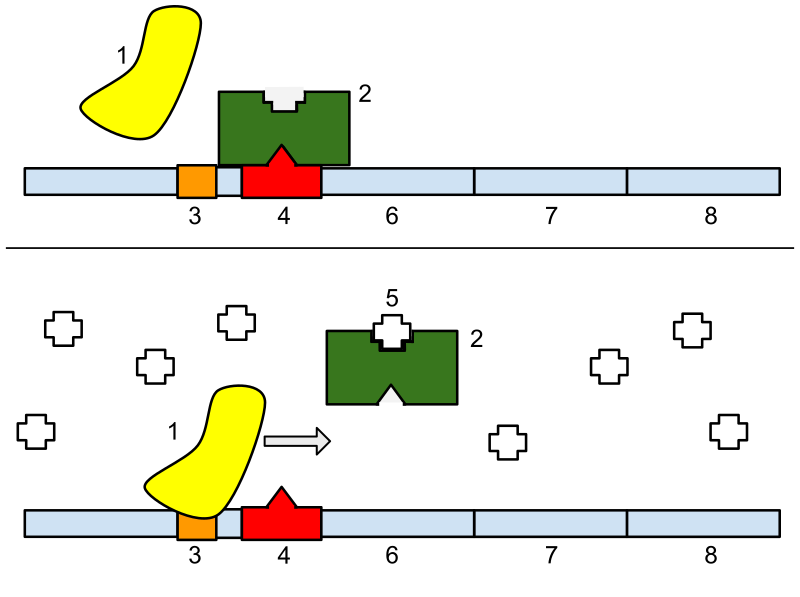
thumb|300x300px|The lac operon: '''1: RNA Polymerase, 2: [[lac repressor, 3: Promoter, 4: Operator, 5: Lactose, 6: lacZ, 7: lacY, 8: lacA.'''
gene knockout
genetic technique

polyadenylation
thumb|430px|Typical structure of a mature eukaryotic mRNA

transcriptome
The transcriptome is the set of all RNA molecules (transcripts) in a cell or a population of cells. It includes all of the functional RNA molecules and all other transcripts that may arise by spurious transcription or transcription of non-functional regions such as pseudogenes or virus fragments. A major goal of modern molecular biology is to determine which transcripts are functional and which ones are junk RNA.
untranslated region
Non-coding regions on either end of mRNA
RNA modification
covalent alteration of one or more nucleotides within an RNA molecule to produce an RNA molecule with a sequence that differs from that coded genetically
gene product
biochemical material resulting from expression of a gene
signal peptide
short peptide (usually 16-30 amino acids long) present at the N-terminus of the majority of newly synthesized proteins that are destined towards the secretory pathway
gene silencing
process that prevents the expression of a gene

demethylation
Demethylation is the chemical process resulting in the removal of a methyl group (CH3) from a molecule. A common way of demethylation is the replacement of a methyl group by a hydrogen atom, resulting in a net loss of one carbon and two hydrogen atoms.
sigma factor
class of proteins
RNA-dependent RNA polymerase
enzyme that synthesizes RNA from an RNA template
terminator
section of genetic sequence that marks the end of gene or operon on genomic DNA for transcription
silencer
DNA sequence capable of binding repressors
RB transcriptional corepressor 1
mammalian protein found in Homo sapiens
precursor mRNA
gene regulatory network
collection of molecular regulators that interact with each other and with other substances in the cell to govern the gene expression levels of mRNA and proteins

RNA sequencing
thumb|419x419px|Summary of RNA-Seq. Within the organism, genes are transcribed and (in a eukaryote|eukaryotic organism) spliced to produce mature mRNA transcripts (red). The mRNA is extracted from the organism, fragmented and copied into stable ds-cDNA (blue). The ds-cDNA is sequenced using high-throughput, short-read sequencing methods. These sequences can then be aligned to a reference genome sequence to reconstruct which genome regions were being transcribed. This data can be used to annotate where expressed genes are, their relative expression levels, and any alternative splice variants.
Mouse Genome Informatics
free, online database and bioinformatics resource
JAK-STAT signaling pathway
biological signaling pathway
Trp operon
operon that codes for the components for production of tryptophan
housekeeping gene
gene which maintains basic cellular functions
nucleic acid analogue
compound which is analogous (structurally similar) to naturally occurring RNA and DNA, used in medicine and in molecular biology research
STAT3
Signal transducer and activator of transcription 3 (STAT3) is a transcription factor which in humans is encoded by the STAT3 gene. It is a member of the STAT protein family.
Morpholino
chemical compound
nuclear-transcribed mRNA catabolic process, nonsense-mediated decay
degrades mRNAs in which an amino-acid codon has changed to a nonsense codon
ribonucleoprotein complex
macromolecular complex containing both protein and RNA molecules.
rho factor
prokaryotic protein
regulatory sequence
type of nucleic acid that affects the expression of associated genes
RNA polymerase III
family of enzyme complexes
three prime untranslated region
sequence at the 3' end of messenger RNA that does not code for product
five prime untranslated region
region of a messenger RNA