Category
page 1Geometrical optics

refraction
thumb|A ray of light being refracted in a plastic block
In physics, refraction is the redirection of a wave as it passes from one medium to another. The redirection can be caused by the wave's change in speed or by a change in the medium. Refraction of light is the most commonly observed phenomenon, but other waves such as sound waves and water waves also experience refraction. How much a wave is refracted is determined by the change in wave speed and the initial direction of wave propagation relative to the direction of change in speed.

reflection
change in direction of a wavefront at an interface between two different media so that the wavefront returns into the medium from which it originated

Snell's law
formula deriving the angle of refraction of light between two mediums
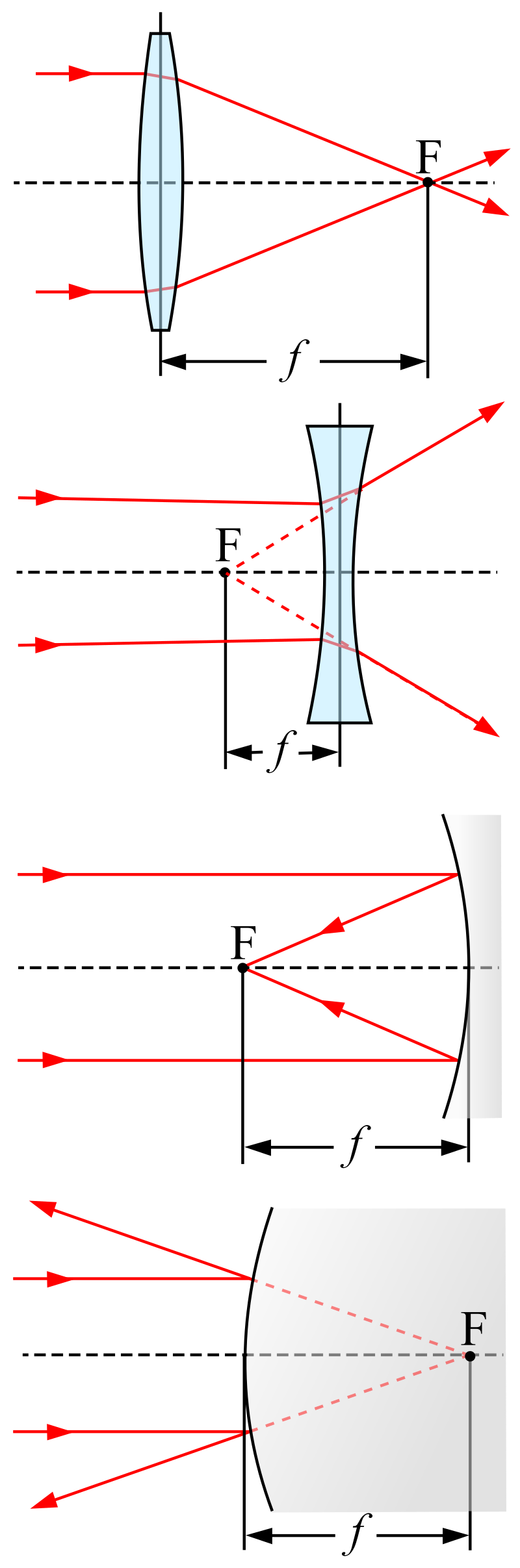
focal length
measure of how strongly an optical system converges or diverges light

focus
point where parallel light rays or light rays originating from a point will converge

geometrical optics
model of optics describing light as geometric rays

Total internal reflection
physical phenomenon
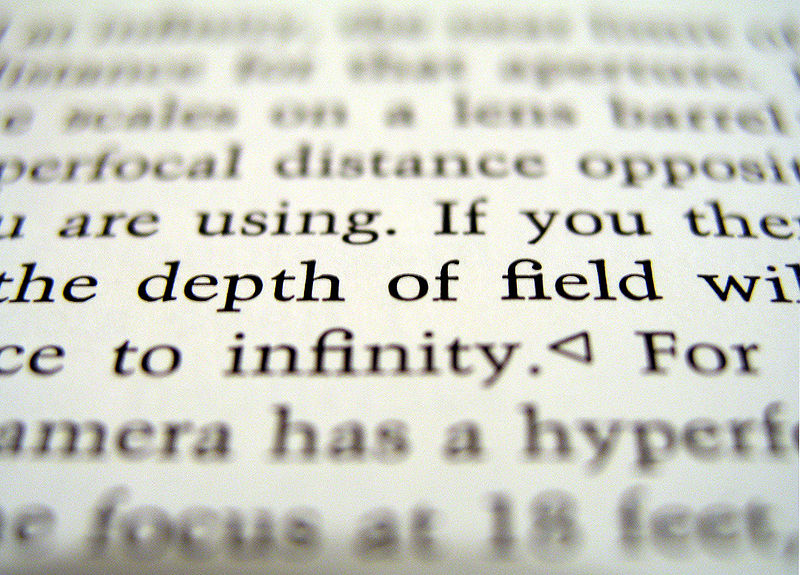
depth of field
distance between the nearest and the furthest objects that are in focus in an image
chromatic aberration
failure of a lens to focus all colors on the same point

optical aberration
departure of the performance of an optical system from the predictions of paraxial optics
Fermat's principle
principle of least time

aperture
thumb|Different apertures of a lens
thumb|In biology, the pupil (appearing as a black hole) of the eye is its aperture and the iris is its diaphragm. In humans, the pupil can constrict to as small as 2 mm (8.3) and dilate to larger than 8 mm (2.1) in some individuals.
thumb|A camera aperture
thumb|Definitions of Aperture in the 1707 Glossographia Anglicana Nova
thumb|Aperture icon

ray tracing
rendering algorithm that works by sending out many virtual rays of light
spherical aberration
optical aberration
ray
in geometrical optics: an idealized model of light; a line that is perpendicular to the wavefronts of the actual light, and that points in the direction of energy flow
optical axis
line along which there is some degree of rotational symmetry in an optical system
Brewster's angle
angle of incidence for which all reflected light will be polarized
Fresnel equations
equations of light transmission and reflection

distortion
In signal processing, distortion is the alteration of the original shape (or other characteristic) of a signal. In communications and electronics it means the alteration of the waveform of an information-bearing signal, such as an audio signal representing sound or a video signal representing images, in an electronic device or communication channel.
coma
aberration inherent to certain optical designs or due to imperfection in the lens
angle of view
angular extent of a given scene that is imaged by a camera
virtual image
Image formed by optics or spherical mirrors,that diminished or magnified.
astigmatism
refractive error in optics
caustic
optic phenomenon due to light rays reflecting/refracting through curved surfaces/objects
paraxial approximation
small angle approximation in geometric optics
angle of incidence
angle between a ray incident on a surface and the line perpendicular to the surface at the point of incidence
optical path length
term
circumzenithal arc
optical phenomenon arising from refraction of sunlight through ice crystals
distortion
deviation from rectilinear projection (optics)
real image
type of an image formed by a mirror
light beam
projection of light energy
cardinal point
term in Gaussian optics
reflection coefficient
measure of wave reflectivity
Petzval field curvature
optical aberration
circle of confusion
blurry region in optics
Scheimpflug principle
Optical imaging rule
ray transfer matrix analysis
ray tracing technique
conic constant
quantity describing conic sections
Snell's window
underwater phenomenon due to Snell's Law
Eikonal equation
non-linear partial differential equation encountered in problems of wave propagation
depth of focus
lens optics concept
transmission coefficient
coefficient describing the amplitude, intensity, or total power of a transmitted wave relative to an incident wave

Optical path
path taken by light in traversing a system

radius of curvature
concept in optical lens design
Alhazen's problem
mathematical problem in geometrical optics
angular aperture
stigmatism
In geometric optics, stigmatism refers to the image-formation property of an optical system which focuses a single point source in one phase optics space into a single point in image space. Two such points are called a stigmatic pair of the optical system. Many optical systems, even those exhibiting optical aberrations, including astigmatism, have at least one stigmatic pair. Stigmatism is applicable only in the approximation provided by geometric optics. In reality, image formation is, at best diffraction-limited, and point-like images are not possible due to the wave nature of light.
Afocal system
Plane of incidence
relating to optical reflection
Gaussian optics
technique in geometric optics
defocus aberration
quality of an image being out of focus
toric lens
type of lens
Abbe sine condition
condition that must be fulfilled by a lens or other optical system in order for it to produce sharp images of off-axis as well as on-axis objects
Schmidt corrector plate
corrective lens used in Schmidt and Schmidt–Cassegrain telescopes
vergence
reciprocal of the distance between the point of focus and a reference plane
pencil
beam of electromagnetic radiation or charged particles
Signal reflection
in signal transmission
off-axis optical system
Infinity focus
State in optics