File:Focal-length.svg · Wikimedia Commons · See Wikimedia Commons
focal length
Sign in to savemeasure of how strongly an optical system converges or diverges light
Focal length measures how strongly a lens or mirror bends light rays to focus them at a point. It matters because it determines what a camera or telescope can see—shorter focal lengths capture a wider view, while longer ones magnify distant objects.
AI-generated from the Wikipedia summary — may contain errors.
Wikidata facts
- Subclass of
- physical quantity
- Image
- Focal-length.svg
Show 5 more facts
- studied by
- optics
- Commons category
- Focal length
- described by source
- Nordisk familjebok
- different from
- depth of focus
- on focus list of Wikimedia project
- Wikipedia:Vital articles/Level/4
via Wikidata · CC0
~13 min read
Encyclopedic overview
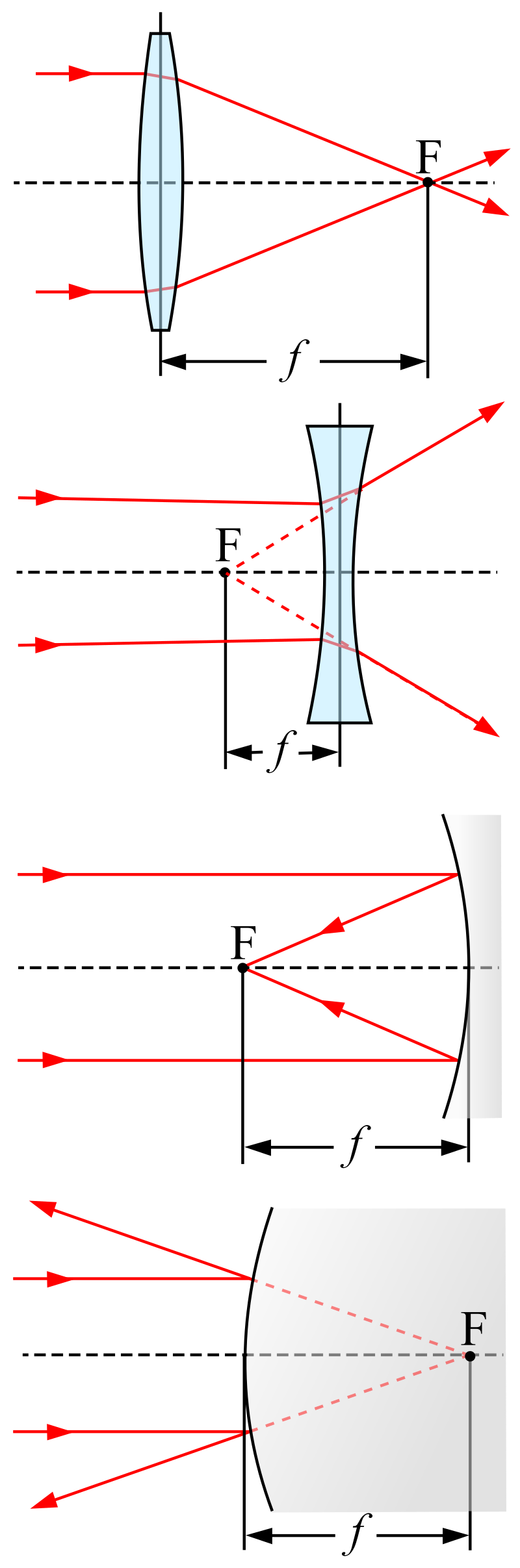
The focal point F and focal length f of a positive (convex) lens, a negative (concave) lens, a concave mirror, and a convex mirror.
The focal length of an optical system is a measure of how strongly the system converges or diverges light; it has units of length, and for an idealized thin lens is equal to the distance between the lens and its focal points. A positive focal length indicates that a system converges light, while a negative focal length indicates that the system diverges light. A system with a shorter focal length bends the rays more sharply, bringing them to a focus in a shorter distance or diverging them more quickly. For the special case of a thin lens in air, a positive focal length is the distance over which initially collimated (parallel) rays are brought to a focus, or alternatively a negative focal length indicates how far in front of the lens a point source must be located to form a collimated beam. For more general optical systems, the focal length has no intuitive meaning; it is simply the inverse of the system's optical power.
Excerpted from Wikipedia’s “focal length” article, available under the CC BY-SA 4.0 licence.