Category
page 1Human female endocrine system
human pregnancy
Pregnancy is the time during which one or more offspring gestates inside a woman's uterus. A multiple pregnancy involves more than one offspring, such as with twins.

hormone
thumb|300px|Left: A hormone feedback loop in a female adult human
Right: Auxin transport from leaves to roots in [[Arabidopsis thaliana]]

breast cancer
cancer that originates in the mammary gland

placenta
The placenta (: placentas or placentae) is a temporary embryonic and later fetal organ that begins developing from the blastocyst shortly after implantation. It plays critical roles in facilitating nutrient, gas, and waste exchange between the physically separate maternal and fetal circulations, and is an important endocrine organ, producing hormones that regulate both maternal and fetal physiology during pregnancy. The placenta connects to the fetus via the umbilical cord, and on the opposite aspect to the maternal uterus in a species-dependent manner. In humans, a thin layer of maternal deci

menopause
thumb|right|Тhe changes in ovarian hormones throughout the human lifespan. During childhood, hormone levels are low. During puberty, estrogen begins to fluctuate, followed by progesterone when you first begin ovulating. After 6-12 years the menstrual cycle normalizes into a rhythm during the menstrual years, barring any reproductive health issues or pregnancy and breastfeeding, which pauses the cycling. Perimenopause, similar to puberty, has high fluctuations of estrogen as progesterone slowly begins to decline. Eventually, a person stops ovulating, reaches menopause, and hormones return to ch

egg cell
haploid female reproductive cell or gamete

puberty

pituitary gland
endocrine gland at the base of the brain. Referred to as the “master gland” because it monitors and regulates many bodily functions through the hormones that it produces, including growth and sexual/reproductive development and function.

hypothalamus
The hypothalamus (: hypothalami; ) is a small part of the vertebrate brain that contains a number of nuclei with a variety of functions. One of the most important functions is to link the nervous system to the endocrine system via the pituitary gland. The hypothalamus is located below the thalamus and is part of the limbic system. It forms the basal part of the diencephalon. All vertebrate brains contain a hypothalamus. In humans, it is about the size of an almond.

estrogen
Estrogen (American English) or oestrogen (Commonwealth English; see spelling differences) is a category of sex hormone responsible for the development and regulation of the female reproductive system and secondary sex characteristics. There are three major endogenous estrogens that have estrogenic hormonal activity: estrone (E1), estradiol (E2), and estriol (E3). Estradiol, an estrane, is the most potent and prevalent. Another estrogen called estetrol (E4) is produced only during pregnancy.

oxytocin
Oxytocin is a peptide hormone and neuropeptide normally produced in the hypothalamus and released by the posterior pituitary. Present in animals since early stages of evolution, in humans it plays roles in behavior that include social bonding, love, reproduction, childbirth, and the period after childbirth. Oxytocin is released into the bloodstream as a hormone in response to sexual activity and during childbirth. It is also available in pharmaceutical form. In either form, oxytocin stimulates uterine contractions to speed up the process of childbirth.

menstrual cycle
a type of ovulation cycle where the endometrium is shed if pregnancy does not occur
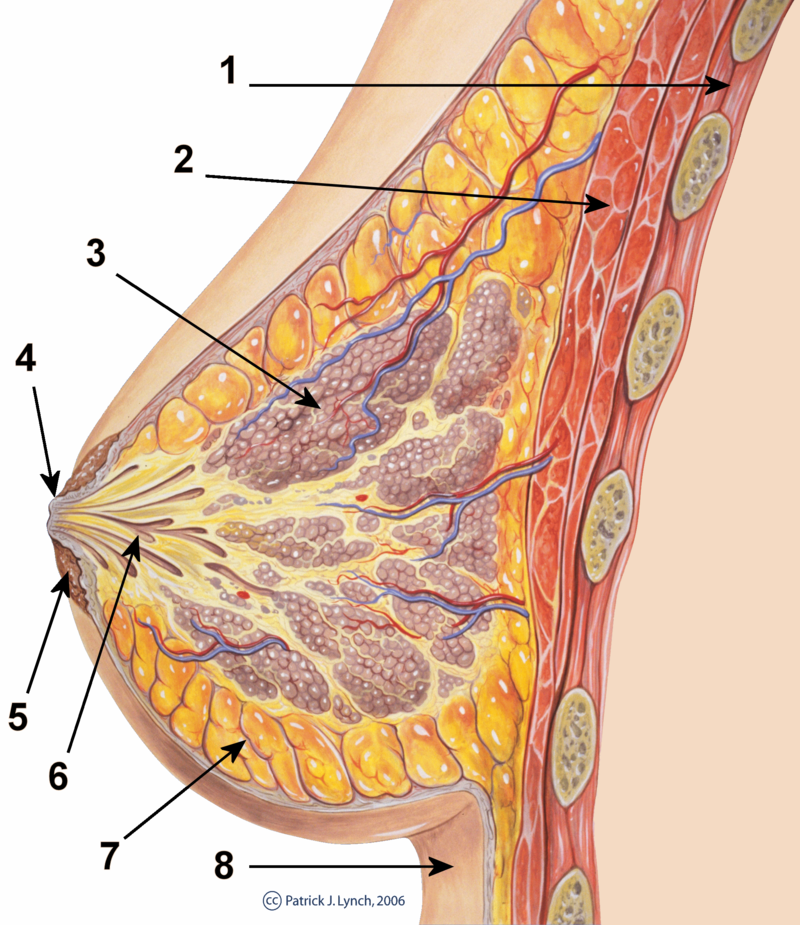
mammary gland
exocrine gland in humans and other mammals

prolactin
Prolactin (PRL), also known as lactotropin and mammotropin, is a protein best known for its role in enabling mammals to produce milk. It is influential in over 300 separate processes in various vertebrates, including humans. Prolactin is secreted from the pituitary gland and plays an essential role in metabolism, regulation of the immune system and pancreatic development.

ovulation
Ovulation is an important part of the menstrual cycle in female vertebrates where the egg cells are released from the ovaries as part of the ovarian cycle. In female humans ovulation typically occurs near the midpoint in the menstrual cycle and after the follicular phase. Ovulation is stimulated by an increase in luteinizing hormone (LH). The ovarian follicles rupture and release the secondary oocyte ovarian cells.
progesterone
Progesterone (; P4) is an endogenous steroid and progestogen sex hormone involved in the menstrual cycle, pregnancy, and embryogenesis of humans and other species. It belongs to a group of steroid hormones called the progestogens and is the major progestogen in the body. Progesterone has a variety of important functions in the body. It is also a crucial metabolic intermediate in the production of other endogenous steroids, including the sex hormones and the corticosteroids, and plays an important role in brain function as a neurosteroid.

polycystic ovary syndrome
complex of symptoms caused by elevated androgen levels in women

17β-estradiol
Estradiol (E2), also called oestrogen, oestradiol, is an estrogen steroid hormone and the major female sex hormone. It is involved in the regulation of female reproductive cycles such as estrous and menstrual cycles. Estradiol is responsible for the development of female secondary sexual characteristics such as the breasts, widening of the hips and a female pattern of fat distribution. It is also important in the development and maintenance of female reproductive tissues such as the mammary glands, uterus and vagina during puberty, adulthood and pregnancy. It also has important effects in many

human follitropin
gonadotropin that regulates the development of reproductive processes

oogenesis
Oogenesis () or ovogenesis is the differentiation of the ovum (egg cell) into a cell competent to further develop when fertilized. It is developed from the primary oocyte by maturation. Oogenesis is initiated during embryonic development.

gonadotroping-releasing hormone
mammalian protein found in Homo sapiens

chorionic gonadotropin
human hormone

lactation
Lactation describes the secretion of milk from the mammary glands in addition to the period of time that a parent lactates to feed her young. The process can occur with all sexually mature female mammals, although it may predate mammals. The process of feeding milk in all female creatures is called nursing, and in humans it is also called breastfeeding. Newborn infants often produce some milk from their own breast tissue, known colloquially as witch's milk.

corpus luteum
temporary endocrine structure in ovaries producing progesterone, estradiol and inhibin A; the remains of an ovarian follicle that has released an egg

menarche
Menarche ( ; ) is the first menstrual cycle, or first menstrual bleeding, in female humans. From both social and medical perspectives, it is often considered the central event of female puberty, as it signals the possibility of fertility. Girls experience menarche at different ages, but the most common age is 12. Having menarche occur between the ages of 9–14 in the West is considered normal.
cell signaling
complex system of communication that governs basic cellular activities and coordinates cell actions

pregnancy test
medical procedure
Relaxin
Relaxin is a protein hormone of about 6000 Da, first described in 1926 by Frederick Hisaw.
areolar glands
sebaceous glands in the areola surrounding the nipple
premature ovarian failure
ovarian disease where ovaries do not produce estrogen despite high levels of circulating gonadotropins in women under 40
precocious puberty
human disease
oestrogen receptor
InterPro Family
delayed puberty
human disease

hyperandrogenism
menotropin
Menotropin (also called human menopausal gonadotropin or hMG) is a hormonally active medication for the treatment of fertility disturbances. Frequently the plural is used as the medication is a mixture of gonadotropins. Menotropins are extracted from the urine of postmenopausal women.
hypothalamic–pituitary–gonadal axis
system of endocrine glands
granulosa cell
cell type
Chorionic somatomammotropin hormone 1
mammalian protein found in Homo sapiens
lactiferous duct
structures which carry milk toward the nipple in a lactating female
Blocked milk duct
temporary medical condition
hormonal contraception
birth control methods that act on the endocrine system

syncytiotrophoblast
The syncytiotrophoblast (from the Greek 'syn'- "together"; 'cytio'- "of cells"; 'tropho'- "nutrition"; 'blast'- "bud") is the epithelial covering of the highly vascular embryonic placental villi, which invades the wall of the uterus to establish nutrient circulation between the embryo and the mother. It is a multinucleate, terminally differentiated syncytium, extending to 13cm.
luteal phase
latter part of the menstrual cycle associated with ovulation and an increase in progesterone

folliculogenesis
Although the process is similar in many animals, this article will deal exclusively with human folliculogenesis.
thumb|right|320px|Order of changes in ovary.1 - Menstruation2 - Developing follicle3 - Mature follicle4 - Ovulation5 - Corpus luteum6 - Deterioration of corpus luteum
In biology, folliculogenesis is the maturation of the ovarian follicle, a densely packed shell of somatic cells that contains an immature oocyte. Folliculogenesis describes the progression of a number of small primordial follicles into large preovulatory follicles that occurs in part during the menstrual cycle.
estetrol
Estetrol (E4), or oestetrol, is one of the four natural estrogenic steroid hormones found in humans, along with estrone (E1), estradiol (E2), and estriol (E3). Estetrol is a major estrogen in the body. In contrast to estrone and estradiol, estetrol is a native estrogen of fetal life. Estetrol is produced exclusively by the fetal liver and is found in detectable levels only during pregnancy, with relatively high levels in the fetus and lower levels in the maternal circulation.
activin and inhibin
regulators of feedback on FSH-production
corpus albicans
structure derived from the corpus luteum
low milk supply
production of breast milk by a mother that is of insufficient quantity to meet the nutritional needs of her infant

follicular phase
phase of the estrous cycle, (or, in humans and great apes, the menstrual cycle) during which follicles in the ovary mature (it ends with ovulation, the main hormone controlling this stage is estradiol)
arcuate nucleus
region of the hypothalamus
urofollitropin
Urofollitropin is a purified form of follicle-stimulating hormone (FSH) that is manufactured by extraction from human urine and then purified to remove various proteins and other substances. FSH is important in the development of follicles (eggs) produced by the ovaries. Given by subcutaneous injection, it is used in combination with human chorionic gonadotropin (hCG) to assist in ovulation and fertility. It is also used with in vitro fertilization methods. The dosage is adjusted to each individual's response.
prolactin cell
cell type
Uterine gland
type of gland
FSHR
protein-coding gene in the species Homo sapiens
Breastfeeding and medications
Description of the medications used during breastfeeding
theca interna
anatomical entity
gonadotropic cell
cell type
ESRRG
protein-coding gene in the species Homo sapiens
premature thelarche
term
Estrogen insensitivity syndrome
genetic variation in which the body does not respond to estrogen