Category
page 1Islamic terminology

Qur’an
The Quran (, ), also romanized '''Qur'an or Koran', is the central religious text of Islam, believed by Muslims to be a revelation directly from God (Allāh). It is organized in 114 chapters (, ) which consist of individual verses (''). Besides its religious significance, it is widely regarded as the finest work in Arabic literature, and has significantly influenced the Arabic language.
Allah
thumb|right|The word 'Allah' in thuluth calligraphy

Ramadan
Ramadan is the ninth month of the Islamic calendar. It is observed by Muslims worldwide as a month of fasting (sawm), communal prayer (salah), reflection, study of the Quran, charity, and strengthening community ties. It is also the month in which the Quran is believed to have been revealed to the Islamic prophet Muhammad, known as Laylat al-Qadr. The annual observance of Ramadan is regarded as one of the five pillars of Islam and lasts 29 to 30 days, from one sighting of the crescent moon to the next.

Eid al-Adha
Islamic holiday on the tenth day of Dhu al-Hijja

Hajj
Hajj (; also spelled Hadj or Haj) is an annual Islamic pilgrimage to Mecca, Saudi Arabia, the holiest city for Muslims. Hajj is a mandatory religious duty for capable Muslims that must be carried out at least once in their lifetime by all adult Muslims who are physically and financially capable of undertaking the journey, and of supporting their family during their absence from home.

Islamic calendar
lunar calendar used by Muslims to determine religious observances

Eid al-Fitr
Eid al-Fitr is the first of the two main festivals in Islam, the other being Eid al-Adha. The holiday falls on the first day of Shawwal, the tenth month of the Islamic calendar. One of the most important Islamic celebrations, Eid al-Fitr is celebrated by Muslims worldwide as it marks the end of the month-long, dawn-to-dusk fasting (sawm) during Ramadan. The holiday is known under various other names in different languages and countries around the world.

sharia
Sharia (; , ), also transliterated as '''''Sharī'ah, Shari'a, or Shariah''''', is a body of religious law that form the Islamic tradition based on scriptures of Islam, particularly the Qur'an and hadith. In Islamic terminology sharīʿah refers to immutable, intangible divine law, in contrast to fiqh (Islamic jurisprudence), which refers to its interpretations by Islamic scholars. Sharia, or fiqh as traditionally known, has always been used alongside customary law from the very beginning in Islamic history; it has been elaborated and developed over the centuries by legal opinions issued by quali
.jpg)
Shahada
The Shahada ( ; , 'the testimony'), also transliterated as Shahadah, is an Islamic oath and creed, and one of the Five Pillars of Islam and part of the adhan. It reads: "I bear witness that there is no god but God, and I bear witness that Muhammad is the Messenger of God." The Shahada declares belief in the oneness () of God and the acceptance of Muhammad as God's messenger. Some Shia Muslims also include a statement of belief in the of Ali, but they do not consider it as an obligatory part for converting to Islam.

salah
thumb|Various prescribed movements in , which collectively constitute a .
From left to right: , , , , and .

hadith
Hadith is the Arabic word for a 'report' or an 'account [of an event]' and refers to the Islamic oral tradition of anecdotes containing the purported words, actions, and the silent approvals of the Islamic prophet Muhammad or his immediate circle (companions in Sunni Islam, Ahl al-Bayt in Shia).

zakāt
thumb|313x313px|Zakat spending as per the Quran on 8 categories of people
Zakat (or Zakāh) is one of the Five Pillars of Islam. Zakat is the Arabic word for "giving to charity" or "giving to the needy". Zakat is a form of almsgiving, often collected by the Muslim Ummah. It is considered in Islam a religious obligation, and by Quranic ranking, is next after prayer (salah) in importance. Eight heads of zakat are mentioned in the Quran.
Five Pillars of Islam
five basic acts in Islam

fasting in Islam
fasting regulated by Islamic jurisprudence

jinn
Jinn (Arabic: جِنّ), also romanized as djinn or anglicized as genies, are supernatural beings in pre-Islamic Arabian religion and Islam. Like humans, they are accountable for their deeds and can be either believers (''Mu'minun) or unbelievers (kuffar''), depending on whether they accept God's guidance.

caliphate
A caliphate ( ) is an institution or public office under the leadership of an Islamic steward with the title of caliph (; , ), a person considered a political–religious successor to the Islamic prophet Muhammad and a leader of the entire Muslim world (ummah). Historically, the caliphates were polities based on Islam which developed into multi-ethnic trans-national empires.

Hijra
thumb|Islamic miniature depicting Gabriel|Jibril delivering to [[Muhammad a message from God telling him to undertake the Hijrah]]
The Hijrah, () also Hegira (from Medieval Latin), was the journey the Islamic prophet Muhammad and his followers took from Mecca to Medina. The year in which the Hijrah took place is also identified as the epoch of the Lunar Hijri and Solar Hijri calendars; its date equates to 16 July 622 in the Julian calendar.

Sunnah
'''''' is the body of traditions and practices of the Islamic prophet Muhammad that constitute a model for Muslims to follow. For Muslims, the sunnah is what all the Muslims of Muhammad's time supposedly saw, followed, and passed on to the next generations. However, what constitutes the Sunnah, and its interpretation, depends significantly on the specific Islamic sect and school of thought. Sunnis rely on six major canonical hadith collections to document the Sunnah, known as Kutub al-Sittah. For Shias, the sunnah is generally documented in ''Kutub al-'Arba'a'', which give preference to hadith

surah
A surah (; ; ) is an Arabic word meaning "chapter" in the Quran. There are 114 surah in the Quran, each divided into verses (). The surah are of unequal length; the shortest surah ("al-Kawthar") has only three verses, while the longest (al-Baqarah) contains 286 verses. The Quran consists of one short introductory chapter (Q1), eight very long chapters, making up one-third of the Quran (Q2‒9); 19 mid-length chapters, making up another one-third (Q10‒28); and 86 short and very short ones of the last one-third (Q29‒114).

Mawlid
The Mawlid () is an annual festival commemorating the birthday of the Islamic prophet Muhammad on the traditional date of 12 Rabi' al-Awwal, the third month of the Islamic calendar.

halal
thumb|right|The word halal. It is used as a visual marker for Muslims in restaurants, shops and on products.|263x263px

minaret
thumb|Minaret at the Umayyad Mosque in [[Damascus]]
.jpg)
Ashura
Ashura (, ), also more formally Yawm Ashura (), is a day of commemoration in Islam. It occurs annually on the tenth of Muharram, the first month of the Islamic calendar.

Muharram
Al-Muharram () is the first month of the Islamic calendar. It is one of the four sacred months of the year when warfare is banned. It precedes the month of Safar. The tenth of Muharram is known as Ashura, an important day of commemoration in Islam. For Sunni Muslims, the day commemorates the parting of the Red Sea by Moses and the salvation of the Israelites, observed through voluntary fasting and other permissible expressions of gratitude. By contrast, Ashura is a day of mourning for Shia Muslims, who annually commemorate the death of Husayn ibn Ali, grandson of the Islamic prophet Muhammad a

monotheism in Islam
thumb|upright=0.8|Muslims use the single raised index finger gesture (al-sabbaba or al-sabbaha) as a symbol of tawhid.

Night of Power
anniversary of two very important dates in Islam
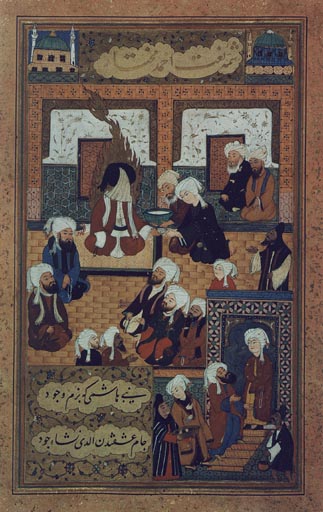
companions of the Prophet
companion, disciple, scribe or family member of the Islamic prophet Muhammad

Dhu'l-Hijja
12th month of the Islamic calendar

harem
thumb|upright=1.2|Ladies of Caubul|Kabul (1848 lithograph, by James Rattray) showing unveiling in [[zenana areas.]]

Basmala

Safar
Safar (), also spelt as Safer in Turkish, is the second month of the lunar Islamic calendar.

Takbir
The ( , ) is the name for the Arabic phrase '''' ( , ).

mihrab
thumb|Mihrab in the Prophet's Mosque, Medina
Mihrab (, ', pl. ') is a niche in the wall of a mosque that indicates the qibla, the direction of the Kaaba in Mecca towards which Muslims should face when praying. The wall in which a mihrab appears is thus the "qibla wall".
Sha'ban
Shaʽban ( '''') is the eighth month of the Islamic calendar. It is called the month of 'separation', as the word means 'to disperse' or 'to separate' because the pre-Islamic Arabs used to disperse in search of water.

Rabi' al-Awwal
3rd month of the Islamic calendar

muezzin
thumb|Islamic miniature depicting Gabriel|Jibril providing instructions on how to perform the call to prayer to Muhammad (golden flame) as well as [[Bilal ibn Rabah the first muezzin calling the Muslims to prayer from atop the Kaaba.]]

Shawwal
Shawwal () is the tenth month of the Islamic calendar. It comes after Ramadan and before Dhu al-Qa'da.

iftar
thumb|Bangladeshi iftar vendor in Mughal-era [[Chawkbazar Iftar Market, Old Dhaka]]

Mahdi
thumb|An image from a Falnama|Falname made in India around 1610–1630, depicts [[Jesus fighting the Dajjal (right). Behind, the Mahdi with a veiled face.]]
Rajab
Rajab () is the seventh month of the Islamic calendar. The lexical definition of the classical Arabic verb rajaba is "to respect", which could also mean "be awe or be in fear", of which Rajab is a derivative.

mujahid
Mujahideen or mujahidin (), is the plural form of mujahid (), an Arabic term that broadly refers to people who engage in jihad (), interpreted in a jurisprudence of Islam as the fight on behalf of God, religion or the community (ummah).

minbar
thumb|Ottoman Empire|Ottoman-era minbar of the [[Molla Çelebi Mosque in Istanbul.]]A minbar (; sometimes romanized as mimber) is a pulpit in a mosque where the imam (leader of prayers) stands to deliver sermons (, khutbah). It is also used in other similar contexts, such as in a Husayniyya, where the speaker sits and lectures the congregation.
Jumādā al-ʾŪlā
5th month of the Islamic calendar

Dhu'l-Qa'da
11th month of the Islamic calendar
iman
faith or belief in Islam
Jumada al-Thani
6th month of the Islamic calendar

ayah
thumb|A Quran showing verses of Al-Baqarah, Verse 253 to Verse 256, the Ayat al Kursi which is the 255th verse is also shown.
thumb|A 16th-century Quran opened to show sura (chapter) 2, ayat (verses) 1–4.
thumb
Rabi' al-Thani
4th month of the Islamic calendar
hafiz
someone who has completely memorized the Qur'an

kafir
Kāfir (; ) is an Islamic term of Arabic origin used by Muslims to refer to non-Muslims who deny the God in Islam, reject his authority, and do not accept the message of Islam as truth.

Suhur
247x247px|thumb|An example of a Jordanian cuisine|Jordanian sahur table

tafsir
Tafsir ( ; ) refers to an exegesis, or commentary, of the Quran. An author of a tafsir is a '''''''' (; plural: ). A Quranic tafsir'' attempts to provide education, explanation, interpretation, context or commentary for clear understanding and conviction of God's will in Islam. The idea of the interpretation of the Quran first appears in the Quran itself, commenting on cases where it is clear and others where it is ambiguous (3:7).
%20surrounding%20him%2C%20circa%2016th%20century.jpg)
Rashidun
thumb|Ottoman Empire|Ottoman miniature paintings depicting [[Muhammad (center) and the Rashidun caliphs (anticlockwise) Abu Bakr, Umar, Ali, and Uthman, ]]

Second Coming
Christian and Islamic belief regarding the future (or past) return of Jesus after his ascension

Isra and Mi'raj
night journey undertaken by Muhammad in Jerusalem
Ilm al-Kalam
Ilm al-kalam or ilm al-lahut, often shortened to kalam, is the scholastic, speculative, or rational study of Islamic theology (aqida). It can also be defined as the science that studies the fundamental doctrines of Islamic faith (usul al-din), proving their validity, or refuting doubts regarding them rationally via logic. Kalām was born out of the need to establish and defend the tenets of Islam against philosophical doubters and non-Muslims, and also to defend against heretical and religious innovations (bidʿah). A scholar of kalam is referred to as a mutakallim (plural mutakallimun), a role
shirk
polytheism in Islamic terminology

People of the Book
Islamic term which refers to Jews, Christians and Sabians and is sometimes applied to members of other religions such as Zoroastrians

waqf
A waqf (; , plural ' ), also called a (, plural or ' ), or mortmain property, is an inalienable charitable endowment under Islamic law. It typically involves donating a building, plot of land or other assets for Muslim religious or charitable purposes with no intention of reclaiming the assets. A charitable trust may hold the donated assets. The person making such donation is known as a ('donor') who uses a mutawalli ('trustee') to manage the property in exchange for a share of the revenues it generates. A waqf allows the state to provide social services in accordance with Islamic law while co
%20%E2%80%93%20Eug%C3%A8ne%20Baugnies%20(1841%E2%80%931891).jpg)
dhikr
thumb|right|The Dhikr, Eugène Baugnies (1841–1891)
'''' (; ; ) is a form of Islamic worship in which phrases or prayers are repeatedly recited for the purpose of remembering God. It plays a central role in Sufism, and each Sufi order typically adopts a specific dhikr, accompanied by specific posture, breathing, and movement. In Sufism, dhikr refers to both the act of this remembrance as well as the prayers used in these acts of remembrance. Dhikr'' usually includes the names of God or supplication from the Quran or hadith. It may be counted with either one's fingers or prayer beads, and may be