Category
page 1Molecular biology

protein
thumb|A representation of the 3D structure of the protein myoglobin showing turquoise α-helices. This protein was the first to have its structure solved by [[X-ray crystallography. Toward the right-center among the coils, a prosthetic group called a heme group (shown in gray) with a bound oxygen molecule (red).]]

biochemistry
Biochemistry, or biological chemistry (distinct from chemical biology), is the study of chemical processes within and relating to living organisms. A sub-discipline of both chemistry and biology, biochemistry may be divided into three fields: structural biology, enzymology, and metabolism. Over the last decades of the 20th century, biochemistry has become successful at explaining living processes through these three disciplines. Almost all areas of the life sciences are being uncovered and developed through biochemical methodology and research. Biochemistry focuses on understanding the chemica

gene
In biology, the word gene has two meanings. The Mendelian gene is a basic unit of heredity. The molecular gene is a sequence of nucleotides in DNA that is transcribed to produce RNA. There are two types of molecular genes: protein-coding genes and non-coding genes. During gene expression (the synthesis of RNA or protein from a gene), DNA is first copied into RNA. RNA can be directly functional or be the intermediate template for the synthesis of a protein.

ribonucleic acid
thumb|A hairpin loop from a pre-mRNA. Highlighted are the nucleobases (green) and the ribose-phosphate backbone (blue). This is a single strand of RNA that folds back upon itself.

cell biology
scientific discipline that studies cells

genetic engineering
direct manipulation of an organism's genome using biotechnology

molecular biology
branch of biology that deals with the molecular basis of biological activity

cloning
thumb|upright=1.35|Many organisms, including aspen trees, reproduce by cloning, often creating large groups of organisms with the same [[DNA. One example depicted here is quaking aspen.]]

nucleotide
thumb|275px|class=skin-invert-image|This nucleotide contains the five-carbon sugar deoxyribose (at center), a [[nucleobase called adenine (upper right), and one phosphate group (left). The deoxyribose sugar joined only to the nitrogenous base forms a Deoxyribonucleoside called deoxyadenosine, whereas the whole structure along with the phosphate group is a nucleotide, a constituent of DNA with the name deoxyadenosine monophosphate.]]
GMO
organisms whose genetic material has been altered using genetic engineering methods

polymerase chain reaction
in vitro method for producing large amounts of specific DNA or RNA fragments from small amounts of short oligonucleotide primers

DNA replication
cellular metabolic process in which a cell duplicates one or more molecules of DNA

standard genetic code
rules by which information encoded within genetic material is translated into proteins

fluorescence
thumb|right|Fluorescent minerals emit visible spectrum|visible light when exposed to [[ultraviolet.]]
thumb|Fluorescent marine organisms
right|thumb|Fluorescent clothes used in black light theatre production, [[Prague]]

retrovirus
A retrovirus is a virus that inserts a DNA copy of its RNA genome into the DNA of a host cell that it invades, thus changing the genome of that cell. After invading a host cell's cytoplasm, the virus uses its own reverse transcriptase enzyme to produce DNA from its RNA genome, the reverse of the usual pattern, thus retro (backward). The new DNA is then incorporated into the host cell genome by an integrase enzyme, at which point the retroviral DNA is referred to as a provirus. The host cell then treats the viral DNA as part of its own genome, transcribing and translating the viral genes along

transcription
biosynthesis of RNA carried out on a template of DNA

messenger RNA
large family of RNA molecules that convey genetic information from DNA to the ribosome, where they specify the amino acid sequence of the protein products of gene expression
.svg)
plasmid
thumb|upright=1.35|Diagram of a bacterium showing chromosomal DNA and plasmids (Not to scale)
A plasmid is a small, extrachromosomal DNA molecule within a cell that is physically separated from chromosomal DNA and can replicate independently. They are most commonly found as small circular, double-stranded DNA molecules in bacteria and archaea; however plasmids are sometimes present in eukaryotic organisms as well. Plasmids often carry useful genes, such as those involved in antibiotic resistance, virulence, secondary metabolism and bioremediation. While chromosomes are large and contain all th

translation
in biology, the creation of proteins using information from nucleic acids

telomere
thumb|right|300px|Human chromosomes (grey) capped by telomeres (white)

gene expression
conversion of a gene's sequence into a mature gene product or products
gene therapy
genetic modification of a patient's cells to produce a therapeutic effect

restriction enzyme
class of enzymes that cleaves DNA into fragments at or near specific recognition sites within the molecule known as restriction sites

central dogma of molecular biology
explanation of the flow of genetic information within a biological system
genetically modified food
foods produced from organisms that have had changes introduced into their DNA
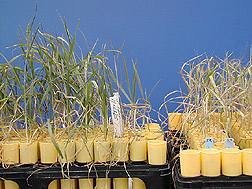
plant breeding
the art and science of changing the traits of plants in order to produce desired characteristics

biopolymer
Biopolymers are natural polymers produced by the cells of living organisms. Like other polymers, biopolymers consist of monomeric units that are covalently bonded in chains to form larger molecules. There are three main classes of biopolymers, classified according to the monomers used and the structure of the biopolymer formed: polynucleotides, polypeptides, and polysaccharides. The polynucleotides, RNA and DNA, are long polymers of nucleotides. Polypeptides include proteins and shorter polymers of amino acids; some major examples include collagen, actin, and fibrin. Polysaccharides are linear

reverse transcriptase
an enzyme which generates DNA from an RNA template, a process termed reverse transcription

nucleosome
thumb|Basic units of chromatin structure
transposable element
semiparasitic DNA sequence, a major fraction of eukaryotic genomes

G protein-coupled recepteishon
large protein family of receptors that detect molecules outside the cell and activate internal signal transduction pathways and cellular responses

CRISPR
thumb|262px|Diagram of the CRISPR prokaryotic antiviral defense mechanism
CRISPR (; acronym for clustered regularly interspaced short palindromic repeats) is a family of DNA sequences found in the genomes of prokaryotic organisms such as bacteria and archaea. Each sequence within an individual prokaryotic CRISPR is derived from a DNA fragment of a bacteriophage that had previously infected the prokaryote or one of its ancestors. These sequences are used to detect and destroy DNA from similar bacteriophages during subsequent infections. Hence these sequences play a key role in the antiviral (i.

transformation
planned genetic alteration of a cell by uptake of genetic material from the environment

oligomer
thumb|right|The 15-crown-5 [[crown ether, a cyclic oligomer, and its monomer, ethylene oxide.]]
In chemistry and biochemistry, an oligomer () is a molecule that consists of a few repeating units which could be derived, actually or conceptually, from smaller molecules, monomers. The name is composed of Greek elements oligo-, "a few" and -mer, "parts". An adjective form is oligomeric.

primer
short strand of RNA or DNA that serves as a starting point for DNA synthesis

protoplast
thumb|right|Protoplasts of cells from a petunia's leaf
thumb|Protoplasts of the moss Physcomitrella patens
Protoplast (), is a biological term coined by Hanstein in 1880 to refer to the entire cell, excluding the cell wall. Protoplasts can be generated by stripping the cell wall from plant, bacterial, or fungal cells by mechanical, chemical or enzymatic means.

microRNA
thumb|400px|Pre-miRNA instead of Pri-miRNA in the first point of mechanism. Diagram of microRNA (miRNA) action with mRNA
thumb|400px|Examples of miRNA hairpins (stem-loops), with the mature miRNAs shown in red
nucleic acid sequence
succession of letters that indicate the order of nucleotides within a DNA (using GACT) or RNA (GACU) molecule
isoelectric point
pH at which a particular molecule carries no net electrical charge
transduction
transfer of genetic information to a bacterium from a bacteriophage, or between bacterial or yeast cells, mediated by a phage vector
structural biology
study of molecular structures in biology
recombinant DNA
DNA molecules formed by laboratory methods
bacterial conjugation
natural genetic exchange of bacteria
small interfering RNA
biomolecule
non-coding RNA
class of RNA that is not translated into proteins
phosphodiester bond
–O– linkage between phosphoric acid and two other compounds

diphosphate
In chemistry, pyrophosphates are phosphorus oxyanions that contain two phosphorus atoms in a linkage. A number of pyrophosphate salts exist, such as disodium pyrophosphate () and tetrasodium pyrophosphate (), among others. Often pyrophosphates are called diphosphates. The parent pyrophosphates are derived from partial or complete neutralization of pyrophosphoric acid. The pyrophosphate bond is also sometimes referred to as a phosphoanhydride bond, a naming convention which emphasizes the loss of water that occurs when two phosphates form a new bond, and which mirrors the nomenclature for anhyd
Okazaki fragments
short DNA sequences synthesized discontinuously during DNA replication
gel electrophoresis
method for separation and analysis of macromolecules

neuropeptide
thumb|right|Neuropeptide Y
fibrous protein
constitutes one of the three main types of proteins (alongside globular and membrane proteins). There are many scleroprotein superfamilies including keratin, collagen, elastin, and fibroin
point mutation
mutation of a single gene
rapid antigen test
a medical test to know in less than a few hour a certain condition
genetic vector
DNA molecule used as a vehicle to artificially carry foreign genetic material into another cell
real-time polymerase chain reaction
laboratory technique of molecular biology based on the polymerase chain reaction (PCR)
DNA computing
computing using molecular biology hardware

transfection
Transfection is the process of deliberately introducing naked or purified nucleic acids into eukaryotic cells. It may also refer to other methods and cell types, although other terms are often preferred: "transformation" is typically used to describe non-viral DNA transfer in bacteria and non-animal eukaryotic cells, including plant cells. In animal cells, transfection is the preferred term, as the term "transformation" is also used to refer to a cell's progression to a cancerous state (carcinogenesis). Transduction is often used to describe virus-mediated gene transfer into prokaryotic cells.
fluorescence in situ hybridization
genetic testing technique
genetic marker
gene or DNA sequence with a known location on a chromosome that can be used to identify individuals or species
optical tweezers
instrument using a highly focused laser to provide an attractive or repulsive force (on the order of piconewtons) to hold and move microscopic dielectric objects similar to tweezers