Category
page 1MOSFETs
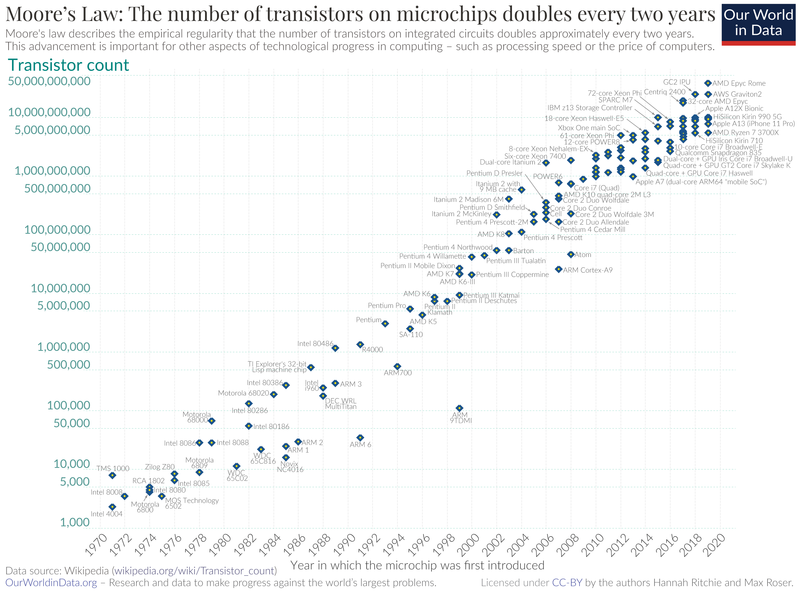
Moore's law
observation on the growth of integrated circuit capacity

computer memory
physical device used to store information for immediate use in a digital electronic device

MOSFET
thumb|upright=1.3|Two power transistor|power MOSFETs in [[D2PAK surface-mount packages. Operating as switches, each of these components can sustain a blocking voltage of 120V in the off state, and can conduct a con­ti­nuous current of 30 A in the on state, dissipating up to about 100 W and controlling a load of over 2000 W. A matchstick is pictured for scale.]]

charge-coupled device
device for the movement of electrical charge
image sensor
device that converts an optical image into an electronic signal
insulated-gate bipolar transistor
three-terminal power semiconductor device
thin-film transistor
field-effect transistor device
passivation
physico-chemical processes contributing to protect a surface against oxidation
semiconductor device fabrication
manufacturing process used to create integrated circuits
Federico Faggin
Italian-American physicist, engineer, inventor and entrepreneur (born 1941)
very-large-scale integration
process of creating an integrated circuit by combining thousands of transistors into a single chip that began in the 1970s when complex semiconductor and communication technologies were being developed
radio-frequency engineering
specialty of electronic engineering
current–voltage characteristic
current output as a function of applied voltage for a material or device
depletion region
insulating region in a conductive, dopend semiconductor
active pixel sensor
image sensor consisting of an integrated circuit
silicon on insulator
semiconductor manufacturing process
NMOS logic
implements logic gates and other digital circuits
semiconductor memory
data storage device
electron mobility
characterizes how quickly an electron can move through a metal or semiconductor, when pulled by an electric field
Martin “John” M. Atalla
electrical engineer and "Father of the PIN" (1924–2009)
high-electron-mobility transistor
field-effect transistor incorporating a heterojunction as the channel

ISFET
An ion-sensitive field-effect transistor (ISFET) is a field-effect transistor used for measuring ion concentrations in solution; when the ion concentration (such as H+, see pH scale) changes, the current through the transistor will change accordingly. Here, the solution is used as the gate electrode. A voltage between substrate and oxide surfaces arises due to an ion sheath. It is a special type of MOSFET (metal–oxide–semiconductor field-effect transistor), and shares the same basic structure, but with the metal gate replaced by an ion-sensitive membrane, electrolyte solution and reference ele
PMOS logic
p-type MOSFETs to implement logic gates
FinFET
type of transistor used in nanoelectronic integrated circuits
high-κ dielectric
dielectric with high dielectric constant κ
multigate device
type of MOS field-effect transistor with more than one gate
Thermal oxidation
process creating a thin layer of silicon dioxide
Dawon Kahng
South Korean engineer
BiCMOS
Bipolar CMOS (BiCMOS) is a semiconductor technology that integrates two semiconductor technologies, those of the bipolar junction transistor and the CMOS (complementary metal–oxide–semiconductor) logic gate, into a single integrated circuit. In more recent times the bipolar processes have been extended to include high mobility devices using silicon–germanium junctions.
switched capacitor
electronic circuit element implementing a filter
voltage regulator module
buck converter that provides a microprocessor with the appropriate supply voltage
memory cell
elementary data-storing circuit within an electronically addressed computer memory/storage device
power MOSFET
power MOS field-effect transistor

Bio-FET
A field-effect transistor-based biosensor, also known as a biosensor field-effect transistor (Bio-FET or BioFET), field-effect biosensor (FEB), or biosensor MOSFET, is a field-effect transistor (based on the MOSFET structure) that is gated by changes in the surface potential induced by the binding of molecules. When charged molecules, such as biomolecules, bind to the FET gate, which is usually a dielectric material, they can change the charge distribution of the underlying semiconductor material resulting in a change in conductance of the FET channel. A Bio-FET consists of two main compartmen
floating-gate MOSFET
MOSFET whose gate is left galvanically isolated in a circuit
Threshold voltage
minimum source-to-gate voltage for a field effect transistor to be conducting from source to drain
power semiconductor device
semiconductor device capable of handling large amounts of electricity
three-dimensional integrated circuit
integrated circuit with vertical interconnections
two-dimensional electron gas
scientific model in solid-state physics; electron gas that is free to move in two dimensions, but tightly confined in the third
LDMOS
LDMOS (laterally-diffused metal-oxide semiconductor) is a planar double-diffused MOSFET (metal–oxide–semiconductor field-effect transistor) used in amplifiers, including microwave power amplifiers, RF power amplifiers and audio power amplifiers. These transistors are often fabricated on p/p+ silicon epitaxial layers. The fabrication of LDMOS devices mostly involves various ion-implantation and subsequent annealing cycles. As an example, the drift region of this power MOSFET is fabricated using up to three ion implantation sequences in order to achieve the appropriate doping profile needed to w
chemical field-effect transistor
field-effect transistor used as a sensor for measuring chemical concentrations in solution.
transistor count
number of transistors in an electronic device
Dennard scaling
scaling law based on a 1974 paper co-authored by Robert H. Dennard, above
Frank Wanlass
Computer pioneer (1933–2010)
Depletion-load NMOS logic
form of digital logic family in integrated circuits
subthreshold conduction
transistor current
RF power amplifier
type of electronic amplifier
Metal gate
Semiconductor structure
Gate dielectric
field-effect transistor
SONOS
SONOS, short for "silicon–oxide–nitride–oxide–silicon", more precisely, "polycrystalline silicon"—"silicon dioxide"—"silicon nitride"—"silicon dioxide"—"silicon",
is a cross sectional structure of MOSFET (metal–oxide–semiconductor field-effect transistor), realized by P.C.Y. Chen of Fairchild Camera and Instrument in 1977. This structure is often used for non-volatile memories, such as EEPROM and flash memories. It is sometimes used for TFT LCD displays.
DNA field-effect transistor
transistor which uses the field-effect due to the partial charges of DNA

gate oxide
dielectric layer of a MOSFET separating the source and drain from the gate terminal
MOS Controlled Thyristor
type of thyristor
field effect
Applied electric field conductivity change
Short-channel effect
secondary effect describing the reduction in threshold voltage Vth in MOSFETs with non-uniformly doped channel regions as the gate length increases
silicon on sapphire
integrated circuits manufacturing process
EOSFET
An EOSFET or electrolyte–oxide–semiconductor field-effect transistor is a FET, like a MOSFET, but with an electrolyte solution replacing the metal for the detection of neuronal activity. Many EOSFETs are integrated in a neurochip.
charge trap flash
type of flash storage
Channel length modulation
effect in field effect transistors
list of semiconductor scale examples
Wikimedia list article