Category
page 1Mutation

mutation
thumb|Three major single-chromosome mutations: deletion (genetics)|deletion (1), duplication (2) and inversion (3).

DNA repair
process of restoring DNA after damage

mutagen
thumb|The Globally Harmonized System of Classification and Labeling of Chemicals|international pictogram for chemicals that are sensitising, mutagenic, [[carcinogenic or toxic to reproduction]]
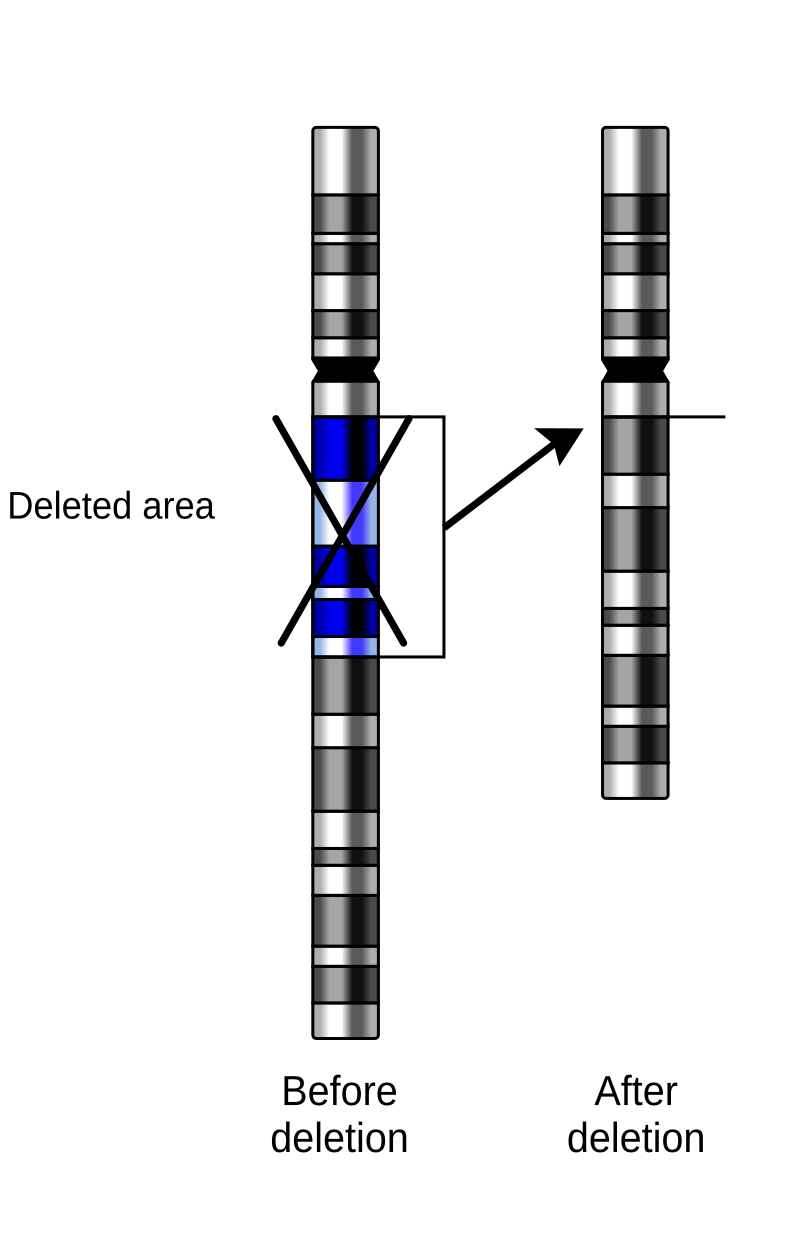
deletion mutation
mutation that removes a part of a DNA sequence
founder effect
loss of genetic variation that occurs when a new population is established by a very small number of individuals
gene duplication
duplication of a gene sequence within a genome

mutant
220px|thumb|right|The American lobster#Coloration|blue lobster, an example of a mutant
thumb|right|220px|Wild-type Physcomitrella patens|Physcomitrella and [[knockout mosses: Deviating phenotypes induced in gene-disruption library transformants. Physcomitrella wild-type and transformed plants were grown on minimal Knop medium to induce differentiation and development of gametophores. For each plant, an overview (upper row, scale bar corresponds to 1 mm) and a close-up (bottom row, scale bar equals 0.5 mm) is shown. A, Haploid wild-type moss plant completely covered with leafy gametophores and
point mutation
mutation of a single gene
missense mutation
genetic point mutation that results in an amino acid change in a protein
nonsense mutation
point mutation in a sequence of DNA that results in a premature stop codon, or a nonsense codon in the transcribed mRNA, and in a truncated, incomplete, and usually nonfunctional protein product
frameshift mutation
mutation that shifts codon alignment

genotoxicity
Genotoxicity is the property of chemical agents that damage the genetic information within a cell causing mutations, which may lead to cancer. While genotoxicity is often confused with mutagenicity, all mutagens are genotoxic, but some genotoxic substances are not mutagenic. The alteration can have direct or indirect effects on the DNA: the induction of mutations, mistimed event activation, and direct DNA damage leading to mutations. The permanent, heritable changes can affect either somatic cells of the organism or germ cells to be passed on to future generations. Cells prevent expression of
insertion mutation
addition of one or more nucleotide base pairs into a DNA sequence
silent mutation
point mutation where a codon is substituted with another codon that encodes the same amino acid
transition
term in genetics
%2C%20by%20Th%C3%A9r%C3%A8se%20Schwartze%20(1851-1918).jpg)
Mutationism
thumb|upright=1.5|Painting of Hugo de Vries, making a painting of an evening primrose, the plant which had apparently produced new forms by large mutations in his experiments, by [[Thérèse Schwartze, 1918]]
Mutationism is one of several alternatives to evolution by natural selection that have existed both before and after the publication of Charles Darwin's 1859 book On the Origin of Species. In the theory, mutation was the source of novelty, creating new forms and new species, potentially instantaneously, in sudden jumps. This was envisaged as driving evolution, which was thought to be limite

Transversion
thumb|right|300px|Illustration of a transversion: each of the 8 nucleotide changes between a purine and a pyrimidine (in red). The 4 other changes are Transition (genetics)|transitions (in blue).
sport
part of a plant genetically different from the rest
mutation rate
measure of the rate at which mutations occur during some unit of time
loss of heterozygosity
in genetics, loss of one allele at a specific locus, caused by a deletion mutation; or loss of a chromosome from a chromosome pair, resulting in abnormal hemizygosity
DNA mismatch repair
system for fixing base errors of DNA replication and repairing some forms of DNA damage
neutral mutation
type of mutation
indel
Indel (insertion-deletion) is a molecular biology term for an insertion or deletion of bases in the genome of an organism. Indels ≥ 50 bases in length are classified as structural variants.

heteroplasmy
Heteroplasmy describes the presence of different copies of organellar DNA (mitochondrial DNA (mtDNA) or plastid DNA) within a single cell or individual. Although previously considered a transient, and often, deleterious state, persistent populations of heteroplasmic individuals have been recorded across plants, animals, and fungi. In animals and fungi, heteroplasmy can be found in mtDNA while plants can exhibit heteroplasmy in mtDNA and ptDNA. Heteroplasmy exists at various degrees of severity and can be caused by various processes such as somatic mutation, DNA recombination, and paternal mtDN
cat coat genetics
genetics responsible for the appearance of a cat's fur
BRCA mutation
medical condition

depurination
Depurination is a chemical reaction of purine deoxyribonucleosides, deoxyadenosine and deoxyguanosine, and ribonucleosides, adenosine or guanosine, in which the β-N-glycosidic bond is hydrolytically cleaved releasing a nucleic base, adenine or guanine, respectively. The second product of depurination of deoxyribonucleosides and ribonucleosides is sugar, 2'-deoxyribose and ribose, respectively. More complex compounds containing nucleoside residues, nucleotides and nucleic acids, also suffer from depurination. Deoxyribonucleosides and their derivatives are substantially more prone to depurinatio
Synonymous substitution
form of Mutation
MSH2
DNA mismatch repair protein Msh2 also known as MutS homolog 2 or MSH2 is a protein that in humans is encoded by the MSH2 gene, which is located on chromosome 2. MSH2 is a tumor suppressor gene and more specifically a caretaker gene that codes for a DNA mismatch repair (MMR) protein, MSH2, which forms a heterodimer with MSH6 to make the human MutSα mismatch repair complex. It also dimerizes with MSH3 to form the MutSβ DNA repair complex. MSH2 is involved in many different forms of DNA repair, including transcription-coupled repair, homologous recombination, and base excision repair.
pyrimidine dimers
type of DNA damage
microsatellite instability
occurrence of highly polymorphic microsatellite repeats in somatic cells
MLH1
DNA mismatch repair protein Mlh1 or MutL protein homolog 1 is a protein that in humans is encoded by the MLH1 gene located on chromosome 3. The gene is commonly associated with hereditary nonpolyposis colorectal cancer. Orthologs of human MLH1 have also been studied in other organisms including mouse and the budding yeast Saccharomyces cerevisiae.
fusion gene
the result of gene fusion
somatic mutation
genetic mutation that occurs during the life of an organism, and may not be sexually inherited
genome instability
high frequency of mutations within the genome of a cellular lineage
clastogen
thumb|Figure comparing the effects of exposure to genotoxic agents (aneugens and clastogens) on DNA. Aneugens induce mis-segregation of chromosomes into daughter cells while clastogens break the DNA and chromosome.
A clastogen is a mutagenic agent that disturbs normal DNA related processes or directly causes DNA strand breakages, thus causing the deletion, insertion, or rearrangement of entire chromosome sections. These processes are a form of mutagenesis which if left unrepaired, or improperly repaired, can lead to cancer. Known clastogens include acridine yellow, benzene, ethylene oxide, ars
homeosis
thumb|Antennapedia mutation
DNA damage
abnormal chemical structure in DNA
Revertant
Type of mutation

selective sweep
genetic process
Point accepted mutation
type of similarity matrix in computational biology
adaptive mutation
Evolutionary theory
Nonsynonymous substitution
nucleotide mutation that alters the amino acid sequence
SNPedia
SNPedia (pronounced "snipedia") is a wiki-based bioinformatics web site that serves as a database of single nucleotide polymorphisms (SNPs). Each article on a SNP provides a short description, links to scientific articles and personal genomics web sites, as well as microarray information about that SNP. Thus SNPedia may support the interpretation of results of personal genotyping from, e.g., 23andMe and similar companies.
PARP14
protein-coding gene in the species Homo sapiens
micronucleus test
test for chromosomal damage leading to the formation of micronuclei