Category
page 1Rotation

torque
In physics and mechanics, torque is the rotational correspondent of linear force. It is also referred to as the moment of force, or simply the moment. Just as a linear force is a push or a pull applied to a body, a torque can be thought of as a twist applied to an object with respect to a chosen axis. For example, driving a screw uses torque to force it into an object. The torque is applied by the screwdriver, rotating around its axis, to the drive on the head of the screw.
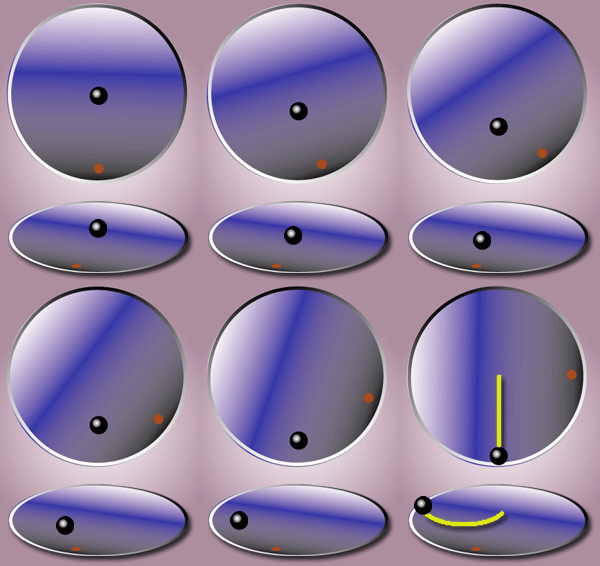
Coriolis force
apparent or fictitious force on objects moving within a reference frame that rotates with respect to an inertial frame

rotation
right|thumb|A sphere rotating (spinning) about an axis
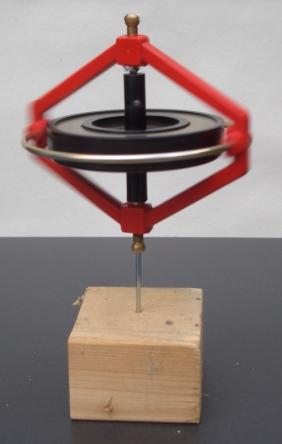
angular momentum
measure of the extent to which an object will continue to rotate in the absence of an applied torque
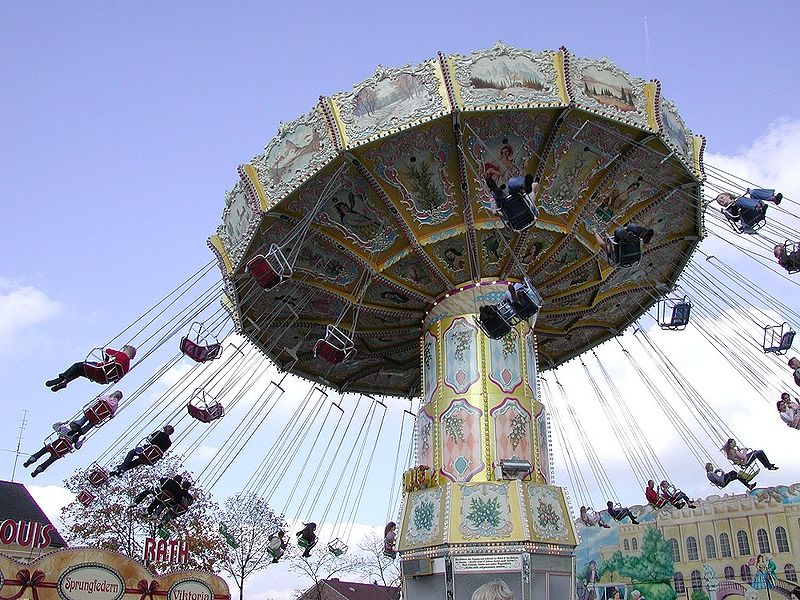
centrifugal force
type of inertial force

centripetal force
force that makes a moving body follow a curved path

moment of inertia
scalar measure of the rotational inertia with respect to a fixed axis of rotation

yo-yo
thumb|A plastic yo-yo
A yo-yo (also spelled yoyo) is a toy consisting of an axle connected to two disks, and a string looped around the axle, similar to a spool. It is an ancient toy documented since 440 BC. It was also called a bandalore in the 18th century.

Earth's rotation
rotation of Earth around its axis
rotation period
(of a celestial object) time that it takes to complete one revolution around its axis of rotation relative to the background stars
angular acceleration
rate of change of angular velocity

circular motion
object movement along a circular path

vortex
thumb|Vortex created by the passage of an wing|aircraft wing, revealed by colored smoke
thumb|249x249px|Kármán vortex street|Von Kármán vortex street behind a drinking straw; milk was poured into the water to make the current visible
thumb|right|250px|A Kármán vortex street is shown in this photo, as winds from the west blow onto clouds that have formed over the mountains in the desert. This phenomenon observed from ground level is extremely rare, as most cloud-related Kármán vortex street activity is viewed from space.

revolutions per minute
number of rotations around a fixed axis in one minute
stellar rotation
angular motion of a star about its axis
artificial gravity
inertial force that mimics the effects of gravity, usually by rotation
rotation around a fixed axis
motion in space when there is fixed line of points
Yarkovsky effect
force acting on a rotating body in space caused by the anisotropic emission of thermal photons, which carry momentum
revolving door
door, typically consists of three or four doors that hang on a central shaft and rotate around a vertical axis within a cylindrical enclosure
differential rotation
astronomical phenomenon

vorticity
In continuum mechanics, vorticity is a pseudovector (or axial vector) field that describes the local spinning motion of a continuum near some point (the tendency of something to rotate), as would be seen by an observer located at that point and traveling along with the flow. It is an important quantity in the dynamical theory of fluids and provides a convenient framework for understanding a variety of complex flow phenomena, such as the generation of lift on wings.
galaxy rotation curve
plot of the orbital speeds of visible stars or gas in that galaxy versus their radial distance from that galaxy’s center
Mach's principle
principle that inertia is determined by the large-scale distribution of matter
rotating black hole
black hole with angular momentum
Sagnac effect
effect due to rotation in special relativity

rolling
right|thumb|The animation illustrates rolling motion of a wheel as a Superposition principle|superposition of two motions: translation with respect to the surface, and rotation around its own axis.
Rolling is a type of motion that combines rotation (commonly, of an axially symmetric object) and translation of that object with respect to a surface (either one or the other moves), such that, if ideal conditions exist, the two are in contact with each other without sliding.
angular displacement
displacement measured angle-wise when a body is showing circular or rotational motion
Euler force
fictitious force arising in non-uniformally rotating frames of references
Yarkovsky–O'Keefe–Radzievskii–Paddack effect
second-order variation on the Yarkovsky effect that changes the rotation rate of a small body
rotational speed
physical quantity
solar rotation
the pattern of rotation of components of the Sun
rotational energy
kinetic energy of rotating body with moment of inertia and angular velocity
rotating reference frame
special case of a non-inertial reference frame that is rotating relative to an inertial reference frame
instant center of rotation
In Fig. P is the point of rotation
rotational spectroscopy
spectroscopy of quantized rotational states of gases
Aristotle's wheel paradox
paradox
coin rotation paradox
apparent absurdity in rolling a coin along its edge

rotation number
invariant of homeomorphisms of the circle

Synestia
thumb|Artistic impression
A synestia is a hypothesized structure for the debris field generated by the collision of planets: a rapidly spinning doughnut-shaped mass of vaporized rock. The term was coined in 2017 by Sarah T. Stewart-Mukhopadhyay, taken from Hestia, goddess of the hearth, combined with syn- meaning together. In computer simulations of giant impacts of rotating objects, a synestia can form if the total angular momentum is greater than the co-rotational limit. Beyond the co-rotational limit, the velocity at the equator of a body would exceed the orbital velocity.
rotating locomotion in living systems
phenomenon and topic of discourse in evolutionary biology and biomechanics
rigid rotor
model of rotating physical systems
circular symmetry
type of continuous symmetry for a planar object that can be rotated by any arbitrary angle and map onto itself
rotating wheel space station
space station concept
rotation group SO(4)
special orthogonal group
revolving stage
mechanically controlled platform within a theatre that can be rotated in order to speed up the changing of scenes
Rotating unbalance
uneven mass distribution around axis of rotation
rotating disk electrode
type of electrode used in electrochemistry
bucket argument
argument demonstrating that rotational motion cannot be defined as the relative rotation of the body with respect to the immediately surrounding bodies
falling cat problem
observation that cats are able to right themselves when falling inverted using a non-obvious source of angular momentum
Rotation formalisms in three dimensions
ways to represent 3D rotations
relativistic angular momentum
angular momentum in special and general relativity
cyclonic rotation
atmospheric motion matching a planet's rotation
Absolute rotation
rotation independent of any external reference
rotordynamics
Rotordynamics (or rotor dynamics) is a specialized branch of applied mechanics concerned with the behavior and diagnosis of rotating structures. It is commonly used to analyze the behavior of structures ranging from jet engines and steam turbines to auto engines and computer disk storage. At its most basic level, rotor dynamics is concerned with one or more mechanical structures (rotors) supported by bearings and influenced by internal phenomena that rotate around a single axis. The supporting structure is called a stator. As the speed of rotation increases the amplitude of vibration often pas
rotational diffusion
Mechanics concept
Walt Disney's Carousel of Progress
rotating theater audio-animatronic stage show attraction at the Walt Disney World Resort
reactive centrifugal force
reaction to centripetal force