Category
page 1Year of death unknown
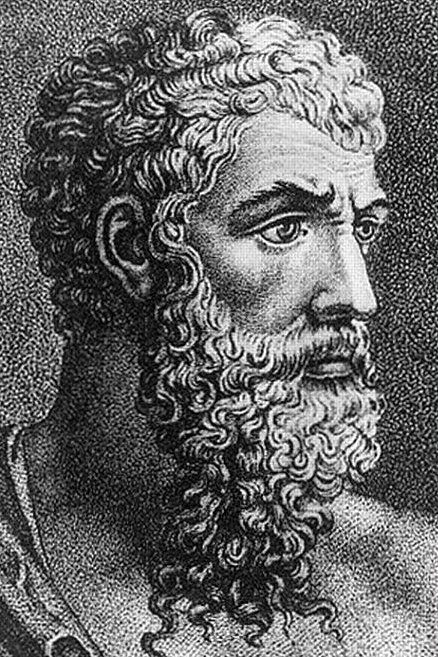
Aristophanes
Aristophanes (; ; ) was an Ancient Greek comic playwright from Athens. He wrote forty plays, of which eleven survive virtually complete. The majority of his surviving plays belong to the genre of comic drama known as Old Comedy and are considered its most valuable examples. Aristophanes's plays were performed at the religious festivals of Athens, mostly the City Dionysia and the Lenaia, and several of them won the first prize in their respective competitions.
_B.jpg)
Zoroaster
Zarathushtra Spitama, more commonly known as Zoroaster or Zarathustra, was an Iranian religious reformer who challenged the tenets of the contemporary Ancient Iranian religion, becoming the spiritual founder of Zoroastrianism. In the oldest Zoroastrian scriptures, the Gathas, which he is traditionally believed to have authored, he is described as a preacher and a poet-prophet. Some have claimed, with much scholarly controversy, to find his influence in Heraclitus, Plato, Pythagoras, and, perhaps less controversially, in the Abrahamic religions, including Judaism, Christianity, and Islam, parti

Hesiod
Hesiod ( or ; Hēsíodos; ) was an Ancient Greek poet generally thought to have been active between 750 and 650 BC, around the same time as Homer.

Anaximander
Anaximander ( ; Anaximandros; ) was a pre-Socratic Greek philosopher who lived in Miletus, a city of Ionia (in modern-day Turkey). He belonged to the Milesian school and learned the teachings of his master Thales. He succeeded Thales and became the second master of that school, where he counted Anaximenes and, arguably, Pythagoras amongst his pupils.

Al-Biruni

Nefertiti
Nefertiti (; ) was a queen of the 18th Dynasty of Ancient Egypt, the great royal wife of Pharaoh Akhenaten. Nefertiti and her husband were known for their radical overhaul of state religious policy, in which they promoted an exclusivist and possibly even monotheistic religion, Atenism, centered on the sun disc and its direct connection to the royal household. With her husband, she reigned at what was arguably the wealthiest period of ancient Egyptian history.

Mary Magdalene
follower of Jesus (-100)

Matthew the Apostle
Christian evangelist and apostle (10-74)

Leif Erikson
norse explorer (c. 970 – c. 1020)
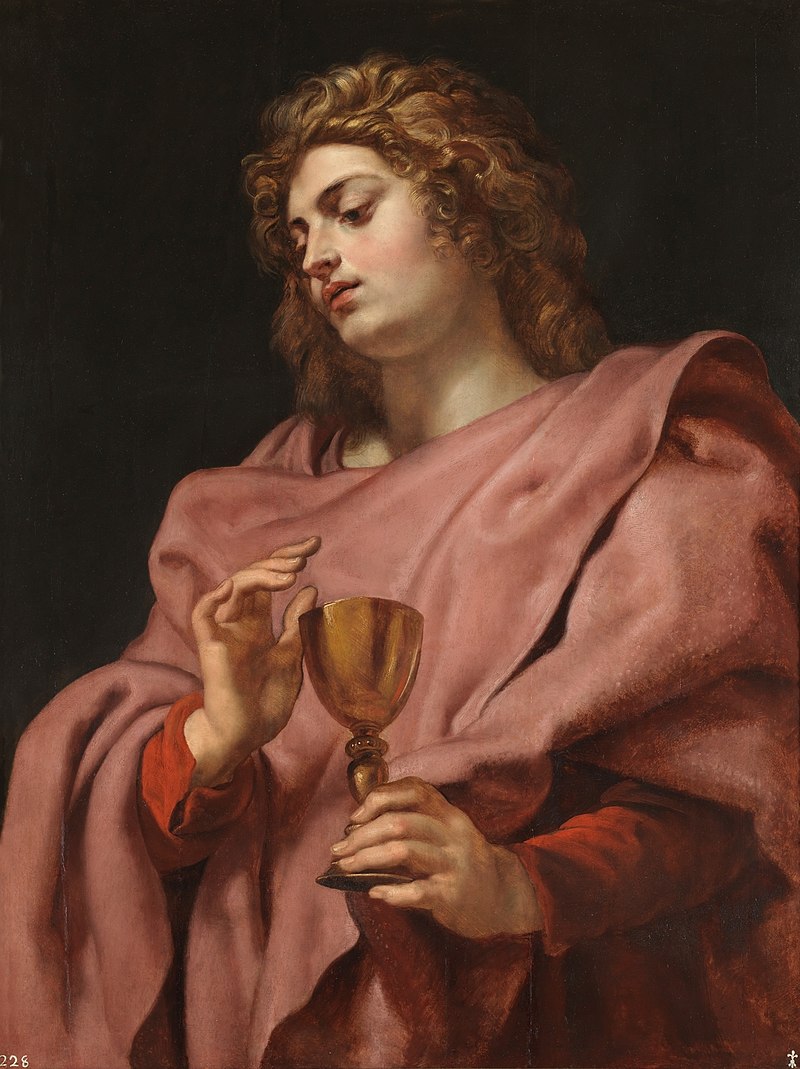
John the Apostle
apostle of Jesus; son of Zebedee and Salome, brother of James; traditionally identified with John the Evangelist, John of Patmos, and the Beloved Disciple

François Villon
French poet and criminal

Josephus
Flavius Josephus (born Yosef ben Mattityahu; ) was a Roman–Jewish historian and military leader. Best known for writing The Jewish War, he was born in Jerusalem—then part of the Roman province of Judea—to a father of priestly descent and a mother who claimed Hasmonean royal ancestry.

Vitruvius
Vitruvius ( ; ; –70 BC – after ) was a Roman architect and engineer during the 1st century BC, known for his multi-volume work titled . As the only treatise on architecture to survive from antiquity, it has been regarded since the Renaissance as the first book on architectural theory, as well as a major source on the canon of classical architecture. It is not clear to what extent his contemporaries regarded his book as original or important.

Romulus Augustus
last emperor of the Western Roman Empire (475–476)

Leucippus
Leucippus (; , Leúkippos; ) was a pre-Socratic Greek philosopher. He is traditionally credited as the founder of atomism, which he developed with his student Democritus. Leucippus divided the world into two entities: atoms, indivisible particles that make up all things, and the void, the nothingness that exists between the atoms. He developed his philosophy as a response to the Eleatics, who believed that all things are one and the void does not exist. Leucippus's ideas were influential in ancient and Renaissance philosophy. Leucippus was the first Western philosopher to develop the concept of
Theocritus
Theocritus (; , Theokritos; ; born 300 BC, died after 260 BC) was a Greek poet from Sicily, Magna Graecia, and the creator of Ancient Greek pastoral poetry.
.jpg)
Jonah
Jonah the son of Amittai or Jonas ( , ) was a Jewish prophet from Gath-hepher in the Northern Kingdom of Israel around the 8th century BCE according to the Hebrew Bible. He is the central figure of the Book of Jonah, one of the minor prophets, which details his reluctance in delivering the judgment of God to the city of Nineveh (near present-day Mosul) in the Neo-Assyrian Empire. After he is swallowed by a large sea creature () and then released, he returns to the divine mission.

Ammianus Marcellinus
4th-century Roman historian and soldier

Romanus
pope

Barnabas
Barnabas (; ; ), born Joseph () or Joses (), was a prominent Christian disciple, identified as an apostle in Acts 14:14. According to Acts 4:36, he was a Cypriot Levite. He undertook missionary journeys as a companion of Paul the Apostle, evangelizing among the "God-fearing" Gentiles who attended synagogues in some of the Hellenized cities of Anatolia. He participated in the Council of Jerusalem ( AD).

Quintus Curtius Rufus
Roman historian

Diogenes Laërtius
3rd-century Roman biographer of Greek philosophers

Khafra
Khafre or Chephren (died 2532 BC) was an ancient Egyptian monarch who was the fourth king of the Fourth Dynasty, during the earlier half of the Old Kingdom period ( 2700–2200 BC). He was son of the king Khufu, and succeeded his brother Djedefre to the throne.

Pausanias
ancient Greek geographer, travel writer and mythographer

Alcaeus of Mytilene
thumb|Alcaeus and Sappho, Attic red-figure calathus, c. 470 BC, [[Staatliche Antikensammlungen (Inv. 2416)]]
Apollonius of Rhodes
3rd century BC Greek epic poet

Dionysius of Halicarnassus
1st-century BC Greek historian and teacher

Aspasia
thumb|right|Marble portrait herm (sculpture)|herm identified by an inscription as Aspasia, possibly copied from her grave.
Aspasia (after 428 BC) was a metic woman who lived in Classical Athens. Born in Miletus, she moved to Athens and began a relationship with the statesman Pericles. According to the traditional historical narrative, she worked as a courtesan, though modern scholars have questioned the factual basis for this claim, which derives from ancient comedy. Though Aspasia is one of the best-attested women from the Greco-Roman world, and the most important woman in the history of fift

Pytheas
Pytheas of Massalia (; Ancient Greek: Πυθέας ὁ Μασσαλιώτης Pythéās ho Massaliōtēs; Latin: Pytheas Massiliensis; born 350 BC, 320–306 BC) was a Greek geographer, explorer and astronomer from the Greek colony of Massalia (modern-day Marseille, France). He made a voyage of exploration to Northern Europe in about 325 BC, but his account of it, known widely in antiquity, has not survived and is now known only through the writings of others.

Denis Papin
French physicist, mathematician and inventor (1647–1713)

Wu Cheng'en
Chinese writer

Vegetius
thumb|300px|Mulomedicina (1250-1375 ca., Biblioteca Medicea Laurenziana, pluteo 45.19)
Publius (or Flavius) Vegetius Renatus, known as Vegetius (), was a writer of the Later Roman Empire (late 4th century). Nothing is known of his life or station beyond what is contained in his two surviving works: Epitoma rei militaris (also referred to as De re militari), and the lesser-known Digesta Artis Mulomedicinae, a guide to veterinary medicine. He identifies himself in the opening of his work Epitoma rei militaris as a Christian.

Pappus of Alexandria
4th century Greek mathematician

Theognis of Megara
Greek lyric poet active in approximately the sixth century BC

Glycerius
Glycerius (died after 474) was Roman emperor of the West from 473 to 474. He served as (commander of the palace guard) during the reign of Olybrius (), until Olybrius died in November 472. After a four-month interregnum, Glycerius was proclaimed as emperor in March 473 by Gundobad, the (master of soldiers) and power behind the throne. Very few of the events of his reign are known other than that an attempted invasion of Italy by the Visigoths was repelled by local commanders, diverting them to Gaul. Glycerius also prevented an invasion by the Ostrogoths through diplomacy, including a gift of 2

Draco
first legislator of Athens in Ancient Greece
.jpg)
Lycurgus of Sparta
Lycurgus (; ) was the legendary lawgiver of Sparta, credited with the formation of its (), involving political, economic, and social reforms to produce a military-oriented Spartan society in accordance with the Delphic oracle. The Spartans in the historical period honoured him as a god.

Theodosios III
Byzantine Emperor

Melissus of Samos
5th-century BC Greek Eleatic philosopher

Justin
Roman historian, 2nd century

Scorpion II
second of two kings of that name during the Protodynastic Period of Upper Egypt

Valerius Maximus
early 1st century AD Roman professional rhetorician, historian and author
.jpg)
Nabonidus
Nabonidus (, meaning "May Nabu be exalted" or "Nabu is praised") was the last king of the Neo-Babylonian Empire, ruling from 556 BC to the fall of Babylon to the Achaemenian Empire under Cyrus the Great in 539 BC. Nabonidus was the last native ruler of ancient Mesopotamia, the end of his reign marking the end of thousands of years of Sumero-Akkadian states, kingdoms and empires. He was also the last independent king of Babylon. Regarded as one of the most vibrant and individualistic rulers of his time, Nabonidus is characterised by some scholars as an unorthodox religious reformer and as the f
%2C%20King%20of%20Judah%20and%20the%20Babylonian%20captivity.%20From%20Babylon%2C%20Iraq.%20C.%20580%20BCE.%20Vorderasiatisches%20Museum%2C%20Berlin.jpg)
Jeconiah
Jeconiah ( meaning "Yahweh has established"; ; ), also known as Coniah and as Jehoiachin ( Yəhōyāḵin ; ), was the nineteenth and penultimate king of Judah who was dethroned by the King of Babylon, Nebuchadnezzar II in the 6th century BCE and was taken into captivity. He was the son and successor of King Jehoiakim, and the grandson of King Josiah. Most of what is known about Jeconiah is found in the Hebrew Bible. Records of Jeconiah's existence have been found in Iraq, such as the Jehoiachin's Rations Tablets. These tablets were excavated near the Ishtar Gate in Babylon and dated to c. 592 BCE.

Lapulapu

Tyrtaeus
thumb|Tyrtée by Gustave Moreau, 1882
Tyrtaeus (; Tyrtaios; fl. mid-7th century BC) was a Greek elegiac poet from Sparta whose works were speculated to fill five books. His works survive from quotations and papyri, and include 250 lines or parts of lines. He wrote at a time of two crises affecting the city: a civic unrest threatening the authority of kings and elders, later recalled in a poem named Eunomia ("Law and Order"), where he reminded citizens to respect the divine and constitutional roles of kings, council, and demos; and the Second Messenian War, during which he served as a sort of "s

Marcus Manilius
1st century Roman writer

Bacchylides
right|thumb|A Musician by Albert Joseph Moore
Bacchylides (; Bakkhulides; – ) was a Greek lyric poet. Later Greeks included him in the canonical list of Nine Lyric Poets, which included his uncle Simonides. The elegance and polished style of his lyrics have been noted in Bacchylidean scholarship since at least Longinus. Some scholars have characterized these qualities as superficial charm. He has often been compared unfavourably with his contemporary, Pindar, as "a kind of Boccherini to Pindar's Haydn". However, the differences in their styles do not allow for easy comparison, and translator R
.jpg)
Alcman
thumb|Roman-period mosaic portrait of Alcman from Gerasa, 3rd century AD
Alcman (; Alkmán; fl. 7th century BC) was an Ancient Greek choral lyric poet from Sparta. He is the earliest representative of the Alexandrian canon of the Nine Lyric Poets. He wrote six books of choral poetry, most of which is now lost; his poetry survives in quotation from other ancient authors and on fragmentary papyri discovered in Egypt. His poetry was composed in the local Doric dialect with Homeric influences. Based on his surviving fragments, his poetry was mostly hymns, and seems to have been composed in long sta

Adam de la Halle
French poet, composer and trouvère

Pérotin
Pérotin () was a composer associated with the Notre Dame school of polyphony in Paris and the broader musical style of high medieval music. He is credited with developing the polyphonic practices of his predecessor Léonin, with the introduction of three and four-part harmonies.

Nonnus of Panopolis
Nonnus of Panopolis (, Nónnos ho Panopolítēs, 5th century AD) was the most notable Greek epic poet of the Imperial Roman era. He was a native of Panopolis (Akhmim) in the Egyptian Thebaid and probably lived in the 5th century AD. He is known as the composer of the Dionysiaca, an epic tale of the god Dionysus, and of the Metabole, a paraphrase of the Gospel of John. The epic Dionysiaca describes the life of Dionysus, his expedition to India, and his triumphant return. It was written in Homeric Greek and in dactylic hexameter, and it consists of 48 books at 20,426 lines.
Muhammad al-Mahdi
twelfth and last Imam in Shia Twelver of Islam

Aristoxenus
thumb|200px|A modern imagining of the appearance of Aristoxenus.
Aristoxenus of Tarentum (; born 375, fl. 335 BC) was a Greek Peripatetic philosopher, and a pupil of Aristotle. Most of his writings, which dealt with philosophy, ethics and music, have been lost, but one musical treatise, Elements of Harmony (Greek: ; Latin: Elementa harmonica), survives incomplete, as well as some fragments concerning rhythm and meter. The Elements is the chief source of our knowledge of ancient Greek music.

Hanno the Navigator
5th century BC Carthaginian explorer
Brennus
4th-century BC Gaulish chieftain of the Senones

Xanthippe
thumb|Portrait from Promptuarium Iconum Insigniorum (1553) by [[Guillaume Rouillé]]

Ctesias
Ctesias ( ; ; ), also known as Ctesias of Cnidus, was a Greek physician and historian from the town of Cnidus in Caria, then part of the Achaemenid Empire.

Nectanebo II
last Egyptian pharaoh of the 30th dynasty

Prudentius
thumb|
Aurelius Prudentius Clemens ( ) was a Roman Christian poet, born in the Roman province of Tarraconensis (now Northern Spain) in 348. He probably died in the Iberian Peninsula some time after 405, possibly around 413. The place of his birth is uncertain, but it may have been Caesaraugusta (Zaragoza), Tarraco (Tarragona), or Calagurris (Calahorra).