Category
page 1Zooplankton

Cnidaria
thumb|Chrysaora fuscescens|Pacific sea nettles, Chrysaora fuscescens
Ctenophora
Ctenophora (; : ctenophore ) is a phylum of marine invertebrates, commonly known as comb jellies, that inhabit sea waters worldwide. They are notable for the groups of cilia they use for swimming (commonly referred to as "combs"), and they are the largest animals to swim with the help of cilia.

Euphausiacea
Krill (Euphausiids) (: krill) are small and exclusively marine crustaceans of the order Euphausiacea, found in all of the world's oceans. The name "krill" comes from the Norwegian word '''', meaning "small fry of fish", which is also often attributed to species of fish.

Ciliophora
The ciliates are a group of alveolates characterized by the presence of hair-like organelles called cilia, which are identical in structure to eukaryotic flagella, but are in general shorter and present in much larger numbers, with a different undulating pattern than flagella. Cilia occur in all members of the group (although the peculiar Suctoria only have them for part of their life cycle) and are variously used in swimming, crawling, attachment, feeding, and sensation.

Foraminifera
Foraminifera ( ; Latin for "hole bearers"; informally called "forams") are single-celled organisms, members of a phylum or class of Rhizarian protists characterized by streaming granular ectoplasm for catching food and other uses; and commonly an external shell called a test of diverse forms and materials. Tests of chitin (found in some simple genera, and Textularia in particular) are believed to be the most primitive type. Most foraminifera are marine, the majority of which live on or within the seafloor sediment (i.e., are benthic, with different sized species playing a role within the macro

copepod
Copepods (; meaning 'oar-feet') are a group of small crustaceans found in nearly every freshwater and saltwater habitat. Some species are planktonic (living in the water column), some are benthic (living on the sediments), several species have parasitic phases, and some continental species may live in limnoterrestrial habitats and other wet terrestrial places, such as swamps, under leaf fall in wet forests, bogs, springs, ephemeral ponds, puddles, damp moss, or water-filled recesses of plants (phytotelmata) such as bromeliads and pitcher plants. Many live underground in marine and freshwater c

Radiolaria
The Radiolaria, also called Radiozoa and informally called radiolarians, are unicellular eukaryotes of diameter 0.1–0.2 mm that produce intricate mineral skeletons, typically with a central capsule dividing the cell into the inner and outer portions of endoplasm and ectoplasm. The elaborate mineral skeleton is usually made of silica. They are found as zooplankton throughout the global ocean. As zooplankton, radiolarians are primarily heterotrophic, but many have photosynthetic endosymbionts and are, therefore, considered mixotrophs. The skeletal remains of some types of radiolarians make

zooplankton
thumb|upright=1.8| Zooplankton sample including several species of copepods (1–5), [[gastropod larva (6) doliolids (7), fish eggs (8), and decapod larva (9) (Photo by Iole Di Capua)]]

Diplostraca
The Diplostraca or Cladocera, commonly known as water fleas, is a superorder of small, mostly freshwater crustaceans, most of which feed on microscopic chunks of organic matter, though some forms are predatory.
Abylidae
The Abylidae are a family of marine invertebrates in the order Siphonophorae. They are colonial, but the colonies can superficially resemble jellyfish; although they appear to be a single organism, each specimen is actually a colony of Siphonophora.
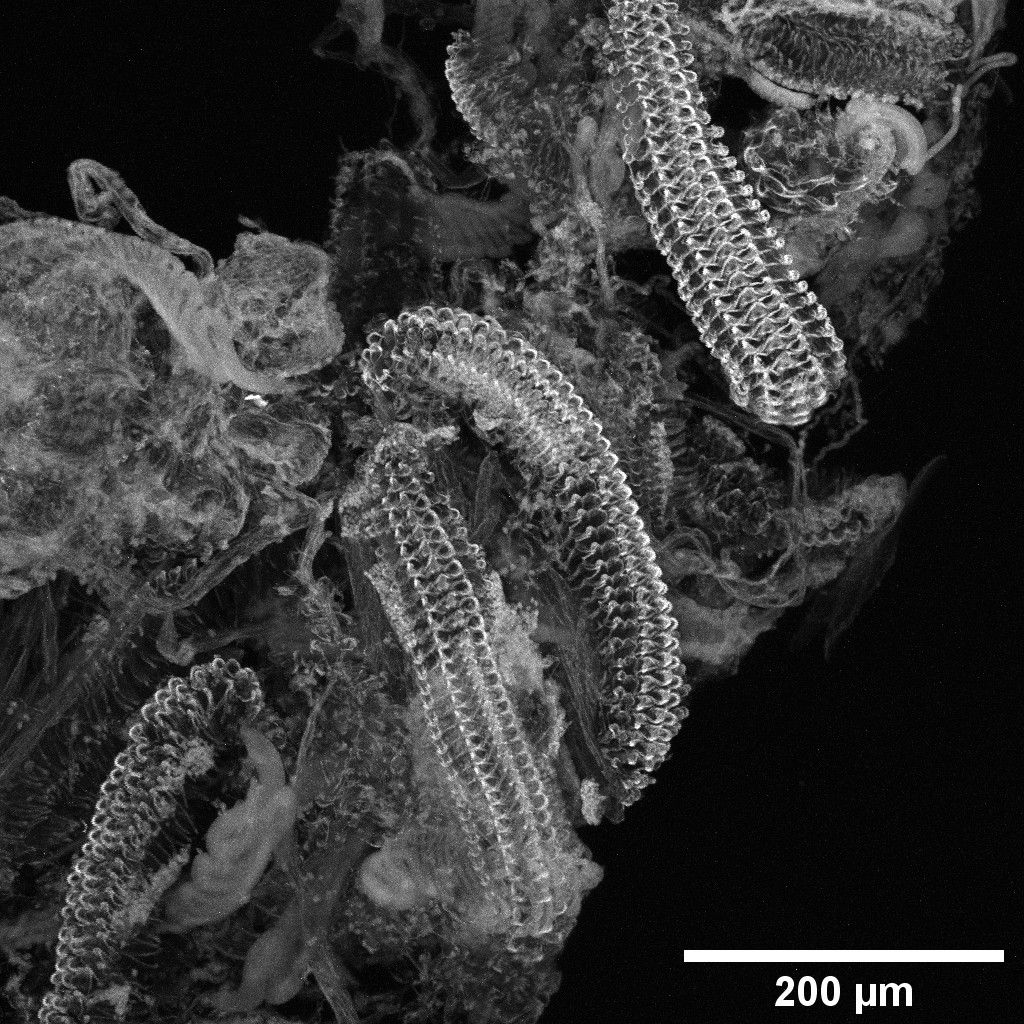
Abyla bicarinata
species of cnidarian