Picture of the Day · NASA
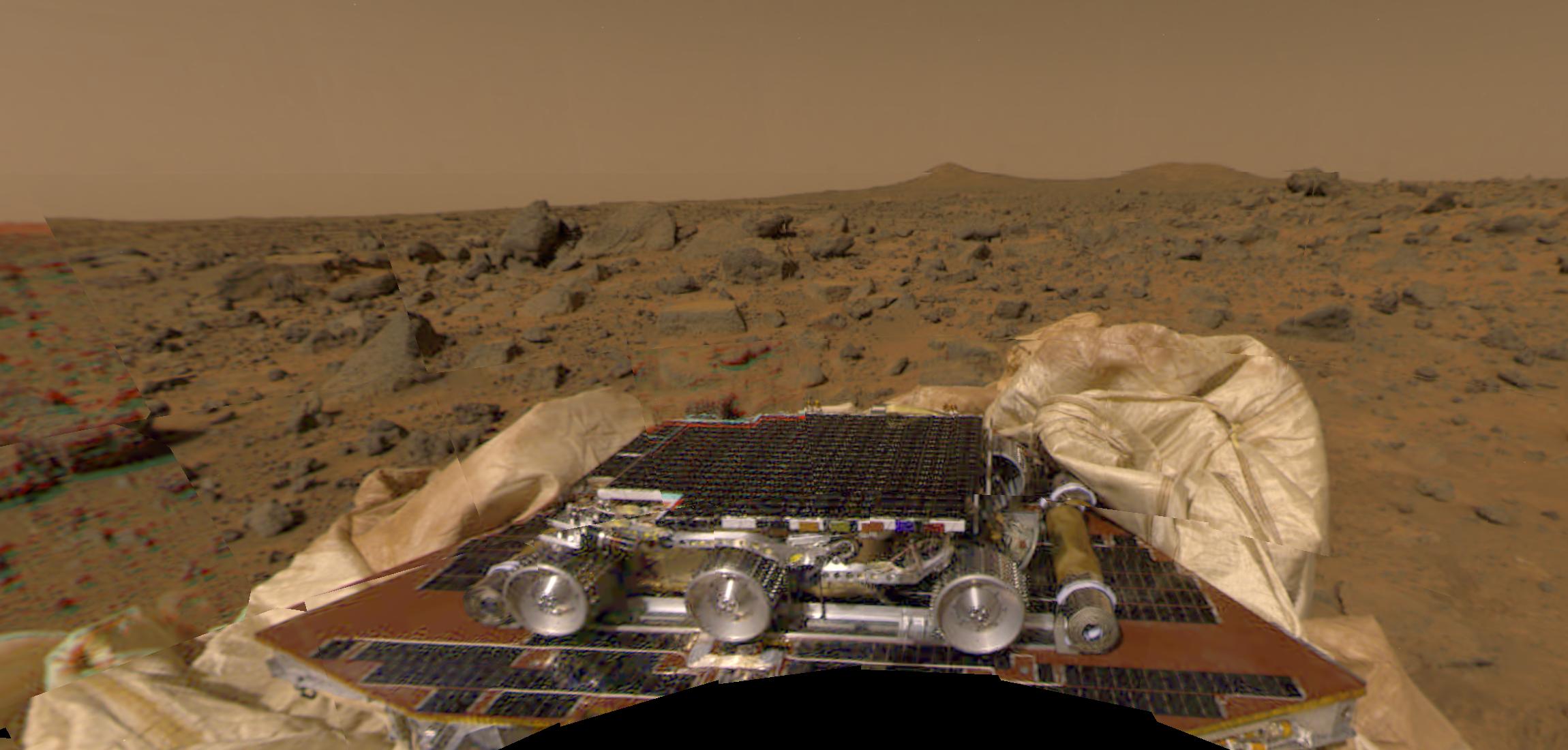
Pathfinder on Mars
2026-07-04
On July 4th, 1997, using its own array of fireworks, a parachute, and a cocoon of airbags, the Mars Pathfinder spacecraft bounced like a giant beach ball at least 15 times before it came to rest on the surface of Mars at 10:07 AM Pacific Daylight Time. After its then novel airbag-assisted landing sequence was completed, Pathfinder transmitted this color mosaic to mission operators on Earth. In the scene from another world, the Mars Sojourner robot rover is visible in the foreground, crouched on top of the unfolded Pathfinder. About the size of a large house cat, the six-wheeled, solar-powered Sojourner became the first successful Martian rover. Surrounding Pathfinder are deflated airbags and the rock-strewn terrain of the Ares Vallis floodplain. In the distance Martian hills appear against a dusty brownish sky. The Pathfinder lander was subsequently renamed the Carl Sagan Memorial Station.
via NASA APOD
Small body data
(3548) Eurybates
- Orbit class
- Jupiter Trojan
- Semi-major axis
- 5.217 AU
- Eccentricity
- 0.091
- Inclination
- 8.051 °
- Absolute magnitude
- 9.790 H
via Minor Planet Center
Key facts
- Discovered by
- C. J. van Houten , I. van Houten-G. , Tom Gehrels
- Discovery site
- Palomar Obs.
- Discovery date
- 19 September 1973
- Pronunciation
- / j ʊ ˈ r ɪ b ə t iː z /
- Named after
- Eurybates , ( Greek mythology )
- Alternative designations
- 1973 SO · 1954 CB, 1957 JX · 1978 EE 5 , 1985 TZ
- Minor planet category
- Jupiter trojan , Greek , Eurybates , binary
- Adjectives
- Eurybatian
- Earliest precovery date
- 9 February 1954
- Aphelion
- 5.680 AU
- Perihelion
- 4.733 AU
- Semi major axis
- 5.206 AU
- Orbital period sidereal
- 11.88 yr (4,339 d)
- Mean anomaly
- 27.507 °
- Mean motion
- 0° 4 58.682 / day
- Inclination
- 8.054°
- Longitude of ascending node
- 43.542°
- Argument of perihelion
- 27.481°
via Wikipedia infobox
Wikidata facts
- Instance of
- asteroid
- Part of
- Jupiter trojan
- Followed by
- 3549 Hapke
- Follows
- 3547 Serov
- Parent body
- Sun
- Minor-planet group
- asteroid belt
- Diameter
- 63.885
- Orbital period
- 4350.85294544983
- Image
- Eurybates-satellite-discovery.gif
Show 18 more facts
- discoverer or inventor
- Tom Gehrels
- site of astronomical discovery
- Palomar Observatory
- provisional designation
- 1985 TZ
- time of discovery or invention
- 1973-09-19
- orbital inclination
- 8.052676233596783
- orbital eccentricity
- 0.09088399261387409
- periapsis
- 4.74172784127821
- apoapsis
- 5.689785415014661
- semi-major axis of an orbit
- 5.215756628146435
- mean anomaly
- 109.3234756435558
- longitude of ascending node
- 43.5547515823932
- argument of periapsis
- 28.56886612226322
- absolute magnitude
- 9.79
- Commons category
- 3548 Eurybates
- albedo
- 0.052
- rotation period
- 8.711
- time of periapsis
- 2459679.248983304
- epoch
- November 21, 2025
via Wikidata · CC0
Article · Deutsch
(3548) Eurybates ist ein Asteroid aus der Gruppe der Jupiter-Trojaner. Damit werden Asteroiden bezeichnet, die bei den Lagrange-Punkten auf der Bahn des Jupiter um die Sonne laufen. (3548) Eurybates wurde am 19. September 1973 vom niederländischen Forscherteam Cornelis Johannes van Houten, Ingrid van Houten-Groeneveld und Tom Gehrels entdeckt. Er ist dem vorauseilenden Lagrangepunkt L4 zugeordnet. Der Asteroid ist nach dem mythischen griechischen Herold Eurybates, dem Freund und Begleiter des Odysseus benannt. Im August 2027 soll die Raumsonde Lucy an Eurybates vorbeifliegen. Am 10. Januar 2020 gab das Minor Planet Center mit MPEC 2020-A113 die Entdeckung eines Mondes bekannt. Er wurde mit dem Hubble-Weltraumteleskop am 12. September 2018 erstmals beobachtet, erneut am 14. September 2018 und ein drittes Mal am 3. Januar 2020. Die scheinbare Helligkeit betrug 26,95 mag, was unter Voraussetzung einer gleichen Albedo wie der von Eurybates einem mittleren Durchmesser von 0,6–1 km entspräche. Die Rotationsperiode des Satelliten beträgt 82,6±0,4 Tage, die mittlere Bahnhalbachse 2310 ± 100 km und seine Exzentrizität ca. 0,05. Der Mond wurde Queta benannt, nach der mexikanischen Leichtathletin Enriqueta Basilio. Der Satellit ist besonders interessant, weil Eurybates das größte Mitglied der einzigen bis jetzt bekannten und bestätigten Familie von Trojanern ist, die auf eine Kollision zurückgeführt werden kann. Lucy soll ein entsprechend erweitertes Programm erhalten, um ihn genauer zu erforschen.
Abstract from DBpedia / Wikipedia · CC BY-SA