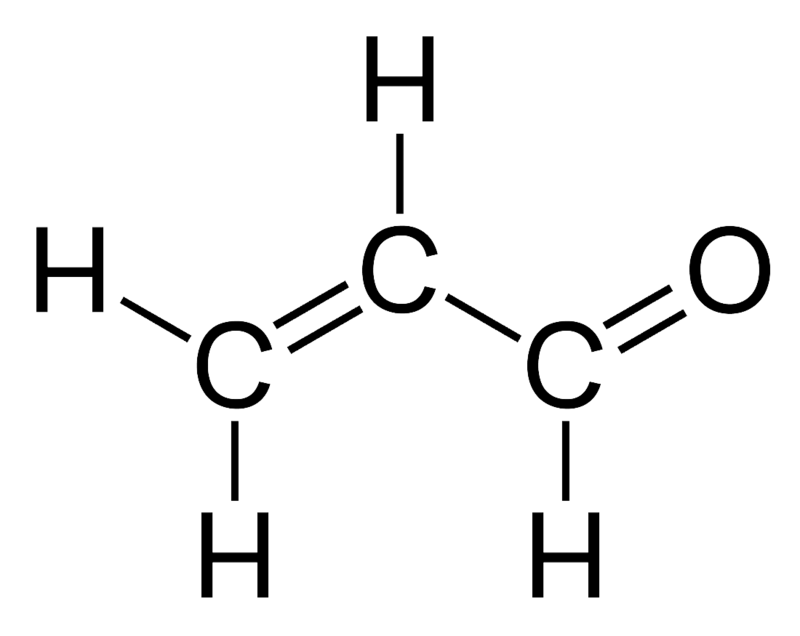
File:Acrolein-s-trans-2D-w.png · Wikimedia Commons · See Wikimedia Commons
acrolein
Sign in to saveAlso known as Slimicide, Crolean, Acquinite, trans-Acrolein Formylethylene, Propylene aldehyde, Propenaldehyde, Magnacide H, Allyl aldehyde
Acrolein (systematic name: propenal) is the simplest unsaturated aldehyde. It is a colorless liquid with a foul and acrid aroma. The smell of burnt fat (as when cooking oil is heated to its smoke point) is caused by glycerol in the burning fat breaking down into acrolein. It is produced industrially from propene and mainly used as a biocide and a building block to other chemical compounds, such as the amino acid methionine.
OverviewAI-generated
Acrolein, also known as prop-2-enal, is a chemical compound with the formula C₃H₄O. It has a molecular mass of 56.026215 and an electric dipole moment of 3.12. The substance exhibits a boiling point of 127 and melting points recorded at -126, -87, and -87.7. Its vapor pressure is 210, while its density is 1.9. Acrolein is flammable, with a flash point of -15, a lower flammable limit of 2.8, and an upper flammable limit of 31. The autoignition temperature is 234.
Safety data for acrolein includes a minimal lethal dose of 5500 and a median lethal dose (LD50) of 875. The immediately dangerous to life or health concentration is 4.58. Exposure limits are set at a time-weighted average of 0.25 and a short-term limit of 0.8. The compound has a solubility of 40 and an ionization energy of 10.13. In terms of molecular structure, it has no hydrogen bond donors, one hydrogen bond acceptor, and a topological polar surface area of 17.1.
Synthesized by Vinony from 35 facts across 4 sources: Wikidata, PubMed, PubChem, Vinony graph. Generated from structured data (not the Wikipedia text) and checked against those facts — may still contain errors.
Chemical data
- Formula
- C3H4O
- Molecular weight
- 56.06 g/mol
- IUPAC name
- prop-2-enal
- SMILES
- C=CC=O
- InChIKey
- HGINCPLSRVDWNT-UHFFFAOYSA-N
- XLogP
- 0
- Polar surface area
- 17.1 Ų
- H-bond donors
- 0
- H-bond acceptors
- 1
- Formal charge
- 0
via PubChem
Drug data · ChEMBL
- Molecule type
- Small molecule
via ChEMBL · EBI
Research
6,230 papers- Acrolein: A Potential Mediator of Oxidative Damage in Diabetic Retinopathy.Biomolecules · 2020
- Acrolein: formation, health hazards and its controlling by dietary polyphenols.Critical reviews in food science and nutrition · 2024
- Acrolein toxicity at advanced age: present and future.Amino acids · 2018
- Acrolein.IARC monographs on the evaluation of carcinogenic risks to humans · 1995
- Acrolein health effects.Toxicology and industrial health · 2008
via PubMed
Wikidata facts
- Has part
- carbon
- Mass
- 56.026215
- Autonomy
- 234
Show 20 more facts
- lower flammable limit
- 2.8
- Commons category
- Acrolein
- vapor pressure
- 210
- canonical SMILES
- C=CC=O
- flash point
- -15
- chemical formula
- C₃H₄O
- solubility
- 40
- NIOSH Pocket Guide ID
- 0011
- density
- 1.9
- immediately dangerous to life or health
- 4.58
- melting point
- -87.7
- boiling point
- 52.69
- upper flammable limit
- 31
- ionization energy
- 10.10
- time-weighted average exposure limit
- 0.2
- short-term exposure limit
- 0.5
- minimal lethal dose
- 674
- median lethal dose (LD50)
- 375
- found in taxon
- Phaseolus vulgaris
- electric dipole moment
- 3.12
via Wikidata · CC0
~7 min read
Encyclopedic overview
14 sectionsContents
- History
- Production
- Niche or laboratory methods
- Reactions
- Uses
- Military uses
- Biocide
- Chemical precursor
- Health risks
- Cigarette smoke
- Chemotherapy metabolite
- Endogenous production
- Analytical methods
- References
Acrolein (systematic name: propenal) is the simplest unsaturated aldehyde. It is a colorless liquid with a foul and acrid aroma. The smell of burnt fat (as when cooking oil is heated to its smoke point) is caused by glycerol in the burning fat breaking down into acrolein. It is produced industrially from propene and mainly used as a biocide and a building block to other chemical compounds, such as the amino acid methionine.
==History== Acrolein was first named and characterized as an aldehyde by the Swedish chemist Jöns Jacob Berzelius in 1839. He had been working with it as a thermal degradation product of glycerol, a material used in the manufacture of soap. The name is a contraction of 'acrid' (referring to its pungent smell) and 'oleum' (referring to its oil-like consistency). In the 20th century, acrolein became an important intermediate for the industrial production of acrylic acid and acrylic plastics.
Excerpted from Wikipedia’s “acrolein” article, available under the CC BY-SA 4.0 licence.