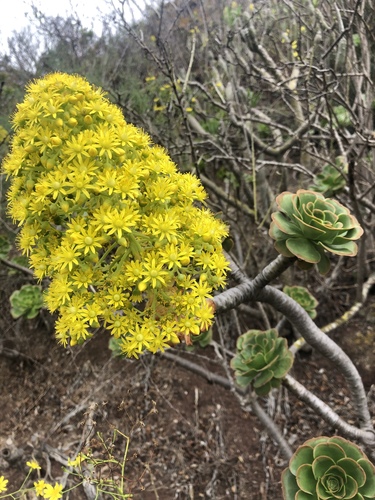
(c) William Stephens, some rights reserved (CC BY), uploaded by William Stephens · cc-by
Aeonium
Sign in to saveAlso known as tree houseleeks
Aeonium, the tree houseleeks, is a genus of about 35 species of succulent, subtropical plants of the family Crassulaceae. Many species are popular in horticulture. The genus name comes from the ancient Greek αἰώνιος / aiōnios (ageless). While most of them are native to the Canary Islands, some are found in Madeira, Cape Verde, Morocco, in East Africa (Ethiopia, Somalia, Uganda, Tanzania and Kenya) and Yemen.
OverviewAI-generated
Aeonium is a genus within the plant kingdom Plantae. It belongs to the phylum Tracheophyta, class Magnoliopsida, and order Saxifragales. The genus is part of the family Crassulaceae. One species within this group is commonly known as the Tree Aeonium.
The native range of Aeonium includes the Canary Islands, Cape Verde, Djibouti, Eritrea, Ethiopia, Kenya, Madeira, Morocco, Somalia, Tanzania, Uganda, and Yemen. Specimens have also been recorded in Spain, the United States, France, Portugal, and New Zealand. These records are held by institutions including MICH, CAS, NY, RSA, and UCR.
Synthesized by Vinony from 26 facts across 7 sources: Wikidata, GBIF, iNaturalist, Gbif Occ, Plants of the World, iDigBio, Vinony graph. Generated from structured data (not the Wikipedia text) and checked against those facts — may still contain errors.
Species
Tree Aeonium
GENUS
- KingdomPlantae
- PhylumTracheophyta
- ClassMagnoliopsida
- OrderSaxifragales
- FamilyCrassulaceae
via GBIF · Kew POWO
Museum specimens
- Specimen records
- 85
- With media
- 64
- Family
- Crassulaceae
- Collections
- MICH, CAS, NY, RSA, UCR, SBBG
- Recorded in
- Spain, United States, France, Portugal, New Zealand
Wikidata facts
- Instance of
- taxon
- Image
- Aeonium haworthii 03.jpg
Show 6 more facts
- Commons category
- Aeonium
- taxon name
- Aeonium
- taxon rank
- genus
- topic's main category
- Category:Aeonium
- taxon common name
- 树莲花属
Sources (1)
via Wikidata · CC0
~8 min read
Encyclopedic overview
5 sectionsContents
- Description
- Species and distribution
- Hybrids
- Images
- References
Aeonium, the tree houseleeks, is a genus of about 35 species of succulent, subtropical plants of the family Crassulaceae. Many species are popular in horticulture. The genus name comes from the ancient Greek αἰώνιος / aiōnios (ageless). While most of them are native to the Canary Islands, some are found in Madeira, Cape Verde, Morocco, in East Africa (Ethiopia, Somalia, Uganda, Tanzania and Kenya) and Yemen.
==Description== The succulent leaves are typically arranged on a basal stem, in a dense, spreading rosette. A feature which distinguishes this genus from many of its relatives is the manner in which the flowers bear free petals, and are divided into 6 or 12 sections. With the exception of Aeonium simsii, each rosette produces a central inflorescence only once, and then dies back (though it will usually branch or offset to produce ensuing rosettes).
Excerpted from Wikipedia’s “Aeonium” article, available under the CC BY-SA 4.0 licence.