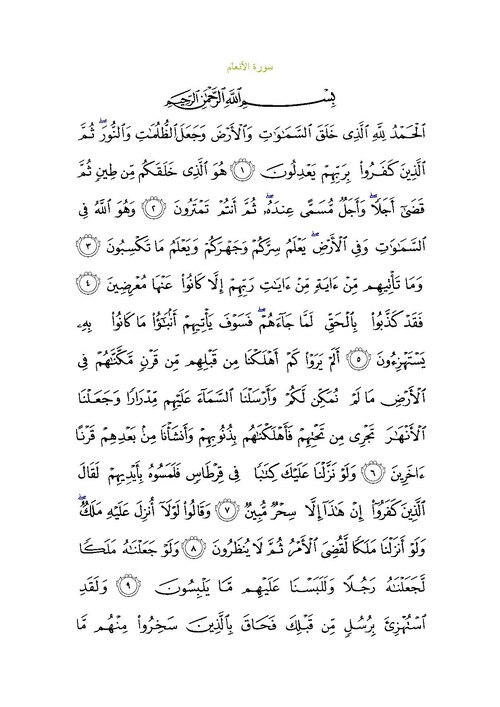
File:Sura6.pdf · Wikimedia Commons · See Wikimedia Commons
Al-Anʻām
Sign in to saveAlso known as The Cattle, Livestock, Surah 6
thumb|Folio|Bifolium from the [[Nurse's Quran (Mushaf al-Hadina) with fragment of the Surah Al-An'am. Kairouan, Zirid dynasty, 1020. Metropolitan Museum of Art]]
Al-Anʻām is the sixth chapter of the Quran, Islam's holy scripture, and contains teachings about God's oneness and guidance. It is significant in Islamic tradition and has been preserved in important historical manuscripts, such as the one shown from 11th-century Kairouan.
AI-generated from the Wikipedia summary — may contain errors.
Key facts
- Surah.number
- 6
- Surah.name
- Al-Anʿām
- Surah.name en
- The Grazing Livestock
- Surah.prev_sura
- Quran 5
- Surah.next_sura
- Quran 7
- Surah.classification
- Makkan
- Surah.juz
- 7—8
- Surah.hizb
- 13—15
- Surah.rukus
- 20
- Surah.verses
- 165
- Surah.words
- 3056
- Surah.letters
- 12,726
via Wikipedia infobox
Wikidata facts
- Instance of
- surah
- Part of
- Qur’an
- Named after
- livestock
- Image
- Koran Page - Google Art Project.jpg
- Has parts of class
- ayah
Show 10 more facts
- characters
- Isaac in Islam
- language of work or name
- Quranic Arabic
- Commons category
- Al-An'am
- name in kana
- かちく
- copyright status
- public domain
- has characteristic
- Meccan surah
- described by source
- Encyclopaedia of the Qur'ān
- work available at URL
- quran.com/6
- Stack Exchange tag
- islam.stackexchange.com/tags/surat-al-anam
- title
- سورة الأنعام
Sources (2)
via Wikidata · CC0
~7 min read
Encyclopedic overview
4 sectionsContents
- Summary
- Placement and coherence with other surahs
- References
- External links
thumb|Folio|Bifolium from the [[Nurse's Quran (Mushaf al-Hadina) with fragment of the Surah Al-An'am. Kairouan, Zirid dynasty, 1020. Metropolitan Museum of Art]]
'''Al-An'am''' (, ; The Cattle) is the sixth chapter (sūrah) of the Quran, with 165 verses (āyāt). Coming in order after Al-Fatiha, Al-Baqarah, Al 'Imran, An-Nisa', and Al-Ma'idah, this surah dwells on such themes as the clear signs of Allah's Dominion and Power, rejecting polytheism and unbelief, the establishment of Tawhid (pure monotheism), the Revelation, Messengership, and Resurrection. It is a Meccan surah and is believed to have been revealed in its entirety during the middle stage of the Meccan period of Islam. This explains the timing and contextual background of the believed revelation (Asbāb al-nuzūl). The surah also reports the story of Ibrahim, who calls others to stop worshiping celestial bodies and turn towards Allah.
Excerpted from Wikipedia’s “Al-Anʻām” article, available under the CC BY-SA 4.0 licence.
Gallery (5)
Available in 62 languages
- Español
- Français
- Deutsch
- 中文
- 日本語
- Русский
- Português
- Italiano
- العربية
- हिन्दी
- Achinese
- Afrikaans
- Assamese
- Avaric
- azb
- Azerbaijani
- Bahasa Indonesia
- Bangla
Show 43 more
- Bashkir
- Bosnian
- Bulgarian
- Burmese
- Catalan
- Central Kurdish
- dag
- dga
- Egyptian Arabic
- Filipino
- Finnish
- Georgian
- Hausa
- Hebrew
- Ingush
- Javanese
- Kashmiri
- Kazakh
- Kurdish
- Malay
- Malayalam
- Mazanderani
- Moroccan Arabic
- Mossi
- Nederlands
- Pashto
- Polski
- simple
- Sindhi
- Slovenian
- Sundanese
- Svenska
- Tajik
- Tatar
- Türkçe
- Ukrainian
- Urdu
- Uyghur
- Uzbek
- Zaza
- zh_yue
- فارسی
- 한국어
via Wikidata sitelinks · CC0