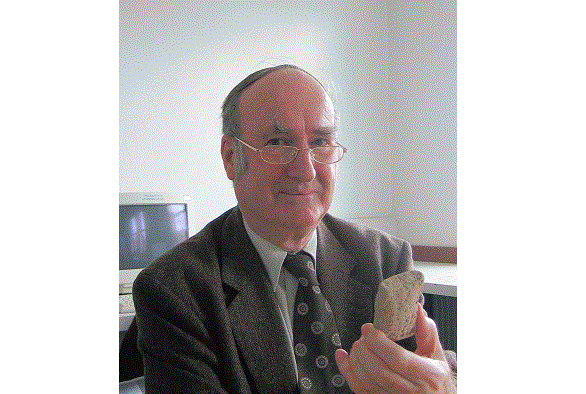
Alan Millard
Sign in to saveAlso known as A. R. Millard, Alan Ralph Millard, Alan R. Millard
British archaeologist and semitist (1937-)
In the Vinony graph
Within Vinony's link graph, Alan Millard is referenced by 50 other articles, and connects out to Society of Antiquaries of London, England and Hebrew.
It sits within the topics 1937 births, 2024 deaths and 20th-century British biblical scholars.
Its subject is documented across 5 Wikipedia language editions.
Person · Open Library
- Works
- 21
via Open Library + Wikidata
Music · MusicBrainz
- Type
- Person
- Gender
- Male
- Origin
- United States
- Active from
- 1975-10-26
Discography
- Nice, Nice, Very Nice…1994
- 50 Intellectually Stimulating Themes From a Cheap Amusement Park for Robots and Aliens, Volume 11998
- To Hell With All of You, I Just Wanna Grow My Vegetables!1999
- The De‐Evolution of Yasmine Bleeth2001
- Fanatical Video‐Game Retroverse2005
- How to Sell the Whole F#@!ing Universe to Everybody… Once and for All!2005
via MusicBrainz · CC0
Listeners · Last.fm
- Listeners
- 1
- Total plays
- 1
<a href="https://www.last.fm/music/Alan+Millard">Read more on Last.fm</a>
Described at
Obituary: Professor Alan Millard - News - University of Liverpool
Obituary: Professor Alan Millard
news.liverpool.ac.uk →Words by Former student, Dr. Paul Lawrence and Dr. Bruce Routledge from the Department of Archaeology, Classics and Egyptology. Professor Alan Ralph Millard died in Leamington Spa on 6th June, 2024 aged 86. He was predeceased by Margaret (née Sibley) his wife of nearly 55 years and survived by their children Clare, Stephen and Jonathan. Alan joined the University of Liverpool in 1970 serving as Rankin Lecturer in Hebrew and Semitic Languages (1970-1976), progressing to Senior Lecturer (1976-1985), Reader (1985-1992), and Professor (1992-2003). Appointed in the Department of Oriental Studies, Alan retired from the School of Archaeology, Classics and Oriental Studies (now Archaeology, Classics and Egyptology) in 2003. Alan was born in Harrow, Middlesex (1 December, 1937). Already as a school boy he showed his interest in the past, excavating The Manor of the More in Rickmansworth and publishing the results as a member of the Merchant Taylors’ School Archaeological Society. Alan studied Semitic Languages at Magdalen College, Oxford under Sir Godfrey Driver, graduating in 1959. From 1961-1963 he was Assistant Keeper in the Department of Western Asiatic Antiquities at the British Museum. During this time, Alan did important work publishing Aramaic inscriptions from the British School of Archaeology in Iraq’s excavations at Nimrud, cataloguing tablets from old excavations at Kuyunjik (Nineveh, Iraq) and, most famously, rediscovering tablets that formed part of the Babylonian Epic of Atrahasis (a creation and flood story), which had remained in a drawer unrecognised for several decades. From 1964 to 1970 Alan was the librarian at Tyndale House in Cambridge, an institution with which he remained deeply involved throughout his career. Alan completed an M.Phil. at SOAS under D.J. Wiseman in 1967 before taking up his post in Liverpool. He was elected as a Fellow of the Society of Antiquaries in 1971 and as a Fellow of the Institute for Advanced Study, Hebrew University in 1984. From 2001-2005 he served as Vice-Chair of the British School of Archaeology in Iraq (now British Institute for the Study of Iraq). For many years he was on the editorial board of Palestine Exploration Quarterly and an active member of the Society for Old Testament Study. Alan had interests and an international reputation in the primary publication of Aramaic and Hebrew inscriptions and in the Akkadian of the Neo-Assyrian Empire. His monographs The Eponyms of the Assyrian Empire 910-612 B.C and La statue de Tell Fekherye et son inscription bilingue assyro-araméenne , with Ali Abou-Assaf and Pierre Bordreuil, are fundamental presentations of primary data that continue to be widely cited. Alan also had an intense interest in the history of writing and questions of literacy in the biblical period. These interests, and his personal commitment to the evangelical expression of Christianity, were represented in his popular and public-oriented work. His books Discoveries from Bible Times (1997) and Reading and Writing in the Time of Jesus ( 2000) both reached wide audiences. He also served as one of the translators of the New International Version of the Bible. Despite his many academic achievements, Alan’s real impact came as a teacher, mentor and colleague, both in his academic duties and as a member of faith communities on and off campus. Former students and colleagues have provided the following tributes to Alan: Dr Paul Lawrence (Translation Consultant, SIL International): “I had the privilege of studying for a BA and PhD under Alan’s guidance. He was a somewhat reserved man, but one who cared deeply for the well-being of his students urging them to take a weekly day off. Alan and his wife Margaret loved to entertain their students in their home in West Kirby. Alan demanded that his students be cautious when making claims in their written work. Loose turns of phrase and inaccuracies were corrected in his tiny angular handwriting. Yet he was generous in giving aw
Excerpt from a page describing this subject · 7,248 chars · not written by Vinony
Wikidata facts
- Instance of
- human
- Given name
- Ralph
- Gender
- male
- Citizenship
- United Kingdom
- Place of birth
- London Borough of Harrow
- Place of death
- Leamington Spa
- Occupation
- researcher
- Educated at
- University of York
- Employer
- British Museum
- Languages spoken
- English language
- Religion
- Christianity
- Academic degree
- Doctor of Philosophy
Show 6 more facts
- member of
- Society of Antiquaries of London
- date of birth
- 1937-12-01
- writing language
- English language
- date of death
- 2024-06-06
- name in native language
- Alan Millard
- described at URL
- news.liverpool.ac.uk/2024/06/14/obituary-professor-alan-millard
Sources (7)
via Wikidata · CC0