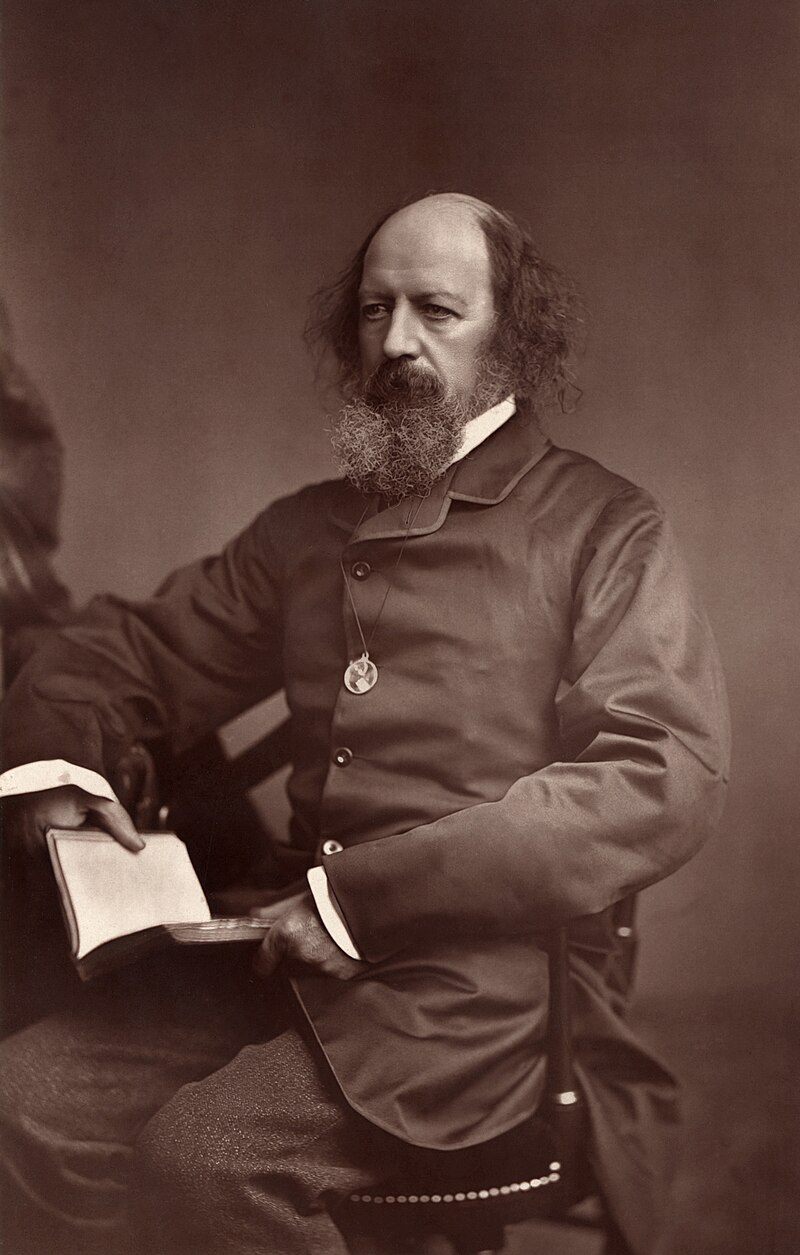
File:Alfred,_Lord_Tennyson_by_Elliott_&_Fry_-_Original.jpg · Wikimedia Commons · See Wikimedia Commons
Alfred Tennyson
Sign in to saveAlso known as Alfred Tennyson, 1st Baron Tennyson, Lord Alfred Tennyson, Alcibiades, A. Tennyson, Alfred Tennyson, Baron Tennyson, Alfred Tennyson Tennyson, Tennyson, 1st Baron Tennyson of Aldworth and Freshwater Alfred Tennyson
British Poet Laureate (1809–1892)
OverviewAI-generated
Alfred Tennyson was a male poet, politician, and writer from the United Kingdom of Great Britain and Ireland. Born in Somersby on 6 August 1809, he was educated at Trinity College and worked in London. He held the position of Poet Laureate of the United Kingdom and was a member of the Royal Society and the American Academy of Arts and Sciences. His notable works include The Charge of the Light Brigade, The Lady of Shalott, Idylls of the King, In memoriam, Queen Mary, and The sailor boy.
Tennyson was an Anglican and had siblings Charles Tennyson Turner, Emilia Tennyson, and Frederick Tennyson. He had a child named Hallam Tennyson, 2nd Baron Tennyson. He died in Aldworth, Haslemere, on 6 October 1892 and is buried in Westminster Abbey. His archives are held at the Beinecke Rare Book & Manuscript Library and the National Library of Wales. He is described by sources including the Nordisk familjebok, Brockhaus and Efron Encyclopedic Dictionary, Encyclopædia Britannica 11th edition, and The Nuttall Encyclopædia.
Synthesized by Vinony from 31 facts across 5 sources: Wikidata, Open Library, TMDb, Europeana Sparql, Vinony collections. Generated from structured data (not the Wikipedia text) and checked against those facts — may still contain errors.
Person · Open Library
- Born
- 6 August 1809
- Died
- 6 October 1892
- Works
- 1126
Top works
- The sailor boy
- In memoriam
- Queen Mary
- Freundes-Klage
- Dedication
via Open Library + Wikidata
Wikidata facts
- Instance of
- human
- Given name
- Alfred
- Gender
- male
- Citizenship
- United Kingdom of Great Britain and Ireland
- Place of birth
- Somersby
- Place of death
- Haslemere
- Occupation
- writer
- Position held
- Poet Laureate of the United Kingdom
- Languages spoken
- English language
- Religion
- Anglicanism
- Notable work
- The Charge of the Light Brigade
- Field of work
- poetry
- Image
- Alfred, Lord Tennyson by Julia Margaret Cameron.jpg
- Work location
- London
Show 14 more facts
- place of burial
- Westminster Abbey
- Commons category
- Alfred, Lord Tennyson
- date of birth
- 1809-08-06
- date of death
- 1892-10-06
- Commons gallery
- Alfred Tennyson
- topic's main category
- Category:Alfred, Lord Tennyson
- Commons Creator page
- Alfred Tennyson
- name in native language
- Alfred Tennyson, 1. Baron Tennyson
- writing language
- English language
- ethnic group
- English people
- has works in the collection
- J. Paul Getty Museum
- medical condition
- epilepsy
- P12749
- Raila Odinga
via Wikidata · CC0
Works in European collections
36 objects attributed to Alfred Tennyson, held across European museums, libraries & archives · via Europeana

The brook/(Tennyson - Dolores)
The poems of Alfred Lord Tennyson
Untitled
Untitled
Untitled
Untitled
Untitled
Untitled
Untitled
Untitled
Untitled
Untitled
Untitled
Untitled
Untitled
Untitled
Untitled
Untitled
Untitled
Untitled
Untitled
Untitled
Untitled
Untitled
Untitled
Untitled
Untitled
Untitled
Untitled
Untitled
Untitled
Untitled
Untitled
Untitled
Untitled
Untitled
~29 min read
Encyclopedic overview
Alfred Tennyson, 1st Baron Tennyson (/ˈtɛnɪsən/; 6 August 1809 – 6 October 1892) was an English poet. He was Poet Laureate of the United Kingdom during much of Queen Victoria's reign. In 1829 he was awarded the Chancellor's Gold Medal at Cambridge for one of his first pieces, "Timbuktu". He published his first solo collection of poems, Poems, Chiefly Lyrical, in 1830. "Claribel" and "Mariana", which remain some of Tennyson's most celebrated poems, were included in this volume. Some critics described Tennyson as overly sentimental. However, his poems proved popular and brought Tennyson to the attention of well-known writers of the day, including Samuel Taylor Coleridge. Tennyson's early poetry, with its medievalism and powerful visual imagery, was a major influence on the Pre-Raphaelite Brotherhood.
Tennyson also focused on short lyrics, such as "Break, Break, Break", "The Charge of the Light Brigade", "Tears, Idle Tears", and "Crossing the Bar". Much of his verse was based on classical mythological themes, such as "Ulysses" and "The Lotos-Eaters". "In Memoriam A.H.H." was written to commemorate his friend Arthur Hallam, a fellow poet and student at Trinity College, Cambridge, after he died of a stroke at the age of 22. Tennyson also wrote notable blank verse, including Idylls of the King, "Ulysses", and "Tithonus". During his career, Tennyson attempted drama, but his plays enjoyed little success.
Excerpted from Wikipedia’s “Alfred Tennyson” article, available under the CC BY-SA 4.0 licence.
Gallery (12)
Available in 71 languages
- Español
- Français
- Deutsch
- 中文
- 日本語
- Русский
- Português
- Italiano
- العربية
- हिन्दी
- Afrikaans
- Aragonese
- Armenian
- azb
- Azerbaijani
- Bahasa Indonesia
- Bangla
- Basque
Show 52 more
- be_x_old
- Bhojpuri
- Breton
- Bulgarian
- Burmese
- Catalan
- Chuvash
- Czech
- Danish
- Egyptian Arabic
- Esperanto
- Estonian
- Finnish
- Galician
- Greek
- Hausa
- Hebrew
- Hungarian
- Icelandic
- Irish
- Kannada
- Latin
- Lingua Franca Nova
- Malayalam
- Marathi
- Mingrelian
- Nederlands
- Norwegian
- Norwegian Nynorsk
- Polski
- Punjabi
- Romanian
- Serbian
- Serbian (Latin)
- simple
- Slovenian
- Svenska
- Tamil
- Telugu
- Tiếng Việt
- Türkçe
- Ukrainian
- Urdu
- Welsh
- West Flemish
- Western Frisian
- Western Panjabi
- Wu Chinese
- zh_yue
- فارسی
- ไทย
- 한국어
via Wikidata sitelinks · CC0