File:Alligator_Gar_10.JPG · Wikimedia Commons · See Wikimedia Commons
alligator gar
Sign in to saveAlso known as Atractosteus spatula
Ray-finned euryhaline fish related to the bowfin in the infraclass Holostei
Species
Least Concernalligator gar
GENUS
- KingdomAnimalia
- PhylumChordata
- ClassCrocodylia
- OrderLepisosteiformes
- FamilyAlligatoridae
福鱷(學名:Atractosteus spatula),又名鱷雀鱔、大雀鱔,臺灣命名為錘骨雀鱔或鱷魚火箭,是一種很原始的輻鰭魚。它的名字來自它跟鱷魚一樣的短吻和兩排匕首般鋒利的牙齒。背部呈褐色或橄欖色,腹部則較為淺色。鱗片是菱形硬鱗,美洲印第安人有時會拿來作為寶石。 福鱷是雀鱔目中體型最大的以及是北美洲最大的淡水魚之一,身長達8至10英尺(2.4至3.0米)、體重至少200至350英磅(91至159公斤)。
via GBIF · IUCN
Wikidata facts
- Instance of
- taxon
- Parent taxon
- Atractosteus
- Image
- Alligator Gar 10.JPG
Show 8 more facts
- taxon rank
- species
- taxon name
- Atractosteus spatula
- Commons category
- Atractosteus spatula
- Commons gallery
- Atractosteus spatula
- IUCN conservation status
- Least Concern
- start time
- 3600000-00
- short name
- A. spatula
- temporal range start
- Late Cretaceous
Sources (1)
via Wikidata · CC0
~24 min read
Encyclopedic overview
The alligator gar (Atractosteus spatula) is a euryhaline ray-finned fish in the clade Ginglymodi of the infraclass Holostei /hoʊˈlɒstiaɪ/, being most closely related to the bowfins. It is the largest species in the gar family (Lepisosteidae), and is among the largest freshwater fishes in North America. The fossil record traces its group's existence back to the Early Cretaceous over 100 million years ago. Gars are often referred to as "primitive fishes" or "living fossils", because they have retained some morphological characteristics of their early ancestors, such as a spiral valve intestine, which is also common to the digestive system of sharks, and the ability to breathe in both air and water. Their common name was derived from their resemblance to the American alligator, particularly their broad snouts and long, sharp teeth. It is suggested that an alligator gar can grow up to 10 ft (3.0 m) in length.
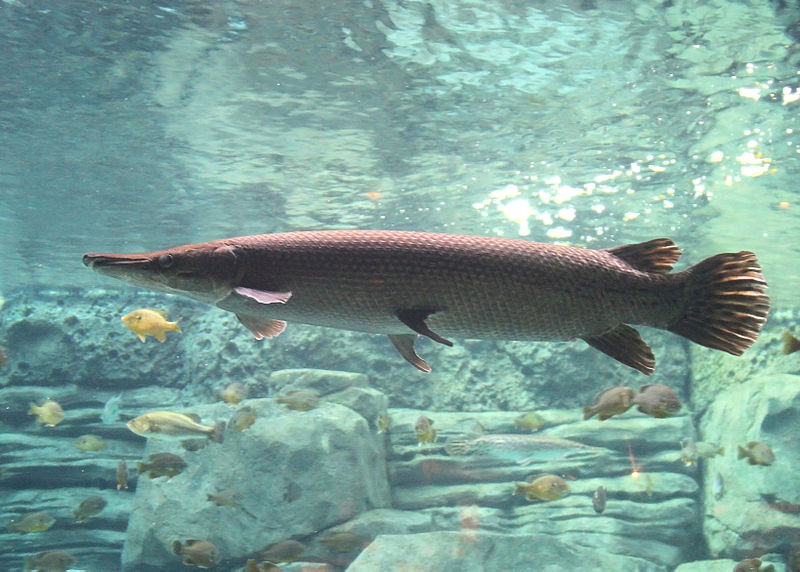
The body of an alligator gar is torpedo-shaped, usually brown or olive colored, fading to a lighter gray or yellow ventral surface. In very rare occurrences, they can also be black, seen in gars that have a high level of melanin. Their scales are not like the scales of other fishes; rather, they are ganoid scales, which are bone-like, rhomboidal-shaped scales, often with serrated edges, and covered by an enamel-like substance. Ganoid scales are nearly impenetrable, and are excellent protection against predation. Unlike other gar species, the upper jaw of an alligator gar has a dual row of large, sharp teeth that are used to impale and hold prey. Alligator gar are stalking, ambush predators, primarily piscivores, but they also ambush and eat waterfowl and small mammals they find floating on the water's surface.
Excerpted from Wikipedia’s “alligator gar” article, available under the CC BY-SA 4.0 licence.