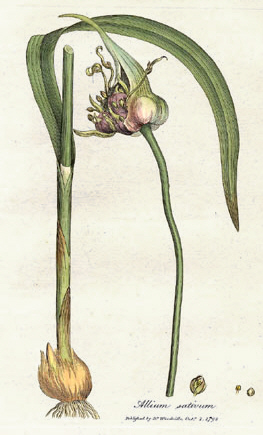
File:Allium_sativum_Woodwill_1793.jpg · Wikimedia Commons · See Wikimedia Commons
Allium sativum
Sign in to saveAlso known as garlic plant, hardneck garlic, softneck garlic, garlic
Garlic (Allium sativum) is a species of bulbous flowering plants in the genus Allium. Its close relatives include the onion, shallot, leek, chives, Welsh onion, and Chinese onion. Garlic is native to central and western Asia, stretching from the Black Sea through the southern Caucasus, northeastern Iran, and the Hindu Kush. It has naturalized in many other parts of the world, including Mediterranean Europe and China. There are two subspecies and hundreds of varieties of garlic.
OverviewAI-generated
Allium sativum is a species of plant in the family Amaryllidaceae. It belongs to the genus Allium and is classified as a useful plant. Common names for this taxon include cultivated garlic, garlic, Knoblauch, ail, and 大蒜. The organism is a source of garlic and garlic oil. It is used as a medicinal plant, vegetable, and spice.
The taxon range includes China, specifically Fujian, Tibet Autonomous Region, and Guangdong. It is native to Iran, Kazakhstan, Kirgizstan, Tadzhikistan, Turkmenistan, and Uzbekistan. Specimens have been recorded in Mexico, the United States, and Thailand. The fruit type is a capsule.
Nutritional data for the category garlic lists energy at 296 kcal, fat at 16.2, and proteins at 7.2. It has a nutriscore of a and nova classification of 1. The species is described in sources such as the Brockhaus and Efron Encyclopedic Dictionary and the Encyclopædia Britannica 11th edition. It is referenced by 3,359 other encyclopedia articles.
Synthesized by Vinony from 56 facts across 8 sources: Wikidata, GBIF, PubMed, Gbif Occ, Plants of the World, Openfoodfacts, iDigBio, Vinony graph. Generated from structured data (not the Wikipedia text) and checked against those facts — may still contain errors.
Species
Allium sativum
SPECIES
- KingdomPlantae
- PhylumTracheophyta
- ClassLiliopsida
- OrderAsparagales
- FamilyAmaryllidaceae
「蒜头、大蒜」重定向至此。關於台灣地名,詳見「蒜頭 (地名)」。 蒜(学名:Allium sativum),亦名大蒜。地下鳞茎味道辣,有刺激性气味,称为蒜头,可作调味料,亦可入药。蒜叶称为青蒜或蒜苗,花薹称为蒜薹,均可作蔬菜食用。蒜為五辛之一。
via GBIF · Kew POWO
Museum specimens
- Specimen records
- 598
- With media
- 366
- Family
- Amaryllidaceae
- Collections
- FCF-UANL, UNIVERSITY OF VERMONT, SEMAHN, INECOL, CM, ANSP
- Recorded in
- Mexico, United States, Thailand
Key facts
- Nutritional value.name
- Garlic, raw
- Nutritional value.image
- Garlic bulbs and cloves.jpg
- Nutritional value.kJ
- 623
- Nutritional value.protein
- 6.36 g
- Nutritional value.fat
- 0.5 g
- Nutritional value.carbs
- 33.06 g
- Nutritional value.fiber
- 2.1 g
- Nutritional value.sugars
- 1 g
- Nutritional value.calcium_mg
- 181
- Nutritional value.iron_mg
- 1.7
- Nutritional value.magnesium_mg
- 25
- Nutritional value.phosphorus_mg
- 153
- Nutritional value.potassium_mg
- 401
- Nutritional value.sodium_mg
- 17
- Nutritional value.zinc_mg
- 1.16
- Nutritional value.manganese_mg
- 1.672
- Nutritional value.opt1n
- Selenium
- Nutritional value.opt1v
- 14.2 μg
via Wikipedia infobox
Nutrition · Open Food Facts
Typical values per 100 g · averaged across 24 products
- Energy
- 296 kcal
- Fat
- 16.2 g
- — of which saturates
- 1.5 g
- Carbohydrates
- 32 g
- — of which sugars
- 2.6 g
- Fibre
- 12.5 g
- Protein
- 7.2 g
- Salt
- 0.71 g
via Open Food Facts · ODbL
Research
9,803 papers- Chemical Constituents and Pharmacological Activities of Garlic (Allium sativum L.): A Review.ReviewNutrients · 2020El-Saber Batiha G, Magdy Beshbishy A, G Wasef L et al.DOI: 10.3390/nu12030872
- Garlic (Allium sativum L.) in diabetes and its complications: Recent advances in mechanisms of action.ReviewCritical reviews in food science and nutrition · 2024Jiang Y, Yue R, Liu G et al.DOI: 10.1080/10408398.2022.2153793
- Exploring the garlic (Allium sativum) properties for fish aquaculture.ReviewFish physiology and biochemistry · 2021Valenzuela-Gutiérrez R, Lago-Lestón A, Vargas-Albores F et al.DOI: 10.1007/s10695-021-00952-7
- Allium sativum: facts and myths regarding human health.ReviewRoczniki Panstwowego Zakladu Higieny · 2014Majewski M
- Antiviral potentials of garlic (Allium sativum) in poultry production: A mini review.ReviewVeterinary medicine and science · 2023Adjei-Mensah B, Quaye B, Opoku O et al.DOI: 10.1002/vms3.1247
- Garlic (Allium sativum) as an antidote or a protective agent against natural or chemical toxicities: A comprehensive update review.ReviewPhytotherapy research : PTR · 2020Dorrigiv M, Zareiyan A, Hosseinzadeh HDOI: 10.1002/ptr.6645
- Insights into garlic (Allium Sativum)'s nutrigenomics-associated fly-repellent potency in cattle.ReviewTropical animal health and production · 2025Mudau F, Durunna O, Mapiye C et al.DOI: 10.1007/s11250-025-04406-7
- Valorization of garlic (Allium sativum L.) byproducts: Bioactive compounds, biological properties, and applications.ReviewJournal of food science · 2025Jain M, Patil N, Mohammed A et al.DOI: 10.1111/1750-3841.70152
via PubMed
Wikidata facts
- Instance of
- taxon
- Subclass of
- useful plant
- Parent taxon
- Allium
- Image
- Allium sativum - Copenhagen Botanical Garden - DSC07941.JPG
- Has use
- spice
Show 16 more facts
- Commons category
- Allium sativum
- taxon name
- Allium sativum
- taxon rank
- species
- taxon common name
- česen
- this taxon is source of
- garlic oil
- Commons gallery
- Allium sativum
- has fruit type
- capsule
- Wikidata usage instructions
- this is about species, see Q21546392 for the ingredient
- taxon range
- Myanmar
- on focus list of Wikimedia project
- Wikipedia:Vital articles/Level/4
- water footprint
- 589
- short name
- A. sativum
- taxon author citation
- L.
- external data available at URL
- www.gbif.org/dataset/93725bf2-6ada-47f9-bd5e-0e679e3d245e
- different from
- garlic
Sources (11)
via Wikidata · CC0
~29 min read
Encyclopedic overview
29 sectionsContents
- Description
- Chemistry
- Taxonomy
- Subspecies and varieties
- Etymology
- Ecology
- Cultivation
- Propagation
- Production
- Adverse effects and toxicology
- Uses
- Nutrition
- Culinary
- Regions
- Culinary history
- Storage
- Medical research
- Cardiovascular
- Cancer
- Common cold
- Folk medicine
- Other uses
- In culture
- Gallery
- See also
- Notes
- References
- Further reading
- External links
Garlic (Allium sativum) is a species of bulbous flowering plants in the genus Allium. Its close relatives include the onion, shallot, leek, chives, Welsh onion, and Chinese onion. Garlic is native to central and western Asia, stretching from the Black Sea through the southern Caucasus, northeastern Iran, and the Hindu Kush. It has naturalized in many other parts of the world, including Mediterranean Europe and China. There are two subspecies and hundreds of varieties of garlic.
Garlic has been used for thousands of years as a seasoning, culinary ingredient, and traditional medical remedy. It was known in many ancient civilizations, including the Babylonians, Egyptians, Jews, Romans, and Chinese, and remains significant in many cuisines and folk treatments, especially across the Mediterranean and Asia. Sulfur compounds give garlic its pungent odor and flavor. There is insufficient clinical evidence to indicate that consuming garlic has any health benefits.
Excerpted from Wikipedia’s “Allium sativum” article, available under the CC BY-SA 4.0 licence.
Gallery (41)
Available in 176 languages
- Español
- Français
- Deutsch
- 中文
- 日本語
- Русский
- Português
- Italiano
- العربية
- हिन्दी
- Afrikaans
- Albanian
- Amharic
- Aragonese
- Armenian
- Assamese
- Asturian
- Aymara
Show 157 more
- azb
- Azerbaijani
- Bahasa Indonesia
- Balinese
- Bangla
- Banjar
- Bashkir
- Basque
- bat_smg
- Bavarian
- be_x_old
- Belarusian
- Bikol
- Bislama
- Bosnian
- Breton
- Bulgarian
- Burmese
- Catalan
- cdo
- Cebuano
- Central Kurdish
- Chechen
- Chuvash
- Corsican
- Croatian
- Czech
- dag
- Danish
- Divehi
- Egyptian Arabic
- Erzya
- Esperanto
- Estonian
- Filipino
- Finnish
- Fon
- Friulian
- Galician
- Ganda
- Georgian
- Goan Konkani
- Gorontalo
- Greek
- Guarani
- Gujarati
- Haitian Creole
- Hausa
- Hebrew
- Hungarian
- hyw
- Icelandic
- Ido
- Inari Sami
- Ingush
- Interlingua
- Irish
- Javanese
- Kabyle
- Kannada
- Kashmiri
- Kazakh
- kge
- Khmer
- Kyrgyz
- Lao
- Latin
- Latvian
- lbe
- Ligurian
- Limburgish
- Lithuanian
- Lower Sorbian
- Luxembourgish
- Macedonian
- Madurese
- Maithili
- Malagasy
- Malay
- Malayalam
- Manipuri
- Manx
- Marathi
- Minangkabau
- Mingrelian
- mnw
- Mongolian
- nah
- Navajo
- Nederlands
- Nepali
- Newari
- Northern Frisian
- Norwegian
- Norwegian Nynorsk
- Occitan
- Odia
- Old English
- olo
- Ossetic
- Pampanga
- Pashto
- Polski
- Punjabi
- Quechua
- Romanian
- rsk
- Sanskrit
- Santali
- Sardinian
- Scots
- Serbian
- Serbian (Latin)
- Shan
- Sicilian
- simple
- Sindhi
- Slovak
- Slovenian
- Somali
- Sundanese
- Svenska
- Swahili
- syl
- Tachelhit
- Tajik
- Tamil
- Tatar
- Telugu
- Tibetan
- Tiếng Việt
- Tulu
- Türkçe
- Turkmen
- Tuvinian
- Tyap
- Ukrainian
- Upper Sorbian
- Urdu
- Uyghur
- Uzbek
- Veps
- Walloon
- Waray
- Welsh
- Western Panjabi
- Wu Chinese
- Yiddish
- Zaza
- zh_classical
- zh_min_nan
- zh_yue
- Zhuang
- Zulu
- فارسی
- ไทย
- 한국어
via Wikidata sitelinks · CC0