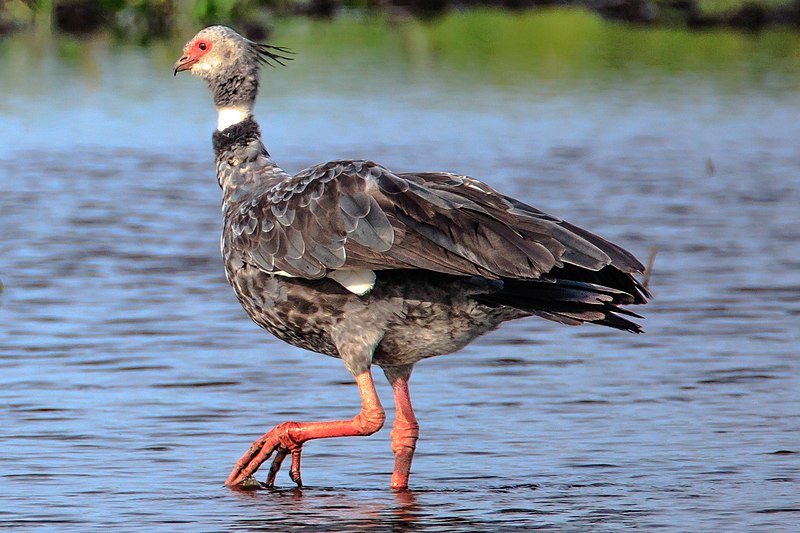
File:At_Possa_da_Londra_in_the_Brazilian_Patanal_(105m)_-_the_weird_looking_Southern_Screamer_(Chauna_torquata)_-_(24213807344).jpg · Wikimedia Commons · See Wikimedia Commons
Anhimidae
Sign in to saveAlso known as Screamer
The screamers are three South American bird species placed in family Anhimidae. They were thought to be related to the Galliformes because of similar bills, but are more closely related to the family Anatidae, i.e. ducks and allies, and the magpie goose, within the clade Anseriformes. The clade is exceptional within the living birds in lacking uncinate processes of ribs. The three species are: The horned screamer (Anhima cornuta); the southern screamer or crested screamer (Chauna torquata); and the northern screamer or black-necked screamer (Chauna chavaria).
OverviewAI-generated
Anhimidae is a family of birds within the order Anseriformes. It belongs to the class Aves, phylum Chordata, and kingdom Animalia. The taxon is classified at the family rank with the scientific name Anhimidae.
Records for this family are held by several institutions, including DMNS, SDNHM, TTU, and MNHN. These records originate from the United States and Peru. The family has been referenced by 355 other encyclopedia articles.
Synthesized by Vinony from 19 facts across 5 sources: Wikidata, GBIF, Gbif Occ, iDigBio, Vinony graph. Generated from structured data (not the Wikipedia text) and checked against those facts — may still contain errors.
Species
Anhimidae
FAMILY
- KingdomAnimalia
- PhylumChordata
- ClassAves
- OrderAnseriformes
- FamilyAnhimidae
Die Wehrvögel (Anhimidae) sind eine Familie südamerikanischer Gänsevögel (Anseriformes), die drei Arten umfasst. Obwohl sie in der Gestalt eher truthuhnartig wirken, sind sie die nächsten Verwandten der Entenvögel. Zu ihren für Gänsevögel ungewöhnlichen Merkmalen zählen der hühnervogelartige Schnabel, die nur partiell ausgebildeten Schwimmhäute zwischen den Zehen, die allmähliche Mauser der Flugfedern, so dass sie ihre Flugfähigkeit anders als die meisten Gänsevögel nie verlieren, sowie ein einzigartiges Netz an Luftsäcken direkt unter der Haut. Bekannt sind Wehrvögel für ihre außerordentlich lautstarken Rufe, die ihnen im Englischen zum Namen Screamers (Schreier) verholfen haben. Inhaltsverzeichnis 1 Merkmale 2 Verbreitung und Lebensraum 3 Lebensweise 3.1 Aktivität 3.2 Ernährung 3.3 Fortpflanzung 4 Stammesgeschichte 5 Systematik 6 Wehrvögel und Menschen 7 Quellen und weiterführende Informationen 7.1 Zitierte Quellen 7.2 Literatur 7.3 Weblinks Merkmale Auf den ersten Blick ähneln Wehrvögel eher Hühnervögeln als den eigentlich verwandten Entenvögeln. Neben der plumpen Körperform ist dafür vor allem der kleine Kopf mit dem kurzen Schnabel verantwortlich. Die zwischen 75 und 95 cm gro
via GBIF
Museum specimens
- Specimen records
- 4
- Family
- Anhimidae
- Collections
- DMNS, SDNHM, TTU, MNHN
- Recorded in
- United States, Peru
Wikidata facts
- Instance of
- taxon
- Parent taxon
- Anseriformes
- Image
- Anhima cornuta -near Manu Wildlife Center, Manu National Park, Peru -three-8.jpg
Show 9 more facts
- Commons category
- Anhimidae
- taxon rank
- family
- taxon name
- Anhimidae
- Code of nomenclature
- International Code of Zoological Nomenclature
- topic's main category
- Category:Anhimidae
- Commons gallery
- Anhimidae
- described by source
- Encyclopædia Britannica 11th edition
- taxon range
- Brazil
- taxon common name
- bodičarke
Sources (2)
via Wikidata · CC0
~4 min read
Encyclopedic overview
6 sectionsContents
- Systematics and evolution
- Distribution and habitat
- Behaviour and ecology
- Status and conservation
- References
- External links
The screamers are three South American bird species placed in family Anhimidae. They were thought to be related to the Galliformes because of similar bills, but are more closely related to the family Anatidae, i.e. ducks and allies, and the magpie goose, within the clade Anseriformes. The clade is exceptional within the living birds in lacking uncinate processes of ribs. The three species are: The horned screamer (Anhima cornuta); the southern screamer or crested screamer (Chauna torquata); and the northern screamer or black-necked screamer (Chauna chavaria).
==Systematics and evolution== Anhimids are most similar to presbyornithids, with which they may form a clade to the exclusion of the rest of Anseriformes. Given the presence of lamelae in the otherwise fowl-like beaks of screamers, it is even possible that they evolved from presbyornithid-grade birds, reverting from a filter-feeding lifestyle to an herbivorous one.
Excerpted from Wikipedia’s “Anhimidae” article, available under the CC BY-SA 4.0 licence.