Logan, Alan;Bitner, Maria Aleksandra
Argyrotheca
Sign in to saveArgyrotheca is a genus of very small to minute lampshells (maximum long). All species share a large pedicel opening (or foramen), one ridge on the inside of the pedunculate valve, pits in a diamond pattern on the inside of both valves, and without radial ridges that end in tubercles. It occurs in depths between 6 and 1300 m. It is known since the latest Cretaceous.
Species
GENUS
- KingdomAnimalia
- PhylumBrachiopoda
- ClassRhynchonellata
- OrderTerebratulida
- FamilyMegathyrididae
via GBIF
Museum specimens
- Specimen records
- 232
- With media
- 26
- Family
- Megathyrididae
- Collections
- USNM, PRI, UF
- Recorded in
- Mexico, United States, Belize, France, Bermuda, Peru, Antigua, Indonesia
Wikidata facts
- Instance of
- taxon
- Parent taxon
- Megathyrididae
- Image
- Argyrotheca cuneata brachial valve.jpg
Show 4 more facts
- Commons category
- Argyrotheca
- taxon name
- Argyrotheca
- taxon rank
- genus
- topic's main category
- Category:Argyrotheca
Sources (1)
via Wikidata · CC0
~9 min read
Encyclopedic overview
15 sectionsContents
- Description
- Differences with related genera
- Taxonomy
- Reassigned species
- Ecology
- Reproduction
- Attachment
- Predation
- Distribution
- Species
- ''A. ageriana''
- ''A. cistellula''
- ''A. cuneata''
- ''A. jacksoni''
- References
Argyrotheca is a genus of very small to minute lampshells (maximum long). All species share a large pedicel opening (or foramen), one ridge on the inside of the pedunculate valve, pits in a diamond pattern on the inside of both valves, and without radial ridges that end in tubercles. It occurs in depths between 6 and 1300 m. It is known since the latest Cretaceous.
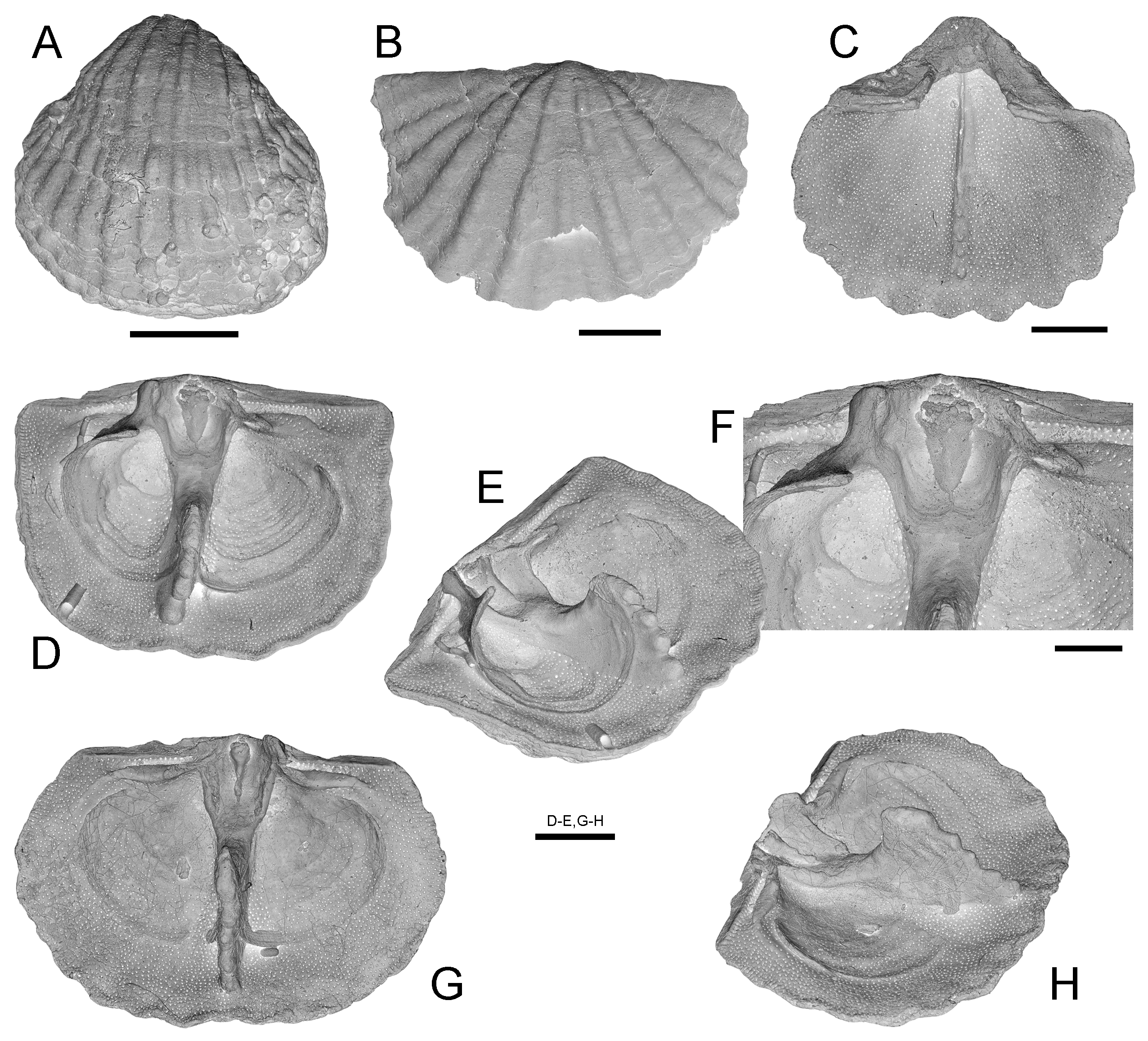
== Description == thumb|left|Argyrotheca cuneata, interior of the shell: A = cardinal muscle, B = adductor muscle, C = pedicle muscle, D = mouth (bottom)Some Argyrotheca species have red stripes radiating from the pedicle opening (or foramen). These species are among a few living brachiopods with color marking on the shell. All other colored brachiopods are from shallow water too. This kind of color patterns may be a form of camouflage. Argyrotheca is fastened by a very short and thick stalk. The shell is biconvex with two high and wide ribs radiating close to the midline (a shell-shape called strangulate) and four radiating ribs of declining height and width further lateral (a shell-shape called oppositely multiplicate), smooth or more commonly multiplicate. The inner surface of the shell has many rather coarse pits (or punctae). The larger valve (pedicle valve or ventral valve) has a fairly short stump beak (or subtruncate). The pedicle opening (or foramen) is large (about a third of the maximum with of the shell), almost entirely situated in the backfolding part (or delthyrium) of the pedicle valve (submesothyridid to almost hypothyridid), leaving ample space for the small deltidial plates. The pedicle collar is well developed, and is supported by median ridge (or septum).The lophophore is large.
Excerpted from Wikipedia’s “Argyrotheca” article, available under the CC BY-SA 4.0 licence.