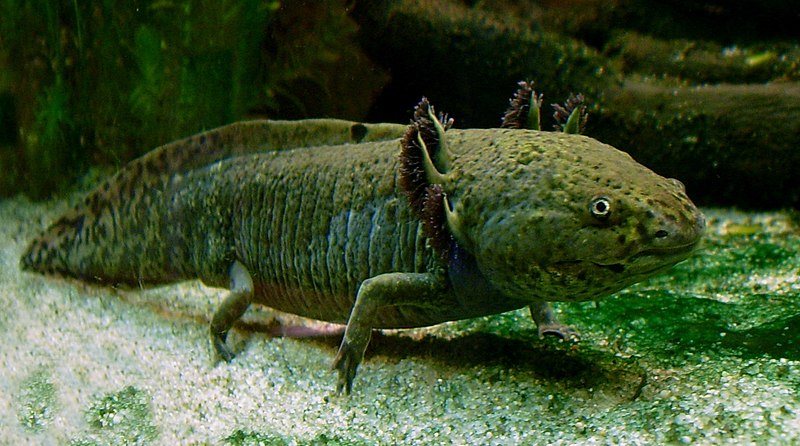
File:Axolotl_ganz.jpg · Wikimedia Commons · See Wikimedia Commons
axolotl
Sign in to saveAlso known as Ambystoma mexicanum, Axolotus pisciformis, siredon, mud-puppy, Mexican salamander
The axolotl (; from ; Ambystoma mexicanum) is a species of paedomorphic mole salamander. They mature into their terrestrial adult form without undergoing metamorphosis; the adults remain fully aquatic with obvious external gills. This trait, although somewhat unusual among the majority of amphibians, is not unique. Axolotls may be difficult to distinguish from the larval stage of other neotenic adult mole salamanders, such as mudpuppies (Necturus spp.) or the occasionally paedomorphic tiger salamander (A. tigrinum).
OverviewAI-generated
The axolotl, scientifically named *Ambystoma mexicanum*, is a species within the family Ambystomatidae. It belongs to the order Caudata, class Amphibia, and phylum Chordata. The taxon was described by Shaw & Nodder in 1798 and holds an accepted status in biological records. This organism inhabits freshwater environments.
Individual axolotls have a length of 18 and a mass of 8. The species is currently classified as Critically Endangered according to the 2020 IUCN Red List assessment. Scientific literature includes 4239 PubMed entries related to the axolotl. Additionally, the subject is referenced by 237 other encyclopedia articles.
Synthesized by Vinony from 24 facts across 6 sources: Wikidata, PubMed, WoRMS, IUCN Red List, iDigBio, Vinony graph. Generated from structured data (not the Wikipedia text) and checked against those facts — may still contain errors.
Species
Critically EndangeredSpecies
- PhylumChordata
- ClassAmphibia
- OrderCaudata
- FamilyAmbystomatidae
via IUCN
Research
4,239 papersvia PubMed
Wikidata facts
- Instance of
- model organism
- Parent taxon
- Ambystoma
- Mass
- 8
- Image
- 6 maja 06 r. ZOO 204.jpg
- Length
- 18
Show 10 more facts
- Commons category
- Ambystoma mexicanum
- Commons gallery
- Ambystoma mexicanum
- taxon common name
- axolote
- described by source
- Encyclopædia Britannica 11th edition
- exact match
- wordnet-rdf.princeton.edu/wn31/101635522-n
- taxon rank
- species
- IUCN conservation status
- Critically Endangered
- taxon name
- Ambystoma mexicanum
- social media followers
- 105156
- short name
- A. mexicanum
Sources (9)
via Wikidata · CC0
~29 min read
Encyclopedic overview
18 sectionsContents
- Nomenclature
- Description
- Physiology
- Regeneration
- Neoteny
- Metamorphosis
- Wild population
- Biology
- Threats
- Conservation efforts
- Relation to humans
- Research history
- Use as a model organism
- Captive care
- Cultural significance
- See also
- References
- External links
The axolotl (; from ; Ambystoma mexicanum) is a species of paedomorphic mole salamander. They mature into their terrestrial adult form without undergoing metamorphosis; the adults remain fully aquatic with obvious external gills. This trait, although somewhat unusual among the majority of amphibians, is not unique. Axolotls may be difficult to distinguish from the larval stage of other neotenic adult mole salamanders, such as mudpuppies (Necturus spp.) or the occasionally paedomorphic tiger salamander (A. tigrinum).
Axolotls originally inhabited a system of interconnected wetlands and lakes in the highlands of Mexico. They were known to inhabit the smaller lakes of Xochimilco and Chalco and are presumed to have inhabited the larger lakes of Texcoco and Zumpango. These waterways were mostly drained by Spanish settlers after the conquest of the Aztec Empire, leading to the destruction of much of the axolotl's natural habitat, an area now largely occupied by Mexico City. Despite this, they remained abundant enough to form part of the staple in the diet of native Mexica during the colonial era. Today, due to continued urbanization in Mexico City, which causes pollution in the remaining waterways, as well as the introduction of invasive species such as tilapia and carp, the axolotls are now near extinction. The species has been listed as critically endangered in the wild, with a decreasing population of around 50 to 1,000 adult individuals, by the International Union for Conservation of Nature (IUCN), and is listed under Appendix II of the Convention on International Trade in Endangered Species (CITES).
Excerpted from Wikipedia’s “axolotl” article, available under the CC BY-SA 4.0 licence.
Gallery (28)
Available in 76 languages
- Español
- Français
- Deutsch
- 中文
- 日本語
- Русский
- Português
- Italiano
- العربية
- Afrikaans
- Albanian
- Asturian
- Azerbaijani
- Bahasa Indonesia
- Balinese
- Bangla
- Basque
- be_x_old
Show 57 more
- Belarusian
- Breton
- Bulgarian
- Catalan
- Cebuano
- Croatian
- Czech
- Danish
- Egyptian Arabic
- Esperanto
- Estonian
- Filipino
- Finnish
- Galician
- Greek
- Hebrew
- Hungarian
- Icelandic
- Ido
- Interlingua
- Irish
- Javanese
- Kashmiri
- Kazakh
- Latin
- Latvian
- Macedonian
- Malay
- Malayalam
- nah
- Navajo
- Nederlands
- Norwegian
- Occitan
- Palatine German
- Polski
- Quechua
- Romanian
- Saterland Frisian
- Scots
- Serbian
- simple
- Sinhala
- Slovak
- Svenska
- Swahili
- Tiếng Việt
- Türkçe
- Ukrainian
- Uzbek
- Waray
- Welsh
- Wu Chinese
- zh_yue
- فارسی
- ไทย
- 한국어
via Wikidata sitelinks · CC0