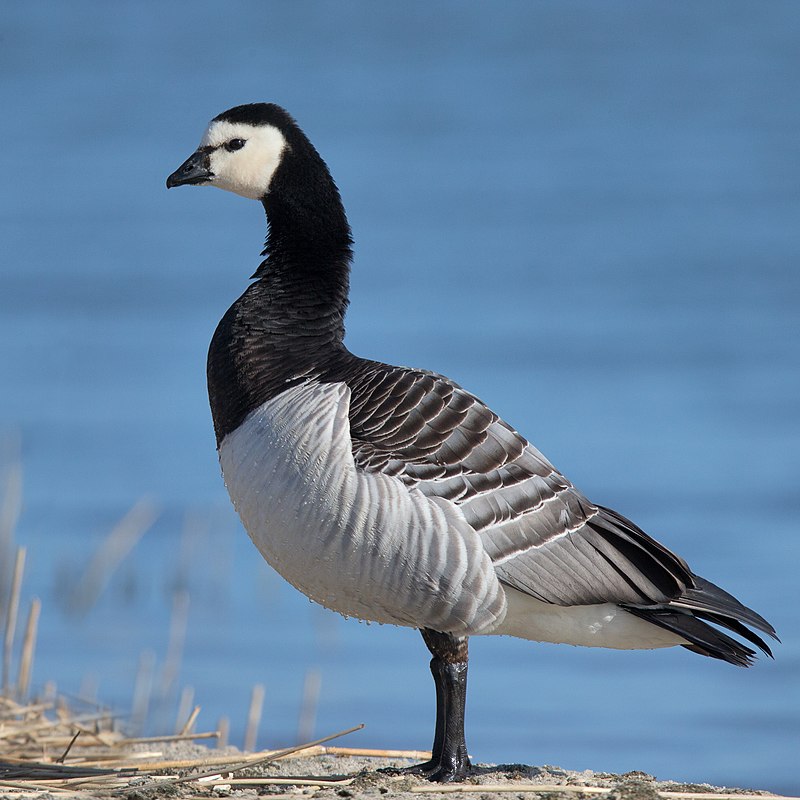
File:Barnacle-Goose.jpg · Wikimedia Commons · See Wikimedia Commons
OverviewAI-generated
The barnacle goose (Branta leucopsis) is a species within the family Anatidae and order Anseriformes. It belongs to the class Aves and phylum Chordata, with the genus Branta serving as its parent taxon. The scientific name was established by Bechstein in 1803. Other common names for this bird include Weißwangengans, Barnacla cariblanca, and Bernache nonnette.
This species inhabits freshwater environments. Its listed range includes Africa. The barnacle goose has a wingspan of 1.08 and a mass of 107, with a litter size of 4.5. The taxon is distinct from Pedunculata.
The IUCN Red List assessed the species as Least Concern in 2018. The taxonomic status is accepted.
Synthesized by Vinony from 26 facts across 4 sources: Wikidata, WoRMS, IUCN Red List, Vinony graph. Generated from structured data (not the Wikipedia text) and checked against those facts — may still contain errors.
Species
Least Concernbarnacle goose
Species
- PhylumChordata
- ClassAves
- OrderAnseriformes
- FamilyAnatidae
Die Weißwangengans oder Nonnengans (Branta leucopsis) ist eine Art der Gattung Meergänse (Branta) in der Familie der Entenvögel (Anatidae). Sie wird nicht in Unterarten, jedoch in drei getrennte Populationen aufgeteilt. Der Verein Jordsand hat diese Vogelart zum Seevogel des Jahres 2021 gekürt. Die Weißwangengans brütete früher ausschließlich an der russischen Eismeerküste. Seit den 1970er Jahren hat sie auch den Ostseeraum besiedelt und zählt mittlerweile zu den Brutvögeln Mitteleuropas. Sie ist nach wie vor jedoch überwiegend ein Wintergast, der meist als Einzelvogel oder in kleinen Trupps in Gesellschaft von Saat- und Blässgänsen beobachtet werden kann.[1] Zu Beginn des Zuges sammeln sie sich dagegen zu gewaltigen Schwärmen, die bis zu 50.000 Tiere zählen können. Zu den Merkmalen dieser Gänseart zählt eine enge Bindung an die Meeresküsten, die besonders im Winter ausgeprägt ist.[2] Sie brüten in Kolonien unterschiedlicher Größe auf Felsvorsprüngen an der Meeresküste und an Flüssen. Die Kolonien finden sich dabei häufig in unmittelbarer Nähe von Greifvogelhorsten. Inhaltsverzeichnis 1 Erscheinungsbild 1.1 Adulte Vögel 1.2 Jungvögel 2 Stimme 3 Lebensweise 4 Ernährung 5 Verbreitung
via IUCN
Wikidata facts
Show 11 more facts
- taxon rank
- species
- IUCN conservation status
- Least Concern
- taxon name
- Branta leucopsis
- Commons category
- Branta leucopsis
- Commons gallery
- Branta leucopsis
- wingspan
- 1.08
- litter size
- 4.5
- different from
- Pedunculata
- short name
- B. leucopsis
- taxon common name
- ganso-de-faces-brancas
- taxon range
- Africa
Sources (9)
via Wikidata · CC0
~10 min read
Encyclopedic overview
The barnacle goose (Branta leucopsis) is a species of goose that belongs to the genus Branta of black geese, which contains species with extensive black in the plumage, distinguishing them from the grey Anser species. Despite its superficial similarity to the brant goose, genetic analysis has shown its closest relative is the cackling goose.
Taxonomy and naming
Excerpted from Wikipedia’s “Barnacle goose” article, available under the CC BY-SA 4.0 licence.
Gallery (12)
Available in 66 languages
- Español
- Français
- Deutsch
- 中文
- 日本語
- Русский
- Português
- Italiano
- العربية
- Afrikaans
- Aragonese
- Asturian
- Bahasa Indonesia
- Bangla
- Basque
- Belarusian
- Breton
- Bulgarian
Show 47 more
- Catalan
- Cebuano
- Czech
- Danish
- Egyptian Arabic
- Esperanto
- Estonian
- Faroese
- Finnish
- Galician
- Hebrew
- Hungarian
- Icelandic
- Irish
- Latin
- Latvian
- Lithuanian
- Low German
- Navajo
- Nederlands
- Northern Frisian
- Northern Sami
- Norwegian
- Norwegian Nynorsk
- olo
- Picard
- Piedmontese
- Polski
- Romanian
- Scots
- Scottish Gaelic
- Serbian
- simple
- Slovak
- Svenska
- Tiếng Việt
- Türkçe
- Ukrainian
- Urdu
- Waray
- Welsh
- Western Frisian
- Wu Chinese
- Zeelandic
- zh_yue
- فارسی
- 한국어
via Wikidata sitelinks · CC0