Burundi
Sign in to saveAlso known as Republic of Burundi, bi, Republika y'Uburundi, Gouvernement du Burundi
Burundi, officially the Republic of Burundi, is a landlocked country in East Africa. It is located in the Great Rift Valley at the junction between the African Great Lakes region and Southeast Africa, with a population of over 14 million people. It is bordered by Rwanda to the north, Tanzania to the east and southeast, and the Democratic Republic of the Congo to the west; Lake Tanganyika lies along its southwestern border. The political capital city is Gitega and the economic capital and largest city is Bujumbura.
OverviewAI-generated
Burundi, officially the Republic of Burundi, is a landlocked sovereign state in Eastern Africa. It shares borders with the Democratic Republic of the Congo, Rwanda, and Tanzania. The country’s highest point is Mount Heha. Its capital is Gitega, though Bujumbura is also listed as a capital. The official languages are Kirundi, French, and English. The currency is the Burundian franc.
The nation is a member of the United Nations, African Union, World Trade Organization, and International Bank for Reconstruction and Development. Its head of state is Évariste Ndayishimiye, and its head of government includes Évariste Ndayishimiye and Gervais Ndirakobuca. Burundi has a population of 12,332,788 and covers an area of 27,834. The top-level Internet domain is .bi.
Administrative entities within Burundi include Bubanza Province, Bujumbura Mairie, Bujumbura Rural Province, and Bururi Province. The country is named after Kirundi. It was established in 1924. The telephone country code is 257.
Synthesized by Vinony from 77 facts across 10 sources: Wikidata, REST Countries, Openweathermap, Open Meteo, World Bank, OpenStreetMap, PubMed, ROR, Vinony graph, Geo. Generated from structured data (not the Wikipedia text) and checked against those facts — may still contain errors.
Weather now
cached 22h ago7-day forecast
via Open-Meteo
Country
- Capital
- Gitega
- Population
- 12,332,788
- Region
- Africa · Eastern Africa
- Demonym
- Burundian
- Currencies
- BIF (Fr)
- Languages
- French, Kirundi
- Calling code
- +257
- Drives on
- Right
- Gini
- 38.6 (2013)
- FIFA code
- BDI
- TLD
- .bi
- Timezones
- UTC+02:00
- Borders
- COD, RWA, TZA
via REST Countries
Indicators · World Bank
- GDP
- $3.1B(2024)
- Population
- 14,047,786(2024)
- Life expectancy
- 63.8 yrs(2024)
- Unemployment
- 0.9 %(2025)
- Urban population
- 24.8 %(2024)
- Internet users
- 8.6 %(2024)
- Forest area
- 10.9 %(2023)
- Renewable energy
- 83 %(2022)
via World Bank Open Data · CC BY 4.0
Wikipedia views (30d)
77,867 totalvia Wikimedia Pageviews API
Key facts
- Country.conventional_long_name
- Republic of Burundi
- Country.common_name
- Burundi
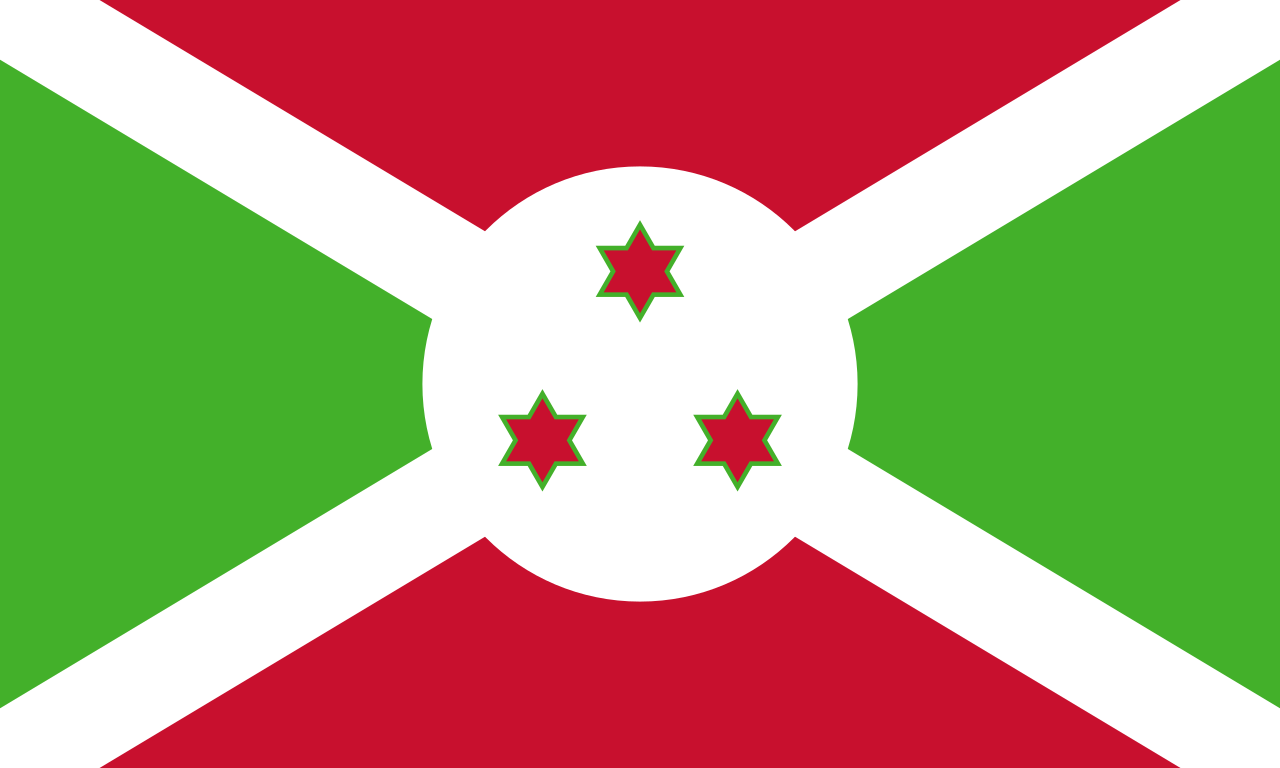
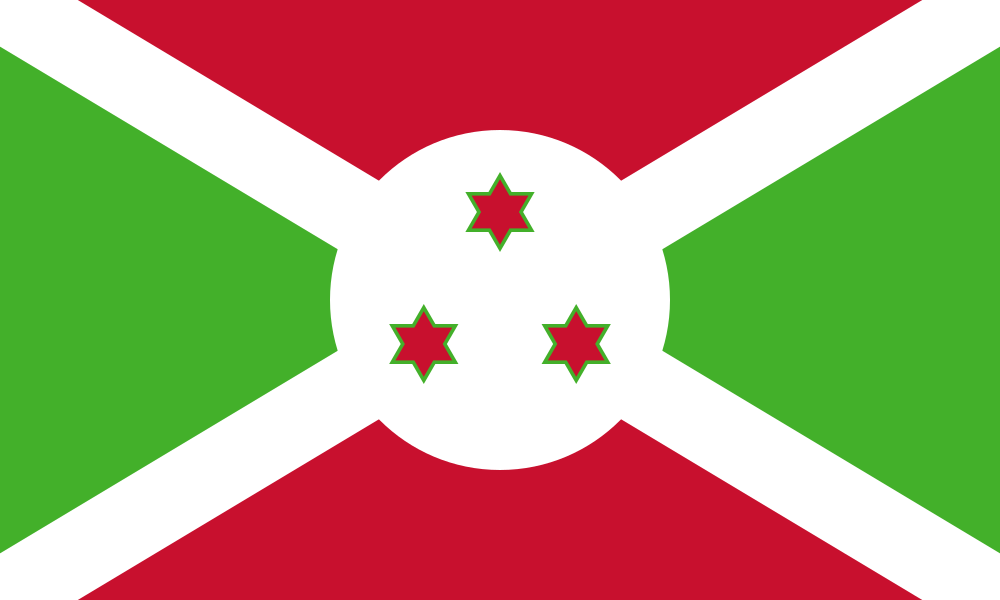
- Country.image_flag
- Flag of Burundi.svg
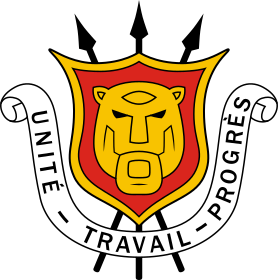
- Country.image_coat
- Coat of arms of Burundi.svg
- Country.map_caption
- Location of Burundi (dark blue) in Africa (light blue)
- Country.national_anthem
- "Our Burundi" File:Burundi Bwacu.ogg
- Country.national_languages
- Kirundi
- Country.capital
- Gitega
- Country.largest_city
- Bujumbura
- Country.demonym
- Burundian
- Country.government_type
- Unitary dominant-party presidential republic under an authoritarian dictatorship
- Country.leader_title1
- President
- Country.leader_name1
- Évariste Ndayishimiye
- Country.leader_title3
- Vice President
- Country.leader_name3
- Prosper Bazombanza
- Country.leader_title2
- Prime Minister
- Country.leader_name2
- Nestor Ntahontuye
- Country.legislature
- Parliament
via Wikipedia infobox
Research
2,129 papers- Burundi.Department of State publication. Background notes series · 1991United States. Department of State. Bureau of Public Affairs
- Management of cancer disease in Burundi, a health challenge.Bulletin du cancer · 2023Bagorane J, Negamiyimana G, Kwizera J et al.DOI: 10.1016/j.bulcan.2022.11.004
- Burundi.Department of State publication. Background notes series · 1985United States. Department of State. Bureau of Public Affairs
- Burundi.Department of State publication. Background notes series · 1988United States. Department of State. Bureau of Public Affairs
- [Burundi].Jeune Afrique (Paris, France : 1980) · 1996
- [Burundi].L' Infirmiere · 1970Nyonzina M
- Malaria, Burundi.Releve epidemiologique hebdomadaire · 2001
- Burundi Cancer Care Needs: A Call to Action.The oncologist · 2020Manirakiza AVC, Rubagumya F, Ngendahayo LDOI: 10.1634/theoncologist.2020-0410
via PubMed
Research organization · ROR
- Type
- Funder, Government
- Founded
- 1924
- Location
- Bujumbura, Burundi
- Also known as
- Gouvernement du Burundi, Republika y'Uburundi
- Status
- Active
GRID grid.453543.0 · ISNI 0000 0001 2097 7669
Wikidata facts
- Instance of
- country
- Named after
- Kirundi
- Official name
- Uburundi
- Demonym
- Burúnach
- Country
- Burundi
- Contains
- Muramvya Province
- Continent
- Africa
- Capital
- Bujumbura
- Official language
- English language
- Currency
- Burundian franc
- Population
- 13689450
- Area
- 27834
- Time zone
- UTC+02:00
- Head of government
- Gervais Ndirakobuca
- Head of state
- Évariste Ndayishimiye
- Form of government
- presidential system
- Legislature
- Parliament of Burundi
- Anthem
- Burundi Bwacu
- Shares border with
- Tanzania
- Highest point
- Mount Heha
- Headquarters
- Bujumbura
- Follows
- Kingdom of Burundi
- Official website
- www.presidence.gov.bi
Show 64 more facts
- Image
- By-map-fr.png
- Life expectancy
- 57.481
- Nominal GDP
- 2642161668
- Unemployment rate
- 7
- Calling code
- +257
- Licence plate code
- RU
- Mains voltage
- 220
- Motto
- Unité, Travail, Progrès
- Flag
- flag of Burundi
- Coat of arms
- coat of arms of Burundi
- topic's main Wikimedia portal
- Portal:Burundi
- top-level Internet domain
- .bi
- Commons category
- Burundi
- member of
- African Continental Free Trade Area
- topic's main category
- Category:Burundi
- category for people born here
- Category:Births in Burundi
- category for people who died here
- Category:Death in Burundi
- category for films shot at this location
- Category:Films shot in Burundi
- category of associated people
- Category:Burundian people
- diplomatic relation
- Georgia (country)
- Commons gallery
- Burundi
- mobile country code
- 642
- lowest point
- Lake Tanganyika
- driving side
- right
- geography of topic
- Geography of Burundi
- central bank
- Bank of the Republic of Burundi
- age of majority
- 21
- marriageable age
- 18
- short name
- Burundi
- office held by head of government
- Prime Minister of Burundi
- number of out-of-school children
- 857183
- office held by head of state
- President of Burundi
- total fertility rate
- 5.948
- maritime identification digits
- 609
- inception
- 1962-07-01
- Unicode character
- 🇧🇮
- native label
- Uburundi
- language used
- Kirundi
- literacy rate
- 61.6
- suicide rate
- 7.1
- history of topic
- history of Burundi
- culture
- culture of Burundi
- VAT rate
- 18
- BTI Status Index
- 3.38
- BTI Governance Index
- 3.25
- economy of topic
- economy of Burundi
- replaces
- Kingdom of Burundi
- demographics of topic
- demographics of Burundi
- Democracy Index
- 2.14
- Human Development Index
- 0.426
- P11012
- Usedom
- hashtag
- Burundi
- on focus list of Wikimedia project
- Wikipedia:Vital articles/Level/4
- Gini coefficient
- 38.6
- Happy Planet Index score
- 37.7
- Inequality-adjusted Human Development Index
- 0.302
- birth rate
- 34.109
- male population
- 6400926
- death rate
- 7.311
- rural population
- 11031286
- female population
- 6488650
- urban population
- 1858290
- P8168
- chac mool
- located in/on physical feature
- East Africa
Sources (15)
via Wikidata · CC0
Travel guide
Understand
Burundi is about large and has a population of almost 12 million people, making it one of the smallest countries in the world. Although the country is landlocked, much of the south-western border is adjacent to Lake Tanganyika, one of the deepest lakes in the world.
The region was colonised in the 19th century as part of German East Africa, then taken by Belgium after the First World War. It became independent in 1962.
Burundi is one of the poorest and least developed nations in the world. The vast majority of Burundians live in poverty and work as subsistence farmers. There are many reasons behind Burundi's lack of development and poverty: civil wars, political instability, corruption, a lack of access to education, and the effects of HIV/AIDS.
Cobalt and copper are among the nation's natural resources. Other resources include coffee, sugar and tea.
Burundi's population today is mostly comprised of the Hutu ethnic group (85%) followed by the Tutsi (14%) and Twa (1%).
Get in
thumb|375px|Visa policy of Burundi thumbnail|The road between Gitega and Bujumbura
Get around
thumbnail|Bus and Taxi station in Gitega Road and water transport are the main ways for getting around. There are no railways in the country, and the airport in Bujumbura is the only one with scheduled flights (all international).
See
thumbnail|Gitega Church thumbnail|The road to Bujumbura thumbnail|School in Gitega, Burundi Bujumbura is in the western part of the country. Moving towards the east, is Gitega; it’s a large market held in the middle of the town, and its Museum of Traditions (ancient utensils, pictures, commented visit). Travellers will have to make advance bookings to be able to watch an extraordinary and fascinating show unique in the world: “The Drummers of Giheta” playing in their traditional environment. Then you will be making head away towards Rutana to see the admirable panorama of the Karea Falls and the Nyakazu Break, called the “Break of the Germans”, which is an exceptional lookout that oversees the Kumoso plain. You will be ending your tour by the visit of Gihofi, a booming town with its new sugar refinery in the heart of the sugar cane plantations country.
Towards the South-eastern part of the country, don’t miss by any means the visit of the Nile Sources near Rutovu. Don’t forget to take your swimming gear with you; otherwise, you may miss the benefit of the hot springs in charming and subtle surroundings. You will also be able to see on your way the last traditional enclosed villas (round habitations surrounded by wooden fences strip in turn surrounded by grazing meadows and ploughed fields).
Further south, you will be able to cross a line of villages succeeding one after the other and wedged between the lake and abrupt mountains. Fortunately, you will be able to stop and hav…
Eat
thumbnail|Pineapple market in Burundi thumbnail|Rice farm in Burundi thumbnail|Village road in Burundi For the international visitor, Burundi offers some culinary surprises: fresh fish from Lake Tanganyika and produce from the nation's rich volcanic soil are particularly notable. There is a sizeable South Asian community, offering curried dishes alongside the more traditional rice and beans, and French-inspired European offerings. For lighter meals, samosas and skewered meats are common, and bananas and fresh fruit are often served as a sweet snack.
The national dish is beef brochettes (kebabs) and grilled plantains (cooking bananas) available almost everywhere.
Other signature dishes are: Mealie-Meal Porridge Sangala fish garnished with onions and stewed beef
Drink
Soft drinks and beer are readily available. As in Rwanda and DRC, big 72 cl Primus bottles are available for between USD1-2 as well as Amstel, which is about USD2. Both are locally produced and of good quality.
Sleep
Although accommodation in rural areas can be basic, Bujumbura hosts a number of international-grade hotels, catering to a mainly UN and international clientèle. Notable hotels include the Source du Nil (USD120/night), the Hotel Botanika (USD85/night), the Clos de Limbas (USD70/night) and the new, anglophone Sun Safari.
A cheaper option is the Camel Africa Hotel in Bujumbura at USD9 a night.
Stay safe
Although some semblance of normality has returned to much of the country with the conclusion of the nation's democratic transition and a democratically chosen head of state in 2005, travellers should be warned that there is still significant insecurity throughout the country and exercise extreme caution. Besides the still-active rebel group, the Forces Nationales de la Libération (FNL) that continues to attack government forces and civilians, threats posed by banditry and armed robbery, as well as petty crimes, remain. Visitors should exercise caution, avoid travelling after dark, and be aware of curfew laws. Many roads close at night, and most embassies put out curfews on their staff. As in any other conflict or post-conflict situation, visitors should consult their embassy to be apprised of the latest local developments, and be sensitive to the changing security environment.
Stay healthy
Be careful of kiosk foods and avoid unboiled water. Also ensure you have been vaccinated.
As in many other African countries, HIV infection is widespread. In 2012, UNICEF estimated that 1.3% of the adult population is living with HIV.
Respect
As is the case in all African countries, Burundi is a hierarchial society, which means that respect for elders is important. Always treat an older person/authority figure with a great degree of respect, and do not do anything that would make an older person/authority figure feel challenged.
Burundians are family-oriented. It's common for Burundian parents to be intimiately involved in the lives of their children, and they aim to school their children in proper behavior, communal values, and family values. Passing unwarranted comments and/or criticisms about someone's family members is considered rude.
If you've been invited to a Burundian home, you may be showered with snacks and drinks. Do not reject any of these; it's considered rude manners to do so and it could get your host(s) to think that you do not appreciate their hospitality.
Travel guide from Wikivoyage (CC BY-SA 4.0)
~40 min read
Encyclopedic overview
35 sectionsContents
- Etymology
- History
- Kingdom of Burundi
- Colonial rule
- Independence
- Genocides
- Civil war and early democracy project
- Peace agreements
- UN involvement
- Post-conflict reconstruction
- 2015 civil unrest
- Present day
- Government
- Legislative branch
- Administrative divisions
- Human rights
- Geography
- Wildlife
- Economy
- Currency
- Transport
- Demographics
- Languages
- Religion
- Health
- Culture
- Media
- Education
- Science and technology
- See also
- Notes
- References
- Bibliography
- Further reading
- External links
Burundi, officially the Republic of Burundi, is a landlocked country in East Africa. It is located in the Great Rift Valley at the junction between the African Great Lakes region and Southeast Africa, with a population of over 14 million people. It is bordered by Rwanda to the north, Tanzania to the east and southeast, and the Democratic Republic of the Congo to the west; Lake Tanganyika lies along its southwestern border. The political capital city is Gitega and the economic capital and largest city is Bujumbura.
The Twa, Hutu, and Tutsi peoples have lived in Burundi for at least 500 years. For more than 200 of those years, Burundi was an independent kingdom. In 1885, it became part of the German colony of German East Africa. After the First World War and Germany's defeat, the League of Nations mandated the territories of Burundi and neighboring Rwanda to Belgium in a combined territory called Rwanda-Urundi. After the Second World War, this transformed into a United Nations Trust Territory.
Excerpted from Wikipedia’s “Burundi” article, available under the CC BY-SA 4.0 licence.
Gallery (38)
On the map
3 mapped locations
Available in 254 languages
- Español
- Français
- Deutsch
- 中文
- 日本語
- Русский
- Português
- Italiano
- العربية
- हिन्दी
- Abkhazian
- abstract
- Achinese
- Afrikaans
- Akan
- Albanian
- Albanian
- Amharic
Show 235 more
- ami
- Aragonese
- Armenian
- Arpitan
- Assamese
- Asturian
- azb
- Azerbaijani
- Bahasa Indonesia
- Balinese
- Bambara
- Bangla
- Banjar
- Bashkir
- Basque
- bat_smg
- Bavarian
- be_x_old
- Belarusian
- Betawi
- Bhojpuri
- Bikol
- Bishnupriya
- Bislama
- Bosnian
- Breton
- Bulgarian
- Buriat
- Burmese
- Catalan
- cbk_zam
- cdo
- Cebuano
- Central Kurdish
- Chechen
- Cherokee
- Chuvash
- Cornish
- Corsican
- Crimean Tatar
- Croatian
- Czech
- dag
- Danish
- Dinka
- Divehi
- dty
- Egyptian Arabic
- Esperanto
- Estonian
- Ewe
- Extremaduran
- Faroese
- Fiji Hindi
- Filipino
- Finnish
- fiu_vro
- Fula
- Gagauz
- Galician
- Ganda
- gcr
- Georgian
- Gilaki
- Goan Konkani
- gpe
- Greek
- Guarani
- Gujarati
- Haitian Creole
- Hakka Chinese
- Hausa
- Hebrew
- Hungarian
- hyw
- Icelandic
- Ido
- Igbo
- Iloko
- Inari Sami
- Interlingua
- Interlingue
- Inupiaq
- Irish
- Jamaican Creole English
- Javanese
- Kabyle
- kai
- Kannada
- Kanuri
- Kara-Kalpak
- Kazakh
- kbp
- Kikuyu
- Kinyarwanda
- Kongo
- Kotava
- Kurdish
- Kyrgyz
- Ladino
- Lao
- Latgalian
- Latin
- Latvian
- Ligurian
- Limburgish
- Lingala
- Lingua Franca Nova
- Lithuanian
- lld
- Lombard
- Low German
- Lower Sorbian
- Luxembourgish
- Macedonian
- Malagasy
- Malay
- Malayalam
- Maltese
- Manipuri
- Manx
- Māori
- map_bms
- Marathi
- Mazanderani
- Minangkabau
- Mingrelian
- Mirandese
- Moksha
- Mongolian
- Moroccan Arabic
- nds_nl
- Nederlands
- Nepali
- Newari
- Northern Frisian
- Northern Sami
- Northern Sotho
- Norwegian
- Norwegian Nynorsk
- Novial
- nup
- Obolo
- Occitan
- Old English
- olo
- Oromo
- Ossetic
- Pampanga
- Papiamento
- Pashto
- Picard
- Piedmontese
- Polski
- Punjabi
- Quechua
- roa_rup
- Romanian
- Romansh
- Rundi
- Rusyn
- Samoan
- Sango
- Sanskrit
- Santali
- Sardinian
- Saterland Frisian
- Scots
- Scottish Gaelic
- Serbian
- Serbian (Latin)
- Shan
- Shona
- Sicilian
- Silesian
- simple
- Sindhi
- Sinhala
- Slovak
- Slovenian
- Somali
- Southern Sotho
- Standard Moroccan Tamazight
- Sundanese
- Svenska
- Swahili
- Swati
- szy
- Tachelhit
- Tajik
- Talysh
- Tamil
- Taroko
- Tatar
- tay
- Telugu
- Tibetan
- Tiếng Việt
- Toki Pona
- Tsonga
- Tumbuka
- Türkçe
- Turkmen
- Udmurt
- Ukrainian
- Upper Sorbian
- Urdu
- Uyghur
- Uzbek
- Venetian
- Veps
- Volapük
- Walloon
- Waray
- Welsh
- West Flemish
- Western Frisian
- Western Mari
- Western Panjabi
- Wolof
- Wu Chinese
- Xhosa
- Yakut
- Yiddish
- Yoruba
- Zaza
- Zeelandic
- zh_classical
- zh_min_nan
- zh_yue
- Zhuang
- Zulu
- فارسی
- ไทย
- 한국어
via Wikidata sitelinks · CC0