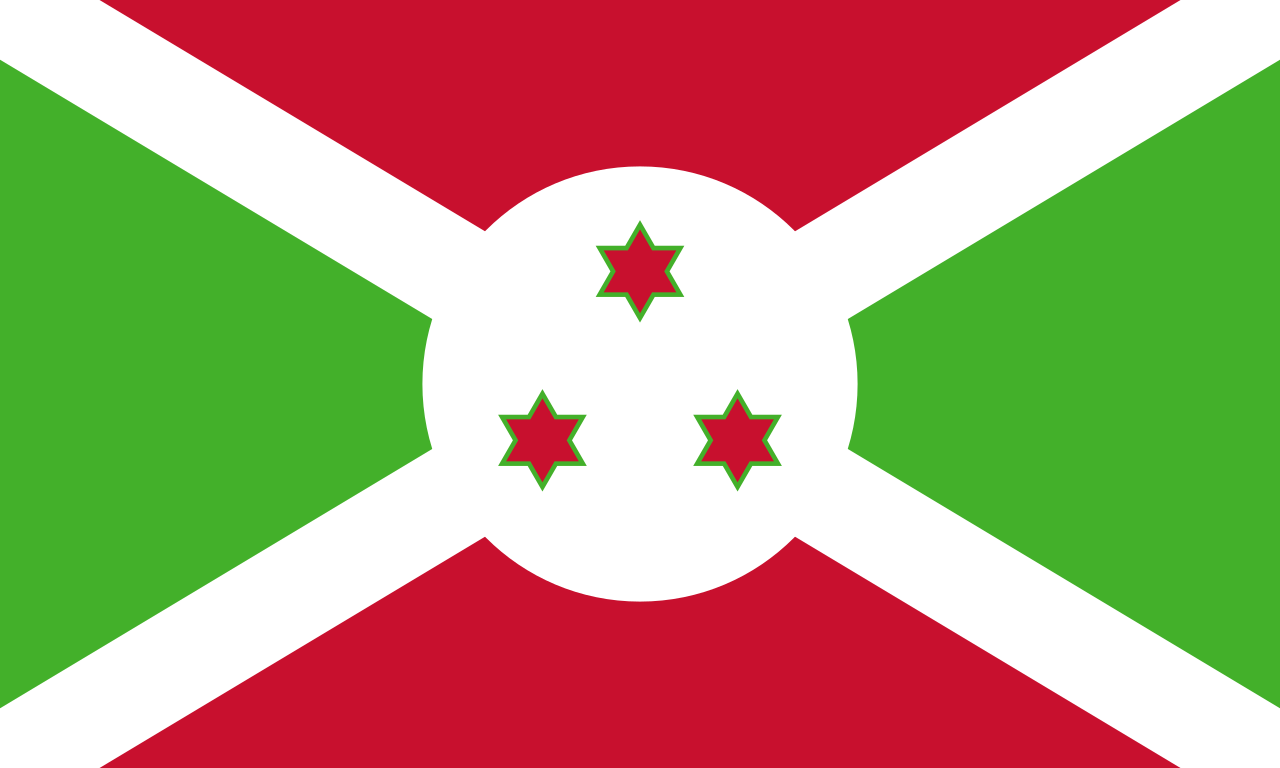
Burundi
Also known as Republic of Burundi, bi, Republika y'Uburundi, Gouvernement du Burundi
país de África
AI overview
Burundi is a landlocked country in East Africa with a population of over 14 million people, bordered by Rwanda, Tanzania, the Democratic Republic of the Congo, and Lake Tanganyika. Its strategic location in the Great Lakes region and its position at the junction between East and Southeast Africa make it an important part of the African continent's geography and regional dynamics.
AI-generated from the Wikipedia summary — may contain errors.
Weather now
19°scattered clouds
53% 2.2 m/s OpenWeatherMap
7-day forecast
via Open-Meteo
Country
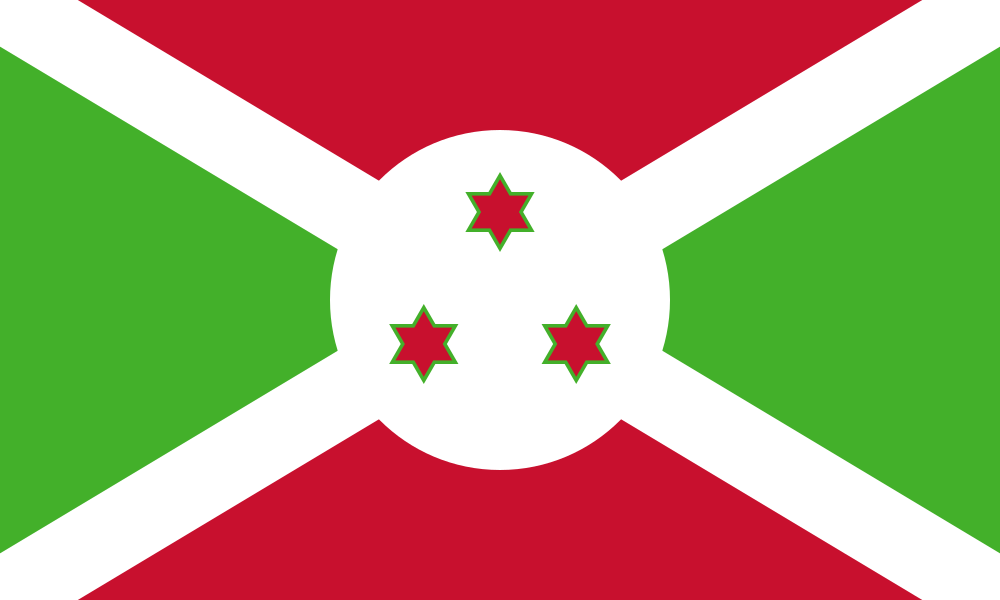
- Capital
- Gitega
- Population
- 12,332,788
- Region
- Africa · Eastern Africa
Travel guide
Understand
Burundi is about large and has a population of almost 12 million people, making it one of the smallest countries in the world. Although the country is landlocked, much of the south-western border is adjacent to Lake Tanganyika, one of the deepest lakes in the world.
The region was colonised in the 19th century as part of German East Africa, then taken by Belgium after the First World War. It became independent in 1962.
Burundi is one of the poorest and least developed nations in the world. The vast majority of Burundians live in poverty and work as subsistence farmers. There are many reasons behind Burundi's lack of development and poverty: civil wars, political instability, corruption, a lack of access to education, and the effects of HIV/AIDS.
Cobalt and copper are among the nation's natural resources. Other resources include coffee, sugar and tea.
Burundi's population today is mostly comprised of the Hutu ethnic group (85%) followed by the Tutsi (14%) and Twa (1%).
Get in
thumb|375px|Visa policy of Burundi thumbnail|The road between Gitega and Bujumbura
Get around
thumbnail|Bus and Taxi station in Gitega Road and water transport are the main ways for getting around. There are no railways in the country, and the airport in Bujumbura is the only one with scheduled flights (all international).
See
thumbnail|Gitega Church thumbnail|The road to Bujumbura thumbnail|School in Gitega, Burundi Bujumbura is in the western part of the country. Moving towards the east, is Gitega; it’s a large market held in the middle of the town, and its Museum of Traditions (ancient utensils, pictures, commented visit). Travellers will have to make advance bookings to be able to watch an extraordinary and fascinating show unique in the world: “The Drummers of Giheta” playing in their traditional environment. Then you will be making head away towards Rutana to see the admirable panorama of the Karea Falls and the Nyakazu Break, called the “Break of the Germans”, which is an exceptional lookout that oversees the Kumoso plain. You will be ending your tour by the visit of Gihofi, a booming town with its new sugar refinery in the heart of the sugar cane plantations country.
Towards the South-eastern part of the country, don’t miss by any means the visit of the Nile Sources near Rutovu. Don’t forget to take your swimming gear with you; otherwise, you may miss the benefit of the hot springs in charming and subtle surroundings. You will also be able to see on your way the last traditional enclosed villas (round habitations surrounded by wooden fences strip in turn surrounded by grazing meadows and ploughed fields).
Article · Español
Burundi, oficialmente República de Burundi (en kirundi, Republika y'u Burundi, pronunciado /buˈɾundi/; en francés, République du Burundi, pronunciado /by.ʁynˈdi/), es un pequeño Estado soberano, ubicado en la región de los grandes lagos en África Oriental, que carece de salida al mar. Limita al norte con Ruanda, al sur y este con Tanzania, y al oeste con la República Democrática del Congo. Tiene una población estimada de 12 889 577 habitantes y su territorio se extiende sobre una superficie de 27 830 km². Su capital es la recientemente establecida Guitega. Otras ciudades importantes son Buyumbura, la ciudad más poblada con 1.000.000 habitantes, y Ngozi. A pesar de carecer de litoral marino, parte de su frontera occidental limita con el lago Tanganica. Los pueblos twa, tutsi y hutu son los más antiguos de Burundi, han ocupado el país desde su formación hace cinco siglos. Burundi fue gobernado como un reino por el pueblo tutsi durante más de doscientos años. Sin embargo, al inicio del siglo XX, Alemania y Bélgica ocuparon la región, y Burundi y Ruanda se convirtieron en una colonia europea conocida como Ruanda-Urundi. El antiguo nombre del país era Urundi-Ubrundi-Bruwanda. Urundi es la abreviación de Urundi Rwanda ("La otra Rwanda"), tal como las fuerzas coloniales belgas solían referirse al territorio. El nombre actual del país proviene del lenguaje bantú kirundi. La inestabilidad política ocurrida en la región debido a diferencias entre los tutsi y los hutu, provocó dos guerras civiles y genocidios en el año 1970 y de nuevo en los años 1990 (véase Guerra civil de Burundi). Actualmente, Burundi es gobernado como una república representativa presidencialista democrática. El 61 % de la población es católica, el 21 % es protestante, el 2,5 % es musulmán «y el porcentaje restante es animista o pertenece a otras denominaciones cristianas.» Burundi es uno de los países más pobres del mundo y en 2021 tuvo el PIB per cápita más bajo del mundo según el Banco Mundial. El PIB de Burundi es bajo debido a las guerras civiles, la corrupción, el pobre acceso a los servicios de educación y salud, una infraestructura débil y los efectos del VIH/sida. Burundi está densamente superpoblada, con una emigración sustancial. El cobalto y el cobre son sus principales recursos naturales, y algunas de las principales exportaciones son azúcar y café. Hoy en día, Burundi sigue siendo una sociedad abrumadoramente rural, con solo el 13 % de la población viviendo en zonas urbanas según datos del 2013 y la ocupación de las poblaciones rurales ha provocado la deforestación masiva, la erosión del suelo y la pérdida de hábitat.
Abstract from DBpedia / Wikipedia · CC BY-SA
Gallery (38)
On the map
3 mapped locations
Connections
Categories
1962 establishments in BurundiBurundiCountries and territories where English is an official languageCountries and territories where French is an official languageCountries and territories where Swahili is an official languageCountries in AfricaCountries in Central AfricaCountries in East AfricaLandlocked countriesLeast developed countriesMember states of the African Union