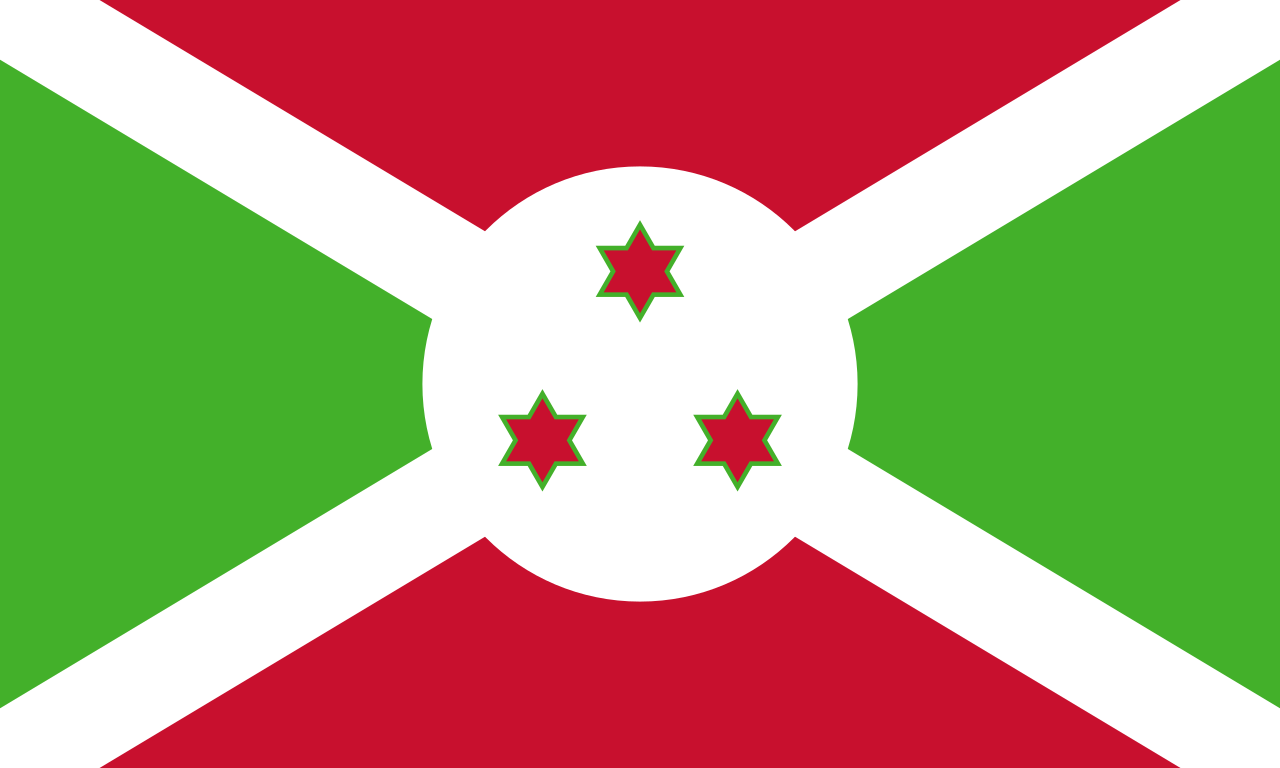
Burundi
Also known as Republic of Burundi, bi, Republika y'Uburundi, Gouvernement du Burundi
stato dell'Africa
AI overview
Burundi is a landlocked country in East Africa with a population of over 14 million people, bordered by Rwanda, Tanzania, the Democratic Republic of the Congo, and Lake Tanganyika. Its strategic location in the Great Lakes region and its position at the junction between East and Southeast Africa make it an important part of the African continent's geography and regional dynamics.
AI-generated from the Wikipedia summary — may contain errors.
Weather now
cached 3h ago19°scattered clouds
53% 2.2 m/s OpenWeatherMap
7-day forecast
via Open-Meteo
Country
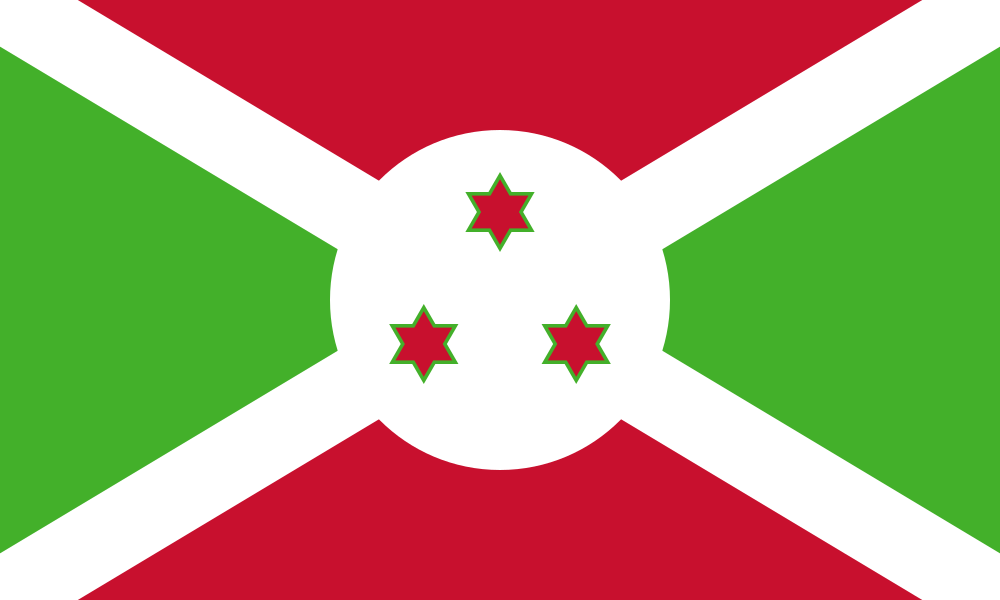
- Capital
- Gitega
- Population
- 12,332,788
- Region
Travel guide
Understand
Burundi is about large and has a population of almost 12 million people, making it one of the smallest countries in the world. Although the country is landlocked, much of the south-western border is adjacent to Lake Tanganyika, one of the deepest lakes in the world.
The region was colonised in the 19th century as part of German East Africa, then taken by Belgium after the First World War. It became independent in 1962.
Burundi is one of the poorest and least developed nations in the world. The vast majority of Burundians live in poverty and work as subsistence farmers. There are many reasons behind Burundi's lack of development and poverty: civil wars, political instability, corruption, a lack of access to education, and the effects of HIV/AIDS.
Cobalt and copper are among the nation's natural resources. Other resources include coffee, sugar and tea.
Burundi's population today is mostly comprised of the Hutu ethnic group (85%) followed by the Tutsi (14%) and Twa (1%).
Get in
thumb|375px|Visa policy of Burundi thumbnail|The road between Gitega and Bujumbura
Get around
thumbnail|Bus and Taxi station in Gitega Road and water transport are the main ways for getting around. There are no railways in the country, and the airport in Bujumbura is the only one with scheduled flights (all international).
See
thumbnail|Gitega Church thumbnail|The road to Bujumbura thumbnail|School in Gitega, Burundi Bujumbura is in the western part of the country. Moving towards the east, is Gitega; it’s a large market held in the middle of the town, and its Museum of Traditions (ancient utensils, pictures, commented visit). Travellers will have to make advance bookings to be able to watch an extraordinary and fascinating show unique in the world: “The Drummers of Giheta” playing in their traditional environment. Then you will be making head away towards Rutana to see the admirable panorama of the Karea Falls and the Nyakazu Break, called the “Break of the Germans”, which is an exceptional lookout that oversees the Kumoso plain. You will be ending your tour by the visit of Gihofi, a booming town with its new sugar refinery in the heart of the sugar cane plantations country.
Towards the South-eastern part of the country, don’t miss by any means the visit of the Nile Sources near Rutovu. Don’t forget to take your swimming gear with you; otherwise, you may miss the benefit of the hot springs in charming and subtle surroundings. You will also be able to see on your way the last traditional enclosed villas (round habitations surrounded by wooden fences strip in turn surrounded by grazing meadows and ploughed fields).
Article · Italiano
Il Burundi (AFI: /buˈrundi/), ufficialmente Repubblica del Burundi, è uno Stato africano di 27.830 km² di superficie che confina con il Ruanda a nord, con la Repubblica Democratica del Congo a ovest, e con la Tanzania a sud ed a est. Si trova nella regione geografica dei Grandi Laghi ed è uno Stato senza sbocco al mare. Politicamente appartiene all'Africa orientale e talvolta all'Africa dei Grandi Laghi. La sua capitale, dal 24 dicembre 2018, è Gitega, mentre precedentemente fu Bujumbura. Abitato fin dai tempi più remoti, conobbe la colonizzazione prima tedesca (Deutsch-Ostafrika), poi belga ed ottenne l'indipendenza nel 1962. Dal 1966 il Burundi è una repubblica presidenziale e l'attuale capo di Stato è il presidente della repubblica Évariste Ndayishimiye. Il Burundi è il paese più povero del mondo in base al PIL nominale pro capite, con un reddito annuale di 622 dollari statunitensi al 2022, ed uno dei paesi con l'indice di sviluppo umano più basso del pianeta.
Abstract from DBpedia / Wikipedia · CC BY-SA
Gallery (38)
On the map
3 mapped locations
Connections
Categories
1962 establishments in BurundiBurundiCountries and territories where English is an official languageCountries and territories where French is an official languageCountries and territories where Swahili is an official languageCountries in AfricaCountries in Central AfricaCountries in East AfricaLandlocked countriesLeast developed countriesMember states of the African Union