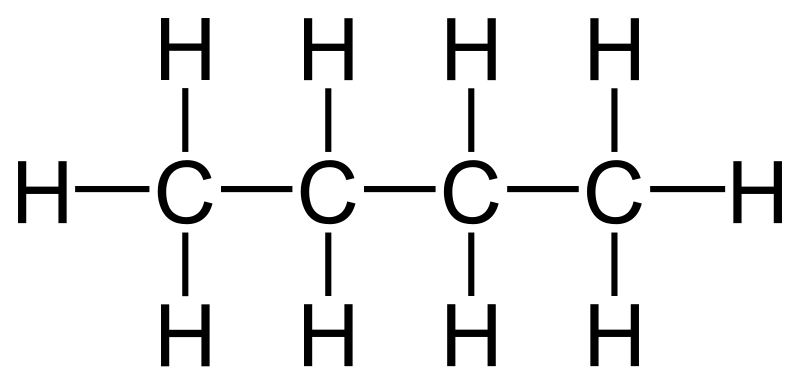
File:Butan_Lewis.svg · Wikimedia Commons · See Wikimedia Commons
butano
Sign in to saveAlso known as n-C4H10, E943a, R-600, E-943a, E 943a, n-butane, normal-butane, butyl hydride
compuesto químico
Butane is a highly flammable gas made of carbon and hydrogen atoms that easily turns into a liquid and then quickly evaporates at room temperature. It occurs naturally in small amounts in natural gas and is also mixed with propane to create liquefied petroleum gas, which is used as a fuel.
AI-generated from the Wikipedia summary — may contain errors.
Chemical data
- Formula
- C4H10
- Molecular weight
- 58.12 g/mol
- IUPAC name
- butane
- SMILES
- CCCC
- InChIKey
- IJDNQMDRQITEOD-UHFFFAOYSA-N
- XLogP
- 2.9
- Polar surface area
- 0 Ų
- H-bond donors
- 0
- H-bond acceptors
- 0
- Formal charge
- 0
via PubChem
Drug data · ChEMBL
- Max clinical phase
- Phase 1
- Molecule type
- Small molecule
- Indications
- essential hypertension
via ChEMBL · EBI
Wikidata facts
- Mass
- 58.07825032
- Autonomy
- 372
- Has use
- Treibgas
Show 22 more facts
- boiling point
- -0.5
- Commons category
- Butane
- canonical SMILES
- CCCC
- chemical formula
- C₄H₁₀
- NIOSH Pocket Guide ID
- 0068
- density
- 0.6
- found in taxon
- Fragaria
- speed of sound
- 1034
- upper flammable limit
- 8.4
- lower flammable limit
- 1.6
- melting point
- -138.29
- vapor pressure
- 2.05
- ionization energy
- 10.53
- time-weighted average exposure limit
- 1900
- topic's main category
- Category:Butane
- flash point
- -60
- standard molar entropy
- 310.2
- described by source
- Brockhaus and Efron Encyclopedic Dictionary
- UN class
- 2.1
- different from
- Butan
- has characteristic
- carcinogen
- on focus list of Wikimedia project
- Wikipedia:Vital articles/Level/4
Sources (8)
via Wikidata · CC0
Article · Español
El butano, también llamado n-butano, es un hidrocarburo saturado, parafínico o alifático, inflamable, gaseoso que se licúa a presión atmosférica a -0,5 °C, formado por cuatro átomos de carbono y por diez de hidrógeno, cuya fórmula química es C4H10.También puede denominarse con el mismo nombre a un isómero de este gas: el isobutano o metilpropano. El butano comercial es un gas licuado, obtenido por destilación del petróleo, compuesto principalmente por butano normal (60%), propano (9%), isobutano (30%) y etano (1%). Como es un gas incoloro e inodoro, en su elaboración se le añade un odorizante (generalmente un mercaptano) que le confiere olor desagradable. Esto permite que se detecte en caso de fugas, porque al ser muy volátil puede acumularse en un recinto y provocar una explosión. Para extinguir un fuego originado por gas butano se emplean distintos métodos, como dióxido de carbono (CO2), polvo químico o niebla de agua.
Abstract from DBpedia / Wikipedia · CC BY-SA
Gallery (19)
Available in 76 languages
- Español
- Français
- Deutsch
- 中文
- 日本語
- Русский
- Português
- Italiano
- العربية
- हिन्दी
- Afrikaans
- Armenian
- Asturian
- azb
- Azerbaijani
- Bahasa Indonesia
- Bangla
- Basque
Show 57 more
- be_x_old
- Belarusian
- Bosnian
- Bulgarian
- Catalan
- Church Slavic
- Croatian
- Czech
- Danish
- Esperanto
- Estonian
- Finnish
- Galician
- Greek
- Hebrew
- Hungarian
- Irish
- Kannada
- Kazakh
- Kurdish
- Latin
- Latvian
- Lithuanian
- Low German
- Luxembourgish
- Macedonian
- Malay
- Malayalam
- Nederlands
- Norwegian
- Norwegian Nynorsk
- Occitan
- Polski
- Punjabi
- Romanian
- Saterland Frisian
- Serbian
- Serbian (Latin)
- simple
- Slovak
- Slovenian
- Svenska
- Tamil
- Telugu
- Tiếng Việt
- Türkçe
- Ukrainian
- Urdu
- Uzbek
- Waray
- Welsh
- Wu Chinese
- zh_min_nan
- zh_yue
- فارسی
- ไทย
- 한국어
via Wikidata sitelinks · CC0