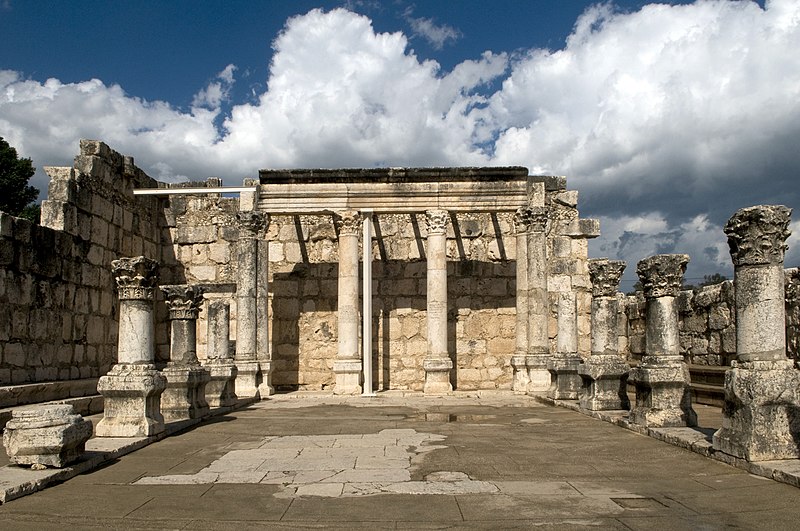
File:Sites_of_Christianity_in_the_Galillee_-_Ruins_of_the_ancient_Great_Synagogue_at_Capernaum_(or_Kfar_Nahum)_on_the_shore_of_the_Lake_of_Galilee,_Northern_Israel.jpg · Wikimedia Commons · See Wikimedia Commons
Capharnaüm
Sign in to saveAlso known as Kfar Nahum, Kfar Nachum
village situé sur les rives du lac de Tibériade au nord d'Israël, associé à Jésus dans l'Évangile de Matthieu
Capernaum was a small fishing village of about 1,500 people on the northern shore of the Sea of Galilee during the 1st century AD, where archaeological digs have uncovered two ancient synagogues built consecutively. The site is significant to Christian tradition as the reputed location of Saint Peter's house, which was later converted into a church during the Byzantine period.
AI-generated from the Wikipedia summary — may contain errors.
Key facts
- Ancient site.name
- Capernaum
- Ancient site.native_name
- (Kǝfar Naḥūm)
- Ancient site.alternate_name
- Kapharnaum, Kepharnōkón, Kafr Nāḥūm, Talḥūm
- Ancient site.image
- Sites of Christianity in the Galillee - Ruins of the ancient Great Synagogue at Capernaum (or Kfar Nahum) on the shore of the Lake of Galilee, Northern Israel.jpg
- Ancient site.caption
- Ruins of the 4th-century Capernaum synagogue
- Ancient site.map_type
- Israel
- Ancient site.map_size
- 250
- Ancient site.location
- Plain of Ginosar, Sea of Galilee, Israel
- Ancient site.region
- Galilee
- Ancient site.type
- Settlement
- Ancient site.epochs
- Hasmonean, Roman, Byzantine, early Islamic periods
- Ancient site.cultures
- Jewish (Second Temple and Talmudic eras), Christian
- Ancient site.excavations
- 1838–present
- Ancient site.archaeologists
- Edward Robinson, Charles William Wilson, Heinrich Kohl, Carl Watzinger, Vendelin von Benden, Gaudenzio Orfali, Virgilio Corbo, Stanislao Loffreda, Vassilios Tzaferis
- Ancient site.condition
- Partially preserved
- Ancient site.public_access
- Yes
- Ancient site.website
- Capernaum – Custody of the Holy Land
via Wikipedia infobox
Wikidata facts
- Instance of
- tourist destination
- Country
- Israel
- Located in
- Northern District
- Area
- 1728
- Time zone
- Israel Standard Time
- Body of water
- Sea of Galilee
- Location
- Tiberias
- Image
- Kafarnaum BW 7.JPG
Show 8 more facts
- P12749
- Mauricio Hochschild
- described by source
- Wikitólica
- Commons category
- Capernaum
- Commons gallery
- Kapernaum
- topic's main category
- Category:Capernaum
- time period
- Second Temple period
- inception
- 0200-00-00
- culture
- culture of ancient Rome
via Wikidata · CC0
Article · Français
Capharnaüm ou Capernaüm (en hébreu כְּפַר נַחוּם Kəfar Nāḥūm ou Kfar Naḥūm, ou Tell Naḥūm, en arabe كفر ناحوم ou تل ناحوم) est un village de pêcheurs de l'ancienne province de Galilée, sur la rive nord-ouest du lac de Tibériade (ou lac de Génézareth, ou mer de Galilée) au nord de l'État d'Israël. Sous la dynastie des Hasmonéens, ce village faisait de 6 à 10 hectares et sa population avoisinait les 1 700 personnes. Ce mot est surtout utilisé au sens figuré pour qualifier un lieu de grande pagaille, renfermant beaucoup d'objets entassés pêle-mêle, un endroit en désordre et par métonymie un amas de ces objets. Ce sens, uniquement utilisé en français et beaucoup utilisé par Balzac, est justifié par Littré par le fait que Capharnaüm était lié à la lecture de l'évangile selon Saint-Marc, II, 2, sur l'attroupement lors de la venue de Jésus. Selon Larousse, il s'agit d'« une grande ville de commerce ». Il y a probablement aussi un rapprochement phonétique avec cafourniau (issu du latin furnus, « four »), petite pièce à côté de la maison servant de « débarras obscur ».
Abstract from DBpedia / Wikipedia · CC BY-SA
Gallery (22)
On the map
3 mapped locations
Available in 60 languages
- Español
- Français
- Deutsch
- 中文
- 日本語
- Русский
- Português
- Italiano
- العربية
- Afrikaans
- Aragonese
- Armenian
- Bahasa Indonesia
- Basque
- Belarusian
- Bishnupriya
- Breton
- Bulgarian
Show 41 more
- Catalan
- Cebuano
- Croatian
- Czech
- Danish
- Esperanto
- Filipino
- Finnish
- Galician
- Greek
- Hebrew
- Hungarian
- Javanese
- Kashubian
- Latvian
- Malagasy
- Malayalam
- Mazanderani
- Nederlands
- Norwegian
- Norwegian Nynorsk
- Occitan
- Polski
- Romanian
- Serbian
- Serbian (Latin)
- Slovenian
- Svenska
- Swahili
- Tamil
- Tiếng Việt
- Türkçe
- Ukrainian
- Urdu
- Venetian
- Waray
- Western Frisian
- Wu Chinese
- فارسی
- ไทย
- 한국어
via Wikidata sitelinks · CC0