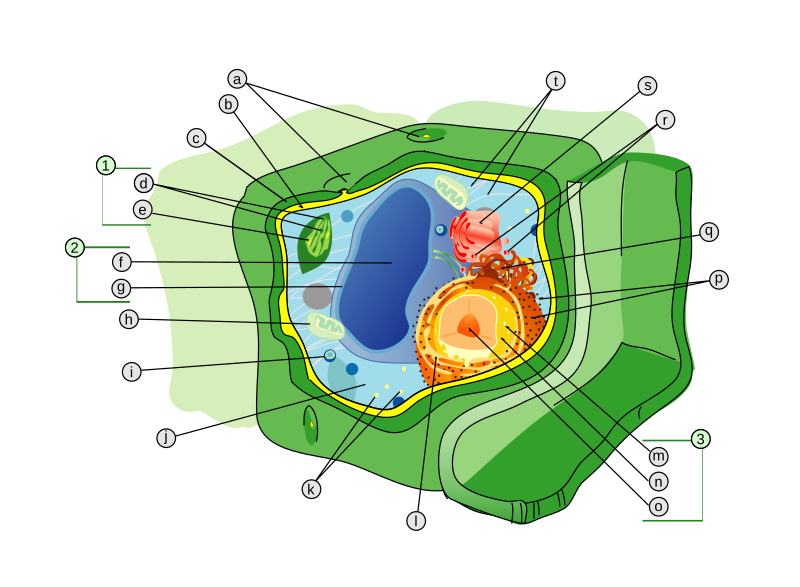
File:Plant_cell_structure_svg_labels.svg · Wikimedia Commons · See Wikimedia Commons
A cell wall is a rigid or semi-rigid outer layer that surrounds the cell membrane in plants, fungi, and most bacteria, giving these cells their shape and structure. It protects cells from bursting due to osmotic pressure, which occurs when water moves in and out of the cell.
AI-generated from the Wikipedia summary — may contain errors.
Research
134,511 papers- The Fungal Cell Wall: Structure, Biosynthesis, and Function.ReviewMicrobiology spectrum · 2017Gow NAR, Latge JP, Munro CADOI: 10.1128/microbiolspec.FUNK-0035-2016
- The plant cell wall: Biosynthesis, construction, and functions.ReviewJournal of integrative plant biology · 2021Zhang B, Gao Y, Zhang L et al.DOI: 10.1111/jipb.13055
- Plant Cell Wall Proteins and Development.International journal of molecular sciences · 2020Jamet E, Dunand CDOI: 10.3390/ijms21082731
- Cell-wall microdomain remodeling controls crucial developmental processes.ReviewTrends in plant science · 2022Dauphin BG, Ranocha P, Dunand C et al.DOI: 10.1016/j.tplants.2022.05.010
- Cell Wall Signaling in Plant Development and Defense.ReviewAnnual review of plant biology · 2022Wolf SDOI: 10.1146/annurev-arplant-102820-095312
- The Staphylococcal Cell Wall.ReviewMicrobiology spectrum · 2019Sobral R, Tomasz ADOI: 10.1128/microbiolspec.GPP3-0068-2019
- Cell wall-associated effectors of plant-colonizing fungi.ReviewMycologia · 2021Tanaka S, Kahmann RDOI: 10.1080/00275514.2020.1831293
- Plasma Membrane-Cell Wall Feedback in Bacteria.ReviewJournal of bacteriology · 2023García-Heredia ADOI: 10.1128/jb.00433-22
via PubMed
Wikidata facts
- Image
- Eukaryota cell strucutre.PNG
Show 3 more facts
- exact match
- purl.obolibrary.org/obo/GO_0005618
- Commons category
- Cell wall
- on focus list of Wikimedia project
- Wikipedia:Vital articles/Level/4
Sources (2)
via Wikidata · CC0
Article · Français
La paroi cellulaire est une paroi, assez rigide, située à l'extérieur de la membrane cellulaire des cellules végétales (paroi pectocellulosique) et de la plupart des procaryotes. Elle apporte à la cellule un soutien structurel, une protection contre les facteurs biotiques (agents pathogènes) et les facteurs abiotiques (stress mécanique, osmotique), et agit comme un mécanisme de filtrage. La paroi cellulaire fait aussi obstacle à l'expansion lorsque l'eau pénètre dans la cellule. Elle est apparue de façon indépendante dans de nombreux groupes de procaryotes et d'eucaryotes et est étroitement associée à l'évolution de la multicellularité, l'acquisition de la photosynthèse, la sortie des eaux et la vascularisation des plantes. Tous les organismes vivants en possèdent sauf les animaux et les protozoaires. La paroi seule est appelée sacculus.
Abstract from DBpedia / Wikipedia · CC BY-SA
Gallery (8)
Available in 76 languages
- Español
- Français
- Deutsch
- 中文
- 日本語
- Русский
- Português
- Italiano
- العربية
- हिन्दी
- Armenian
- Assamese
- Asturian
- Azerbaijani
- Bahasa Indonesia
- Bangla
- Basque
- Belarusian
Show 57 more
- Bosnian
- Bulgarian
- Catalan
- Central Kurdish
- Croatian
- Czech
- Danish
- Esperanto
- Estonian
- Finnish
- Galician
- Georgian
- Greek
- Haitian Creole
- Hebrew
- Hungarian
- Icelandic
- Javanese
- Kannada
- Kazakh
- Khmer
- Kyrgyz
- Latin
- Latvian
- Lithuanian
- Low German
- Macedonian
- Malay
- Malayalam
- Manx
- Nederlands
- Norwegian
- Norwegian Nynorsk
- Oromo
- Polski
- Romanian
- Serbian
- Serbian (Latin)
- simple
- Slovak
- Slovenian
- Sundanese
- Svenska
- Tamil
- Tiếng Việt
- Türkçe
- Ukrainian
- Urdu
- Uzbek
- Welsh
- Western Panjabi
- Wu Chinese
- zh_min_nan
- zh_yue
- فارسی
- ไทย
- 한국어
via Wikidata sitelinks · CC0