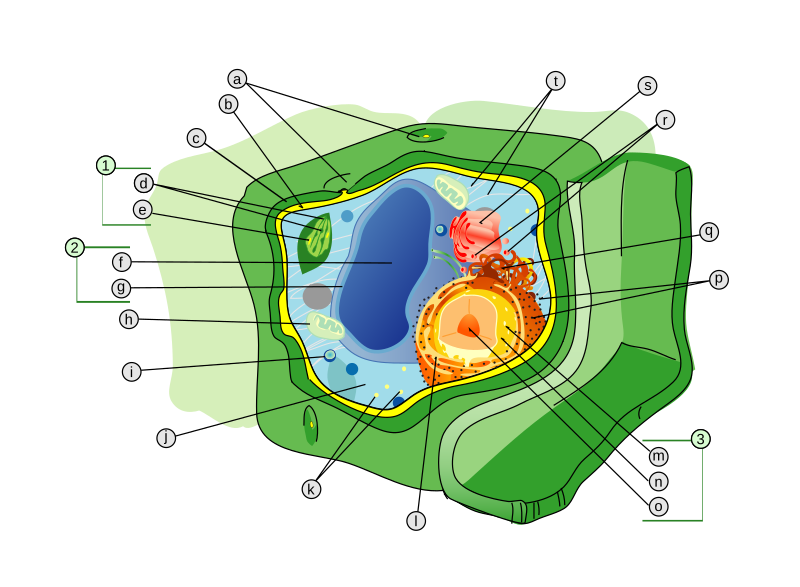
File:Plant_cell_structure_svg_labels.svg · Wikimedia Commons · See Wikimedia Commons
AI overview
A cell wall is a rigid or semi-rigid outer layer that surrounds the cell membrane in plants, fungi, and most bacteria, giving these cells their shape and structure. It protects cells from bursting due to osmotic pressure, which occurs when water moves in and out of the cell.
AI-generated from the Wikipedia summary — may contain errors.
Research
134,511 papers- The Fungal Cell Wall: Structure, Biosynthesis, and Function.ReviewMicrobiology spectrum · 2017Gow NAR, Latge JP, Munro CADOI: 10.1128/microbiolspec.FUNK-0035-2016
- The plant cell wall: Biosynthesis, construction, and functions.ReviewJournal of integrative plant biology · 2021Zhang B, Gao Y, Zhang L et al.DOI: 10.1111/jipb.13055
- Plant Cell Wall Proteins and Development.International journal of molecular sciences · 2020Jamet E, Dunand CDOI: 10.3390/ijms21082731
- Cell-wall microdomain remodeling controls crucial developmental processes.ReviewTrends in plant science · 2022Dauphin BG, Ranocha P, Dunand C et al.
Article · 日本語
細胞壁(さいぼうへき)は、植物や菌類、細菌類の細胞にみられる構造。動物細胞には存在しない。細胞膜の外側に位置するために細胞外マトリクスの1つである。 細胞壁を形成する物質は、植物ではセルロースで、これはグルコース(ブドウ糖)がいくつもつながって出来ている糖鎖である。他にも、リグニンやペクチンのようなものもある。細胞壁は、二重構造(一次壁・二次壁)になっていてたえず成長を繰り返している。細胞壁の主な役割は、防御(細胞膜から内側を守る)、改築・補強、物質補給、細胞間連絡、影響感知細胞である。また細胞壁の分子間は微細ではないため、水・ナトリウムイオン・カリウムイオンなどを容易に通す。通常、植物細胞は緑色をしているが、木などは茶色をしている。これは細胞壁がリグニンによって木化したためで、通常の細胞壁よりも硬い。
Abstract from DBpedia / Wikipedia · CC BY-SA