File:Biga._Festa_do_esquecemento._Xinzo_de_Limia,_Ourense,_Galicia.jpg · Wikimedia Commons · See Wikimedia Commons
chariot
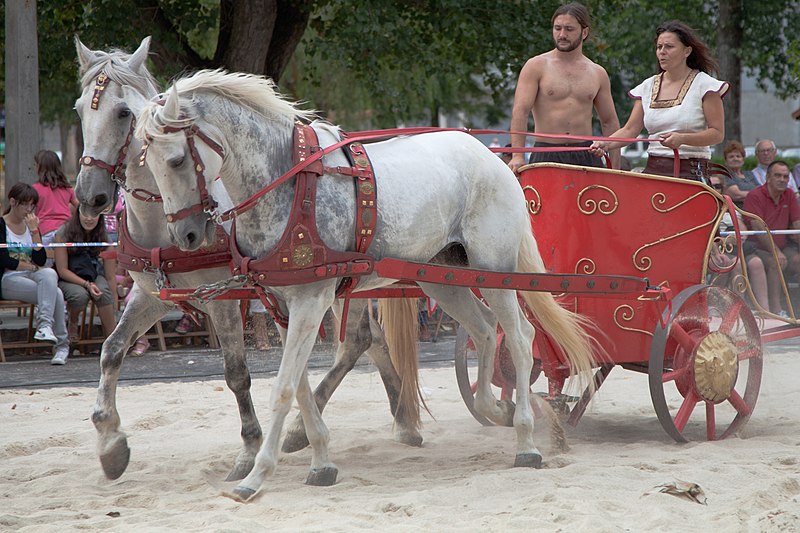
Sign in to savethumb|250px|Reconstructed Roman chariot drawn by horses. thumb|250px|Approximate historical map of the spread of the spoke-wheeled chariot, 2000—500 BC
A chariot is a wheeled vehicle pulled by horses that was used in ancient civilizations for warfare, transportation, and ceremonies. It was an important innovation that spread across Europe and Asia between 2000 and 500 BC, fundamentally changing how armies fought and societies operated.
AI-generated from the Wikipedia summary — may contain errors.
Wikidata facts
- Subclass of
- military vehicle
- Image
- Рисунки к статье «Военные колесницы». Военная энциклопедия Сытина (Санкт-Петербург, 1911-1915).jpg
Show 5 more facts
- topic's main category
- Category:Chariots
- Commons gallery
- Chariot
- Commons category
- War chariots
- different from
- The Chariot
- on focus list of Wikimedia project
- Wikipedia:Vital articles/Level/4
via Wikidata · CC0
~38 min read
Encyclopedic overview
26 sectionsContents
- Etymology
- Origins
- Spread by Indo-Europeans
- Hittites
- Bronze Age Indian Subcontinent
- In religion
- Hindu symbolism
- Persia
- Introduction in the Near East
- Early wheeled vehicles in the Near East
- Egypt
- Ancient Canaan and Israel
- Urartu
- Introduction in Bronze-Age Europe
- Greece
- Central and Northern Europe
- Western Europe
- Etruria
- Rome
- Introduction in Ancient China
- See also
- Notes
- References
- Sources
- Further reading
- External links
thumb|250px|Reconstructed Roman chariot drawn by horses. thumb|250px|Approximate historical map of the spread of the spoke-wheeled chariot, 2000—500 BC
A chariot is a type of vehicle similar to a cart, driven by a charioteer, usually using horses to provide rapid motive power. The oldest known chariots have been found in burials of the Sintashta culture in modern-day Chelyabinsk Oblast, Russia, dated to c. 1950–1880 BC and are depicted on cylinder seals from Central Anatolia in Kültepe dated to c. 1900 BC. The critical invention that allowed the construction of light, horse-drawn chariots was the spoked wheel.
Excerpted from Wikipedia’s “chariot” article, available under the CC BY-SA 4.0 licence.