
China
Sign in to saveAlso known as Red China, PR China, Communist China, China PR, RPC, cn, The PRC
país na Ásia
OverviewAI-generated
China, officially the People's Republic of China, is a sovereign state located in Asia. Its capital is Beijing, and it operates within the China Standard Time zone (UTC+08:00). The country shares borders with Mongolia, Kazakhstan, Kyrgyzstan, and Tajikistan. Its highest point is Mount Everest, and its elevation is recorded at 3174. The official language is Standard Chinese, also known as Putonghua.
The nation has a population of approximately 1408 million and covers an area of 9706961. Its currency is the renminbi, and the central bank is the People's Bank of China. The legislative body is the National People's Congress, with the Supreme People's Court serving as the highest judicial authority. China maintains diplomatic relations with the United States, Russia, Israel, and Brazil. Its top-level Internet domains include .cn and .中国.
Synthesized by Vinony from 74 facts across 10 sources: Wikidata, REST Countries, Open Meteo, Openweathermap, World Bank, OpenStreetMap, Fred, PubMed, Vinony graph, Geo. Generated from structured data (not the Wikipedia text) and checked against those facts — may still contain errors.
Weather now
7-day forecast
via Open-Meteo
Country

- Capital
- Beijing
- Population
- 1,408,280,000
- Region
- Asia · Eastern Asia
- Demonym
- Chinese
- Currencies
- CNY (¥)
- Languages
- Chinese
- Calling code
- +86
- Drives on
- Right
- Gini
- 38.5 (2016)
- FIFA code
- CHN
- TLD
- .cn, .中国, .中國, .公司, .网络
- Timezones
- UTC+08:00
- Borders
- AFG, BTN, MMR, HKG, IND, KAZ, NPL, PRK, KGZ, LAO, MAC, MNG, PAK, RUS, TJK, VNM
via REST Countries
Indicators · World Bank
- GDP
- $18.7T(2024)
- Population
- 1,408,975,000(2024)
- Life expectancy
- 78 yrs(2024)
- Unemployment
- 4.6 %(2025)
- Urban population
- 65.9 %(2024)
- Internet users
- 91.6 %(2025)
- Forest area
- 24 %(2023)
- Renewable energy
- 15.2 %(2021)
via World Bank Open Data · CC BY 4.0
Place details
- Locality
- 佐盖曼玛镇 མཛོད་དགེ་སྨད་མ།
- Region
- 甘肃省
- Country
- 中国
- Population
- 1,411,778,724
via OpenStreetMap · GeoNames
Wikipedia views (30d)
544,511 totalvia Wikimedia Pageviews API
Key facts
- Country.conventional_long_name
- People's Republic of China
- Country.common_name
- China
- Country.image_flag
- Flag of the People's Republic of China.svg
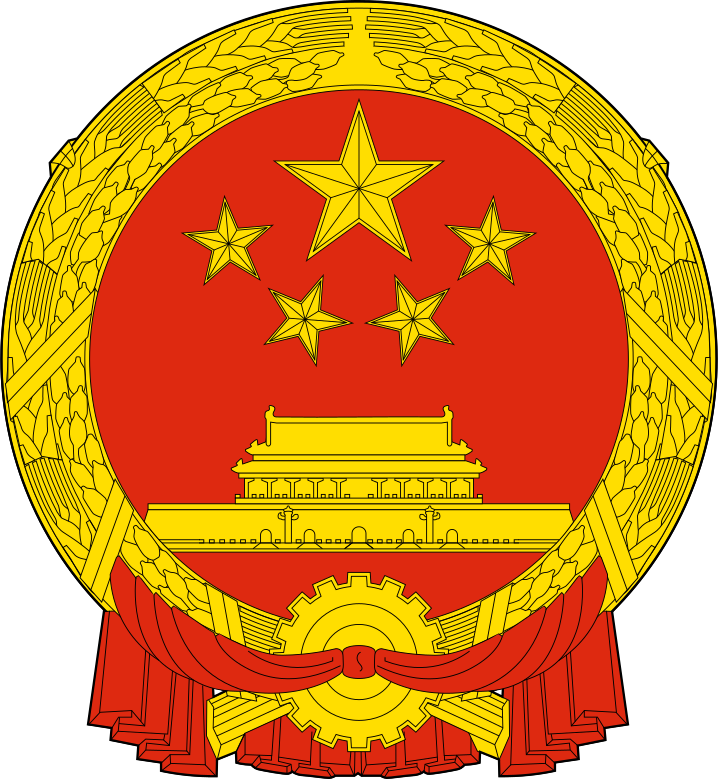
- Country.image_coat
- National Emblem of the People's Republic of China (2).svg
- Country.symbol_type
- Emblem
- Country.national_anthem
- "March of the Volunteers"File:March of the Volunteers instrumental.ogg
- Country.image_map
- CHN orthographic.svg
- Country.map_width
- 250px
- Country.capital
- Beijing
- Country.largest_settlement
- Shanghai
- Country.largest_settlement_type
- city
- Country.admin_center_type
- Largest city
- Country.admin_center
- Chongqing
- Country.official_languages
- Standard Chinese
- Country.languages_type
- Official script
- Country.languages_sub
- yes
- Country.languages
- Simplified Chinese (Mainland), Traditional Chinese (Hong Kong, Macau)
- Country.ethnic_groups_year
- 2020
via Wikipedia infobox
Research
4,171,221 papers- China's environmental solutions.ReviewApplied microbiology and biotechnology · 2023Schmid R, Xiong XDOI: 10.1007/s00253-022-12340-z
- China's big-science bet.Nature · 2024Mitchell Crow JDOI: 10.1038/d41586-024-01597-1
- China's research renaissance.Lancet (London, England) · 2019The LancetDOI: 10.1016/S0140-6736(19)30797-4
- China's three-child policy.Lancet (London, England) · 2021Tatum MDOI: 10.1016/S0140-6736(21)01295-2
- China's vaccine gambit.Science (New York, N.Y.) · 2020Cohen JDOI: 10.1126/science.370.6522.1263
- Mental health after China's prolonged lockdowns.Lancet (London, England) · 2022The LancetDOI: 10.1016/S0140-6736(22)01051-0
- China's "new" silk road.BMJ (Clinical research ed.) · 2018Gostin LODOI: 10.1136/bmj.k816
- Biotech in China 2021, at the beginning of the 14th five-year period ("145").ReviewApplied microbiology and biotechnology · 2021Schmid RD, Xiong XDOI: 10.1007/s00253-021-11317-8
via PubMed
Wikidata facts
- Instance of
- country
- Part of
- China
- Named after
- center
- Official name
- Republik Rakyat Tiongkok
- Demonym
- Síneach
- Country
- China
- Continent
- Asia
- Capital
- Beijing
- Official language
- Chinese
- Currency
- renminbi
- Population
- 1443497378
- Area
- 9596961
- Head of government
- Li Qiang
- Head of state
- Soong Ching-ling
- Form of government
- republic
- Anthem
- March of the Volunteers
- Shares border with
- Kazakhstan
- Highest point
- Mount Everest
- Founded by
- Chinese Communist Party
- Follows
- Republic of China
- Official website
- www.gov.cn
- Image
- Badaling China Great-Wall-of-China-01.jpg
- Life expectancy
- 79
Show 83 more facts
- Nominal GDP
- 17963170521080
- Unemployment rate
- 5
- Calling code
- +86
- Licence plate code
- RC
- Mains voltage
- 220
- Flag
- flag of China
- Coat of arms
- Emblem of China
- central bank
- People's Bank of China
- Commons gallery
- 中华人民共和国
- diplomatic relation
- Soviet Union
- top-level Internet domain
- .公司
- highest judicial authority
- Supreme People's Procuratorate of the People's Republic of China
- Commons category
- China
- inception
- 1949-10-01
- executive body
- State Council of the People's Republic of China
- topic's main category
- Category:People's Republic of China
- native label
- 中華人民共和國
- category for films shot at this location
- Category:Films shot in China
- described by source
- Granat Encyclopedic Dictionary
- located in/on physical feature
- East Asia
- office held by head of government
- Premier of the People's Republic of China
- IPA transcription
- ˈfɔɽkərɛpʉblɪkən ˈçiːnɑ
- mobile country code
- 460
- lowest point
- Ayding Lake
- driving side
- right
- geography of topic
- Geography of China
- history of topic
- history of China
- compulsory education (minimum age)
- 6
- age of majority
- 18
- trunk prefix
- 0
- category for people who died here
- Category:Deaths in the People's Republic of China
- category for people born here
- Category:Births in China
- territory claimed by
- Taiwan
- category of associated people
- Category:People of China
- ethnic group
- Kam people
- office held by head of state
- President of the People's Republic of China
- total fertility rate
- 1.175
- maritime identification digits
- 414
- on focus list of Wikimedia project
- Wikipedia:Vital articles/Level/4
- Stack Exchange tag
- travel.stackexchange.com/tags/china
- different from
- China
- vehicles per thousand people
- 28
- railway traffic side
- left
- Unicode character
- 🇨🇳
- location of formation
- Tiananmen
- suicide rate
- 13.2
- water as percent of area
- 2.8
- minimum temperature record
- -58
- GS1 country code
- 690-699
- culture
- Chinese culture
- category for maps or plans
- Category:Maps of China
- VAT rate
- 13
- BTI Status Index
- 5.04
- BTI Governance Index
- 5.29
- economy of topic
- economy of China
- demographics of topic
- demographics of China
- main regulatory text
- Constitution of the People's Republic of China
- Democracy Index
- 2.21
- category for people buried here
- Category:Burials in China
- hashtag
- china
- Human Development Index
- 0.768
- P11012
- World War III
- Happy Planet Index score
- 41.9
- Gini coefficient
- 38.2
- Inequality-adjusted Human Development Index
- 0.651
- median income
- 36883
- male population
- 720646499
- female population
- 691528501
- urban population
- 901991162
- rural population
- 509787562
- literacy rate
- 96.8
- name
- ꠌꠣꠄꠘꠣ
- language used
- Lashi
- P12749
- Wageningen
- short name
- 中
- general secretary
- Xi Jinping
- birth rate
- 6.77
- death rate
- 7.37
- nickname
- O Xigante Asiático
- most populous urban area
- Shanghai
- position held by head of the organization
- paramount leader of the People's Republic of China
- party chief representative
- Xi Jinping
Sources (15)
via Wikidata · CC0
Travel guide
Understand
China was one of the great civilizations of the ancient world, and for many centuries stood out as a leading nation with technologies that the West was not able to match until the early modern period. Paper, gunpowder and the compass are examples of Chinese inventions that are still widely used today. As the dominant power in the region for much of its history, China exported much of its culture to neighboring Vietnam, Korea and Japan, and Chinese influences can still be seen in the cultures of these countries.
Chinese civilization has endured millennia of tumultuous upheaval and revolutions, golden ages and periods of anarchy. Through the economic boom initiated by the reforms since the 1980s, China has returned to its place as a major political and economic world power, buoyed by its large and industrious population. The depth and complexity of the Chinese civilization, with its rich heritage, has fascinated Westerners such as Marco Polo and Gottfried Leibniz in centuries past, and will continue to excite — and bewilder — the traveller today.
In Chinese, China is zhōng guó, literally "central state" but often translated more poetically as "Middle Kingdom". People from everywhere else are called wàiguórén (外国人, "outside country people"), or colloquially lǎowài, "old outsider" with "old" in the sense of venerable or respected (in practice, these terms mostly refer to white people or Westerners, and almost never to any foreigner of Chinese descent).
Get around
Google Maps does not work in China, and tends to have patchy coverage and data quality even if accessed via VPN. Moreover, China uses its own coordinate system for security reasons, which sometimes causes problems when using foreign map apps. The most common direction-finding app used by the Chinese themselves is Baidu Maps, though it is only available in Chinese. Amap (高德地图 gaode ditu) is a very convenient app available for both, Android and Apple devices. It is useful for navigating on foot or by car and also lists available public transportation options (bus and subway), including the price. Also available in English. It covers all of China and is useful even in seemingly rural places, though sometimes certain routes are only found on Baidu maps, so it's worth having both. Apple Maps uses Amap’s data and is reliable, though it lacks certain features that the others offer. Alternative methods include other map apps based on OpenStreetMap data or renting a local GPS. More information at GPS navigation.
Names of long streets are often given a middle word indicating the part of the street: north (北 běi), south (南 nán), east (东 dōng), west (西 xī), or central (中 zhōng). For example, White Horse Street or Báimǎ Lù (白马路) may be split up into Báimǎ Běilù (白马北路 "White Horse North Street"), Báimǎ Nánlù (白马南路 "White Horse South Street"), and Báimǎ Zhōnglù (白马中路 "White Horse Central Street"). In some cities, however, these names do not indicate parts of one street. In Xiamen, Hubin Be…
See
China's attractions are endless and you will never run out of things to see. Especially near the coastal areas, when finished with one city, the next one is usually just a short train ride away.
Whether you are a history buff, a nature lover or someone who just wants to relax on a nice beach, China has it all from the majestic Forbidden City in Beijing, to the breathtaking scenery of Jiuzhaigou. Even if you live in China for many years, you'll find that there's always something new to discover in another part of the country. Perhaps unsurprisingly due to its sheer size and long history, China has the third largest number of UNESCO World Heritage Sites, after Italy and Spain.
China is on the border between two bioregions. Eurasian wildlife can be seen in the north and west, and South Asian wildlife can be found in the south and southeast.
Make sure you carry your ID around with you in China, as you will need it to purchase tickets and enter tourist attractions. This is typically your Home Return Permit for Hong Kong and Macau residents, Taiwan Compatriot Pass for Taiwanese citizens, or passport for most foreigners. Tickets for some popular attractions like the Forbidden City in Beijing or the Sun Yat-sen Mausoleum in Nanjing must be reserved online in advance. Tickets are tied to your ID in order to prevent scalping, so make sure the ID you present at the entrance matches the one you purchased your ticket with.
thumb|Karst formations, Guilin
Eat
thumb|A fish dish in a [[Yangzhou restaurant]] Food in China varies widely between regions, so the term "Chinese food" is a blanket term, about as descriptive as "Western food." Still, there are some broad characteristics. Gastronomy has a long history in China, and dishes subtly balance many flavors, aromas, and colors. Each region developed cuisine and techniques based on the ingredients at hand, so you'll find spicy meat-filled dishes in cooler inland regions, slowly simmered seafood stews in coastal regions, quickly stir-fried fresh vegetables in busy southern ports like Guangzhou, and simple and hearty meat dishes in the Northeast with its notoriously harsh winters. Even many native Chinese find food from outside their home region to be "foreign".
In southern China, rice (米饭 mǐfàn) is a staple food served with many meals, so much so that its root word 饭 (fàn) means "meal" as well as "cooked grain". It may be served plain (eaten by itself as a side, or used as a bed to soak up sauce from the main dish), stir-fried with a variety of ingredients to make fried rice, a quick tasty street meal and a common way to use up leftovers at home, or made into congee (粥 zhōu), rice porridge that's a common breakfast. Noodles (面 miàn) are another important staple, made from either rice or wheat, and served in a variety of methods. Soybeans are used to make soy sauce, a quintessential seasoning in Chinese cooking. They're also used to make tofu (豆腐 dòufu), which comes in many forms besi…
Drink
The Chinese love a tipple, but unless you are used to imbibing heavily, be careful when drinking with Chinese. Generally speaking, heavy drinking is more prevalent in northern China than in southern China.
There are hardly any liquor laws in China. The legal drinking age is 18, but it's basically not enforced, and you'll never need to show ID. Alcohol can be purchased anywhere and drunk anywhere.
Sleep
thumb|Rural inn in Shennongjia, [[Hubei]]
Availability of accommodation for tourists is generally good and ranges from shared dorm rooms to 5-star luxury hotels. Sleeper trains can also be a decent option if you schedule your long-distance travel overnight (see the Get around section above).
Since 2024, any licensed hotel outside restricted areas by law must accept foreigners. In practice, many hotels, especially cheaper ones or those in remote areas, never got the memo, don't know how to use the mandatory registration system, or simply don't want to bother. Using an English-language booking service like Trip.com can help avoid this hassle, as hotels that choose to list there are almost always foreigner-friendly. Anecdotal accounts have reported success (or at least a free ride to another hotel) requesting the intervention of the Public Security Bureau when hotels refuse to comply with the law. You may also fill in the Online Accommodation Registration Service at the Government Service Platform of National Immigration Administration available in seven provincial-level regions (Hebei, Liaoning, Zhejiang, Hubei, Guangxi, Chongqing, Sichuan) instead, but this requires creating an account on the platform.
Hotel reception staff will make a photocopy of your passport, entry stamp and visa (if applicable) as part of the registration process. On rare occasions, someone from your hotel will escort you to the local police station to satisfy the establishment's reporting requirement…
Stay safe
While China is generally safe for visitors, the government has some authoritarian aspects, and the topic of human rights in China is highly contested. Despite what's written in the Chinese constitution, in practice some freedoms are strongly curtailed, such as free speech, privacy, freedom of information and the press, freedom of religion, and the right to a fair trial. As long as you're not deliberately provocative, most of these are unlikely to affect you during your visit — especially since enforcement is somewhat arbitrary anyway — but if they do, punishments can be heavy. China is known to use extrajudicial detention, torture, and the death penalty. Often criticized as "hostage diplomacy", detentions and enforcement are sometimes stepped up in reaction to geopolitical events. Chinese dual citizens and people of Chinese heritage who are citizens of other countries have been subject to "exit bans", kept in China, sometimes for years, to compel them to cooperate with government investigations or pressure their relatives to return to China.
As long as you behave and do not get involved in drugs or political activity, you shouldn't have any problems. Even bypassing the Internet firewall or accessing potentially subversive material is usually overlooked for the average visitor. However, it doesn't hurt to have a contingency plan in case you run afoul of the government.
Respect
thumb|Tea-serving at a restaurant in China
Foreigners are still a rare breed in most parts of China, which means that how you interact with people there may well shape their impression of your country or even of foreigners in general. Follow the law, be polite, and try to leave a good impression as it affects the general reputation of foreigners in China.
Unlike Japan and South Korea where bowing is extremely common, in China the practice did not survive into the modern era, and is now only used in certain formal occasions such as marriage ceremonies, funerals, religious rituals, and by students greeting teachers in school. Give a soft handshake when greeting someone, which can be accompanied by a slight bow. Buddhist monks and nuns should be greeted by placing your palms together at chest level with your thumb and fingers pointing upwards (similar to the Thai wai), and bowing your head slightly while saying Ēmìtuófó (阿弥陀佛). Personal space more or less does not exist in China. Elevators and buses can get very crowded. It's common and acceptable for someone to come in close contact with you or to bump into you and say nothing. Don't get mad, as they'll be surprised and most likely won't even understand why you're offended. Important items such as business cards or important papers are given and received with both hands. Business cards in particular are treated very respectfully and formally. How you treat someone's business card is seen as representing how you will treat the…
Travel guide from Wikivoyage (CC BY-SA 4.0)
Article · Português
A República Popular da China (RPC; chinês simplificado: 中华人民共和国; chinês tradicional: 中華人民共和國; pinyin: ? ), também conhecida simplesmente como China, é o maior país da Ásia Oriental e o mais populoso do mundo, com mais de 1,38 bilhão de habitantes, quase um quinto da população da Terra. É uma república popular socialista unipartidária. Na constituição, descreve-se como um sistema multipartidário de cooperação e consulta política sob a liderança do Partido Comunista da China e como uma "ditadura democrática popular liderada pela classe trabalhadora e baseada na aliança de trabalhadores e camponeses". Tem jurisdição sobre vinte e duas províncias, cinco regiões autônomas (Xinjiang, Mongólia Interior, Tibete, Ningxia e Quancim), quatro municípios (Pequim, Tianjin, Xangai e Xunquim) e duas Regiões Administrativas Especiais com relativa autonomia (Hong Kong e Macau). A capital da RPC é Pequim. Com aproximadamente 9,6 milhões de quilômetros quadrados, a República Popular da China é o terceiro (ou quarto) maior país do mundo em área total e o terceiro maior em área terrestre. Sua paisagem é variada, com florestas de estepes e desertos (como os de Gobi e de Taclamacã) no norte seco e frio, próximo da Mongólia e da Sibéria (Rússia), e florestas subtropicais no sul úmido e quente, próximo ao Vietnã, Laos e Mianmar. O terreno do país, a oeste, é de alta altitude, com o Himalaia e as montanhas Tian Shan formando fronteiras naturais entre a China, a Índia e a Ásia Central. Em contraste, o litoral leste da China continental é de baixa altitude e tem uma longa faixa costeira de 14 500 quilômetros, delimitada a sudeste pelo Mar da China Meridional e a leste pelo Mar da China Oriental, além dos quais estão Taiwan, Coreia (Norte e Sul) e Japão. A nação tem uma longa história, composta por diversos períodos distintos. A civilização chinesa clássica — uma das mais antigas do mundo — floresceu na bacia fértil do rio Amarelo, na planície norte do país. O sistema político chinês era baseado em monarquias hereditárias, conhecidas como dinastias, que tiveram seu início com a semimitológica Xia (aproximadamente 2 000 a.C.) e terminaram com a queda dos Qing, em 1911. Desde 221 a.C., quando a dinastia Qin começou a conquistar vários reinos para formar um império único, o país expandiu-se, fraturou-se e reformulou-se várias vezes. A República da China, fundada em 1911 após a queda da dinastia Qing, governou o continente chinês até 1949. Em 1945, a república chinesa adquiriu Taiwan do Império do Japão, após o fim da Segunda Guerra Mundial. Na fase de 1946–1949 da Guerra Civil Chinesa, o Partido Comunista derrotou o nacionalista Kuomintang no continente e estabeleceu a República Popular da China, em Pequim, em 1 de outubro de 1949, enquanto o Partido Nacionalista mudou a sede do seu governo para Taipei. Desde então, a jurisdição da República da China está limitada à Taiwan e algumas ilhas periféricas (incluindo Penghu, Quemói e Matsu) e o país recebe reconhecimento diplomático limitado ao redor do mundo. Desde a introdução de reformas econômicas em 1978, a China tornou-se em uma das economias de mais rápido crescimento no mundo, sendo o maior exportador e o terceiro maior importador de mercadorias do planeta. A industrialização reduziu a sua taxa de pobreza de 53% (em 1981) para 8% (em 2001). O país tem sido considerado uma superpotência emergente por vários acadêmicos, analistas econômicos e militares. A importância da China como uma grande potência é refletida através de seu papel como segunda maior economia do mundo (ou segunda maior em poder de compra) e da sua posição como membro permanente do Conselho de Segurança da Organização das Nações Unidas e de várias outras organizações multilaterais, incluindo a Organização Mundial do Comércio, Cooperação Econômica Ásia–Pacífico, Grupo dos Vinte, BRICS e da Organização para Cooperação de Xangai. Além disso, o país é reconhecido como uma potência nuclear, além de possuir o maior exército do mundo em número de soldados e o segundo maior orçamento de defesa.
Abstract from DBpedia / Wikipedia · CC BY-SA
Gallery (59)
On the map
60 mapped locations
Available in 318 languages
- Español
- Français
- Deutsch
- 中文
- 日本語
- Русский
- Português
- Italiano
- العربية
- हिन्दी
- Abkhazian
- abstract
- Achinese
- Adyghe
- Afrikaans
- Akan
- Albanian
- Albanian
Show 299 more
- Amharic
- ami
- Angika
- Aragonese
- Aramaic
- Armenian
- Arpitan
- Assamese
- Asturian
- Avaric
- Awadhi
- Aymara
- azb
- Azerbaijani
- Bahasa Indonesia
- Balinese
- Bambara
- Bangla
- Banjar
- Bashkir
- Basque
- bat_smg
- Batak Toba
- Bavarian
- be_x_old
- Belarusian
- Betawi
- Bhojpuri
- Bikol
- Bishnupriya
- Bislama
- blk
- Bosnian
- Breton
- btm
- Bulgarian
- Buriat
- Burmese
- Catalan
- cbk_zam
- cdo
- Cebuano
- Central Dusun
- Central Kurdish
- Chamorro
- Chechen
- Cherokee
- Cheyenne
- Church Slavic
- Chuvash
- Cornish
- Corsican
- Crimean Tatar
- Croatian
- Czech
- dag
- Danish
- dga
- Dinka
- Divehi
- dty
- Dzongkha
- Egyptian Arabic
- eml
- Erzya
- Esperanto
- Estonian
- Ewe
- Extremaduran
- Faroese
- Fiji Hindi
- Fijian
- Filipino
- Finnish
- fiu_vro
- Friulian
- Fula
- Gagauz
- Galician
- Gan Chinese
- Ganda
- gcr
- Georgian
- Gilaki
- Goan Konkani
- Gothic
- gpe
- Greek
- Guarani
- Gujarati
- guw
- Haitian Creole
- Hakka Chinese
- Hausa
- Hawaiian
- Hebrew
- Hungarian
- hyw
- Iban
- Icelandic
- Ido
- Igbo
- Iloko
- Inari Sami
- Ingush
- Interlingua
- Interlingue
- Inuktitut
- Inupiaq
- Irish
- Jamaican Creole English
- Javanese
- Kabardian
- Kabyle
- Kalmyk
- Kannada
- Kanuri
- Kara-Kalpak
- Karachay-Balkar
- Kashmiri
- Kashubian
- Kazakh
- kbp
- kge
- Khmer
- Kikuyu
- Kinyarwanda
- Komi
- Komi-Permyak
- Kongo
- Kotava
- Kurdish
- Kyrgyz
- Ladino
- Lao
- Latgalian
- Latin
- Latvian
- lbe
- Lezghian
- Ligurian
- Limburgish
- Lingala
- Lingua Franca Nova
- Lithuanian
- lld
- Lojban
- Lombard
- Low German
- Lower Sorbian
- Luxembourgish
- Macedonian
- Madurese
- Maithili
- Malagasy
- Malay
- Malayalam
- Maltese
- Manipuri
- Manx
- Māori
- map_bms
- Marathi
- Mari
- Mazanderani
- Minangkabau
- Mingrelian
- Mirandese
- mnw
- Moksha
- Mongolian
- Moroccan Arabic
- Mossi
- Navajo
- nds_nl
- Neapolitan
- Nederlands
- Nepali
- Newari
- Nias
- Northern Frisian
- Northern Sami
- Northern Sotho
- Norwegian
- Norwegian Nynorsk
- Novial
- nrm
- nup
- Nyanja
- Occitan
- Odia
- Old English
- olo
- Oromo
- Ossetic
- Pampanga
- Pangasinan
- Papiamento
- Pashto
- Pennsylvania German
- Picard
- Piedmontese
- Polski
- Pontic
- Punjabi
- pwn
- Quechua
- roa_rup
- roa_tara
- Romanian
- Romansh
- Romany
- Rusyn
- Samoan
- Sango
- Sanskrit
- Santali
- Sardinian
- Saterland Frisian
- Scots
- Scottish Gaelic
- Serbian
- Serbian (Latin)
- Shan
- Shona
- Sicilian
- Silesian
- simple
- Sindhi
- Sinhala
- skr
- Slovak
- Slovenian
- Somali
- Southern Sotho
- Sranan Tongo
- Standard Moroccan Tamazight
- Sundanese
- Svenska
- Swahili
- Swati
- szy
- Tachelhit
- Tahitian
- Tajik
- Talysh
- Tamil
- Taroko
- Tatar
- tay
- tdd
- Telugu
- Tetum
- Tibetan
- Tiếng Việt
- Tigrinya
- Tok Pisin
- Toki Pona
- Tongan
- Tsonga
- Tswana
- Tulu
- Tumbuka
- Türkçe
- Turkmen
- Tuvinian
- Tyap
- Udmurt
- Ukrainian
- Upper Sorbian
- Urdu
- Uyghur
- Uzbek
- Venda
- Venetian
- Veps
- Volapük
- Walloon
- Waray
- Welsh
- West Flemish
- Western Frisian
- Western Panjabi
- Wolof
- Wu Chinese
- Xhosa
- Yakut
- Yiddish
- Yoruba
- Zaza
- Zeelandic
- zh_classical
- zh_min_nan
- zh_yue
- Zhuang
- Zulu
- فارسی
- ไทย
- 한국어
via Wikidata sitelinks · CC0