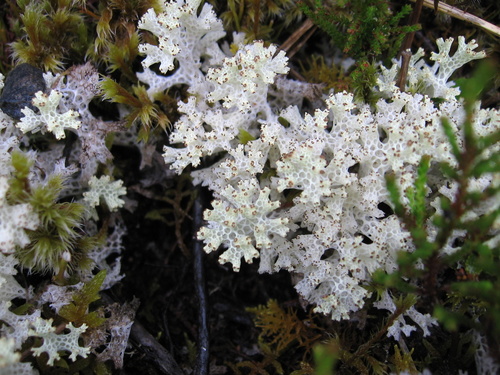
(c) Anita363, some rights reserved (CC BY-NC), uploaded by Anita363 · cc-by-nc
Cladia
Sign in to saveCladia is a genus of lichen-forming fungi in the family Cladoniaceae. Cladia species have a crustose or (scaly) primary thallus and a fruticose, secondary thallus, often referred to as pseudopodetium. The type species of the genus, Cladia aggregata, is widely distributed, occurring in South America, South Africa, Australasia and South-East Asia to southern Japan and India. Most of the other species are found in the Southern Hemisphere.
Species
Coral lichen
GENUS
- KingdomFungi
- PhylumAscomycota
- ClassLecanoromycetes
- OrderLecanorales
- FamilyCladoniaceae
via GBIF
Museum specimens
- Specimen records
- 215
- With media
- 110
- Family
- Cladoniaceae
- Collections
- DUKE, MEL, US, F, CUP
- Recorded in
- Malaysia, Australia, Venezuela, New Zealand, Panama
Wikidata facts
- Instance of
- taxon
- Parent taxon
- Cladoniaceae
- Image
- Cladia aggregata 856324.jpg
Show 7 more facts
- taxon name
- Cladia
- taxon rank
- genus
- taxon common name
- トゲシバリ属
- Commons category
- Cladia
- topic's main category
- Category:Cladia
- taxon author citation
- Nyl.
- taxonomic type
- Cladia aggregata
Sources (2)
via Wikidata · CC0
~4 min read
Encyclopedic overview
6 sectionsContents
- Taxonomy
- Description
- Ecology
- Chemistry
- Species
- References
Cladia is a genus of lichen-forming fungi in the family Cladoniaceae. Cladia species have a crustose or (scaly) primary thallus and a fruticose, secondary thallus, often referred to as pseudopodetium. The type species of the genus, Cladia aggregata, is widely distributed, occurring in South America, South Africa, Australasia and South-East Asia to southern Japan and India. Most of the other species are found in the Southern Hemisphere.
==Taxonomy== Cladia was circumscribed by Finnish lichenologist William Nylander in 1870 with Cladia aggregata as the type species. Rex Filson created a separate family, the Cladiaceae, to contain the genus, but this is no longer used and the genus is classified in the family Cladoniaceae. An updated phylogeny of the Cladoniaceae was published in 2018.
Excerpted from Wikipedia’s “Cladia” article, available under the CC BY-SA 4.0 licence.