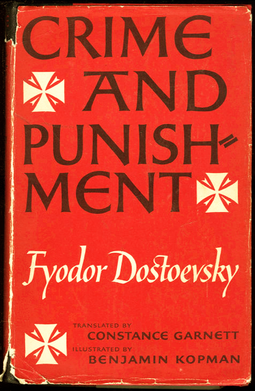
Crime and Punishment
1866 Russian-language novel by Dostoyevsky
AI overview
"Crime and Punishment" is an 1866 Russian novel by Dostoyevsky that follows a poor student named Raskolnikov who commits murder and struggles with guilt and redemption. The book is considered a masterpiece of psychological fiction that explores deep questions about morality, suffering, and the human conscience.
AI-generated from the Wikipedia summary — may contain errors.
Book · Open Library
- Author
- James Lamar Roberts
- First published
- 1963
- Editions
- 8
- Subjects
- Examinations, Literary Criticism, Criticism and interpretation, Nonfiction, Study guides, Dostoyevsky, fyodor, 1821-1881, Russian fiction, history and criticism, Continental european fiction (fictional works by one author)
via Open Library
Wikidata facts
- Image
- Cover of the first edition of Crime and Punishment.jpg
Sources (3)
via Wikidata · CC0
Article
Crime and Punishment is a novel by the Russian author Fyodor Dostoevsky. It was first published in the literary journal The Russian Messenger in twelve monthly installments during 1866. It was later published in a single volume. It is the second of Dostoevsky's full-length novels following his return from ten years of exile in Siberia. Crime and Punishment is considered the first great novel of his mature period of writing and is often cited as one of the greatest works of world literature.
Crime and Punishment follows the mental anguish and moral dilemmas of Rodion Raskolnikov, an impoverished former law student in Saint Petersburg who plans to kill an unscrupulous pawnbroker, an old woman who stores money and valuable objects in her flat. He theorises that with the money he could liberate himself from poverty and go on to perform great deeds, and seeks to convince himself that certain crimes are justifiable if they are committed in order to remove obstacles to the higher goals of "extraordinary" men. Once the deed is done, however, he finds himself wracked with confusion, paranoia, and disgust. His theoretical justifications lose all their power as he struggles with guilt and horror and is confronted with both internal and external consequences of his deed.
Gallery (5)
Connections
Categories
1866 Russian novelsCrime and PunishmentCrime novelsExistentialist novelsNovels about Russian prostitutionNovels by Fyodor DostoevskyNovels first published in serial formNovels set in Saint PetersburgNovels set in the 19th-century Russian EmpirePsychological novelsRussian novels adapted into filmsRussian novels adapted into plays