Encyclopedia of Life · EOL (see source)
Species
bigeye ragged-tooth
Species
- PhylumChordata
- ClassElasmobranchii
- OrderLamniformes
- FamilyPseudocarchariidae
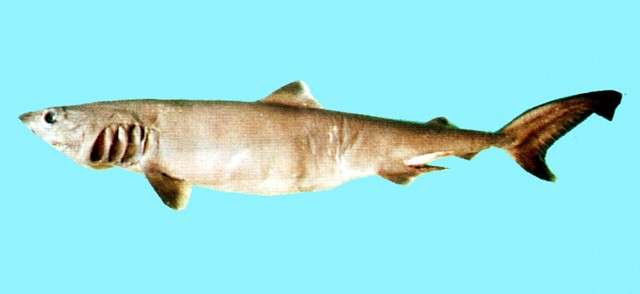
二名法 Pseudocarcharias kamoharaiMatsubara, 1936 糙齒鯊分佈範圍(藍色) 糙齒鯊(學名:Pseudocarcharias kamoharai),又稱蒲原氏擬錐齒鯊或鱷鮫,是糙齒鯊科(或稱擬錐齒鯊科)中的唯一一個物種。分布於全球各熱帶及亞熱帶的海域,平時棲息在590米深的海裡。牠們可以生長至超過1米長。 主要以小型魚類、烏賊及蝦類為食。 目录 1 分佈及棲息地 2 解剖及外觀 3 飲食 4 行為 5 生殖 6 對人類的重要性 7 參考 分佈及棲息地 糙齒鯊是生活在海洋的鯊魚,一般在離岸的區域出沒,偶爾會在淺海附近出現。 解剖及外觀 糙齒鯊是中等身形及呈錠子狀的鯊魚,有很大的眼睛但沒有瞬膜,鰓裂長至背部,牙齒呈針狀,尾巴上有細少的龍骨及尾前小窩。背鰭低及細少,第二背鰭比第一背鰭少一半,但較臀鰭大。胸鰭闊及圓。 身體背部呈淺或深灰色,腹部較淺色。鰭有白邊,身體上有時有細少的白點,口部及鰭裂之間有大白點。 飲食 糙齒鯊是以遠洋的硬骨魚、魷魚及蝦為食物。 行為 糙齒鯊的行為不明,但相信可以游得很快,可能能夠跳出水面。牠們是遠洋的鯊魚。牠們有大的眼睛,估計是夜間活動或在深海覓食。 生殖 糙齒鯊是卵胎生的,胚胎會以卵黃及其他卵子為食,每胎約有4頭幼鯊。 對人類的重要性 雖然糙齒鯊對人類並沒有危害,但牠強壯的顎骨、顎部肌肉及牙齒都令人生畏。牠的身體最有用的是那充滿角鯊烯的肝臟。牠們很久前在日本已被捕獵,但影響不大。 參考 Froese, Rainer & Daniel Pauly, eds. (2006). Pseudocarcharias kamoharai in FishBase. 2006年May月版本 Animaldiversity 取自“https://zh.wikipedia.org/w/index.php?title=糙齿鲨&oldid=42681657” 分类: IUCN近危物種 糙齒鯊屬 隐藏分类: TaxoboxLatinName 本地相关图片与维基数据相同 含有拉丁語的條目 FishBaseLatinName
via
Wikidata facts
- Instance of
- taxon
- Image
- Pseudocarcharias kamoharai.jpg
Show 7 more facts
- taxon rank
- species
- IUCN conservation status
- Least Concern
- Commons category
- Pseudocarcharias kamoharai
- taxon name
- Pseudocarcharias kamoharai
- taxon common name
- 沙魚
- taxon range
- New Guinea
- external data available at URL
- www.gbif.org/dataset/abf8082d-c179-4cb2-acc4-3cdef16c4341
Sources (2)
via Wikidata · CC0
~11 min read
Encyclopedic overview
The crocodile shark (Pseudocarcharias kamoharai) is a species of mackerel shark and the only extant member of the family Pseudocarchariidae. A specialized inhabitant of the mesopelagic zone, the crocodile shark can be found worldwide in tropical waters from the surface to a depth of 590 m (1,940 ft). It performs a diel vertical migration, staying below a depth of 200 m (660 ft) during the day and ascending into shallower water at night to feed. Typically measuring only 1 m (3.3 ft) in length, the crocodile shark is the smallest living mackerel shark. It can be distinguished by its elongated cigar-shaped body, extremely large eyes, and relatively small fins.
An active-swimming predator of pelagic bony fishes, squid and shrimp, the crocodile shark has a sizable oily liver that allows it to maintain its position in the water column with minimal effort. The size and structure of its eyes suggests that it is adapted for hunting at night. The crocodile shark is aplacental viviparous, with females typically giving birth to litters of four. The fetuses are oophagous, meaning that they feed on undeveloped eggs ovulated for this purpose by their mother. Due to its small size, the crocodile shark poses little danger to humans and is of little commercial importance. This species was responsible for damaging deep sea fiberoptic cables when the technology was first deployed in 1985. In 2017, one crocodile shark was spotted on a UK beach spotted by a family walking on the beach.
Excerpted from Wikipedia’s “crocodile shark” article, available under the CC BY-SA 4.0 licence.