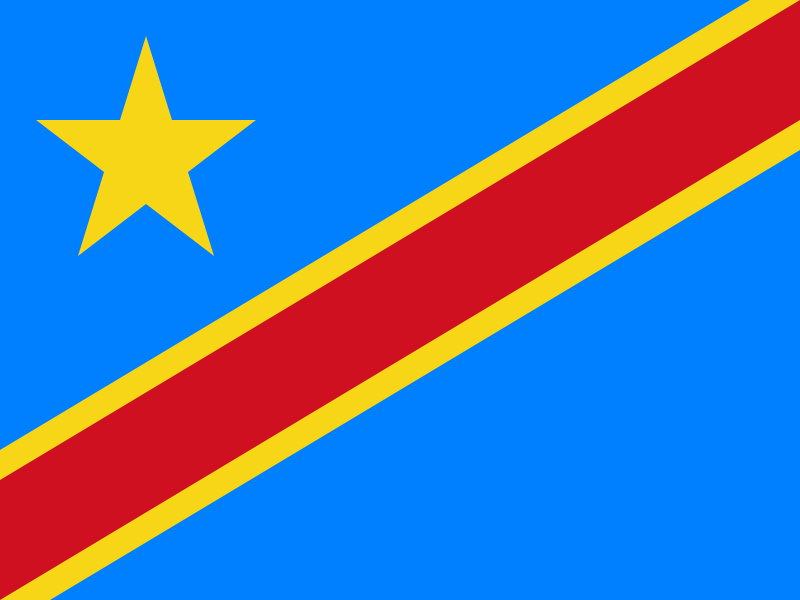
Also known as DRC, DR Congo, Congo-Kinshasa, Zaire, Congo, Democratic Republic of Congo, cd, Dem. Republic of the Congo
کشوری در قاره آفریقا
The Democratic Republic of the Congo is a vast Central African country that is the second-largest by land area in Africa and home to around 124 million people, making it the most populous Francophone nation in the world. It matters globally because of its enormous size, strategic location, dense rainforests centered on the Congo Basin, and significant natural resources, while domestically it serves as the economic and political hub of Central Africa with its capital in Kinshasa.
AI-generated from the Wikipedia summary — may contain errors.
via Open-Meteo
thumb|375px|A map showing the visa requirements of Democratic Republic of the Congo thumb|Railway between [[Kinshasa and Matadi]]
thumb|400px|Map of ground & water transport. With an area covering and inadequately developed infrastructure, the DR Congo can be a very tough country to get around in.
thumb|Epulu River The Democratic Republic of the Congo, often called the "Heart of Africa" in terms of vastness, is the largest nation in sub-Saharan Africa and one of the most enigmatic countries on the continent. Much of the DRC is wild, but its attractions include a multitude of varied cultures and a beauty of tropical landscapes, which include rainforests scattered with waterways and captivating wildlife.
The "Academie des Beaux-Arts" is often considered a touristic site and is in itself and with its gallery a good place to meet the famous artists of this country. Big names like Alfred Liyolo, Lema Kusa oder Roger Botembe are teaching here as well as the only purely abstract working artist Henri Kalama Akulez, whose private studio is worth a visit.
Congo is the centre of popular African music. Try visiting a local bar or disco, in Bandal or Matonge (both in Kinshasa), if possible with live soukouss music, and just hit the dance floor.
thumb|"Bread bike" Congo has one national dish: moambe. It's made of eight ingredients (moambe is the Lingala word for eight): palm nuts, chicken, fish, peanuts, rice, cassave leaves, bananas and hot pepper sauce.
The usual soft drinks (called sucré in Congo) such as Coke, Pepsi and Mirinda are available in most places and are safe to drink. Local drinks like Vitalo are amazing. Traditional drinks like ginger beer are also common.
The local beer is based on rice, and tastes quite good. It comes in 75 cl bottles. Primus, Skol, Castel are the most common brands. Tembo and Doppel are the local dark beers.
In rural areas, you may try the local palm wine, an alcoholic beverage from the sap of the palm tree. It is tapped from the tree, and begins fermenting immediately after collection. After two hours, fermentation yields an aromatic wine of up to 4% alcohol content, mildly intoxicating and sweet. The wine may be allowed to ferment longer, up to a day, to yield a stronger, more sour and acidic taste, which some people prefer.
2 mapped locations
via REST Countries
via World Bank Open Data · CC BY 4.0
via Wikimedia Pageviews API
via PubMed
via Wikidata · CC0
Beware of the local gin. Sometimes unscrupulous vendors mix in methanol which is toxic and can cause blindness. Some people believe that the methanol is a by-product of regular fermentation. This is not the case as regular fermentation can not yield methanol in toxic amounts.
There are an increasing number of hotels in Kinshasa, with a smaller selection in Gombe and Ngaliema area. In many small towns, the local church or monastery may have beds. You may also encounter the occasional decaying colonial hotel. Not all are safe.
thumb|UN peacekeepers near [[Goma]]
The DRC remains one of the most underdeveloped countries in Africa and a significant portion of it is not safe for any travel or sightseeing. In addition to active conflicts, the country has very limited health care and tourism facilities, even by African standards. Those visiting for business, research, or international aid purposes should consult with their organization and seek expert guidance before planning a trip. If visiting on your own, you should consult the advice of your embassy.
Outside the capital Kinshasa, there are very few hospitals or clinics available for sick or injured travellers. If you are travelling on one of the country's isolated, muddy roads or along the Congo River, the nearest one could be over a week away! A number of tropical diseases are present (see Stay healthy below).
The DRC has seen more than its fair share of violence. A number of ongoing wars, conflicts, and episodes of fighting have occurred since independence, with sporadic, regional violence continuing today. As a result, significant sections of the country should be considered off-limits to travellers.
In the northeastern part of the country, the LRA (of child-soldier and 'Kony' fame) continues to roam the jungles near the border with the CAR, South Sudan and Uganda. Although a few areas very close to the Ugandan border are relatively safe to visit, travel anywhere north and east of Kisangani and Bumba is dangerous.
The regions of North and Sou…
Excellent medical care is almost entirely non-existent in DRC, especially for non-citizens.
There are occasional Ebola outbreaks in DRC. On 15 May 2026 the DRC Ministry of Health announced an outbreak of Ebola Bundibugyo in the North-Eastern Ituri Province The World Health Organisation (WHO) have declared this a Public Health Emergency of International Concern. Some countries have heightened health screening for travellers from DRC. Check entry requirements for the country you’re travelling to or transiting. See also Infectious diseases#Ebola.
You will need a yellow fever vaccination in order to enter the country by air (this requirement is often ignored at land entry points, particularly the smaller ones). There are health officials at some major entry points, such as the airport in Kinshasa, who check this before you are allowed to enter.
Congo is malarial, although slightly less in the Kivu region due to the altitude, so use insect repellent and take the necessary precautions such as sleeping under mosquito nets. The riverside areas (such as Kinshasa) are quite prone to malaria.
If you need emergency medical assistance, it is advised that you go to your nation's embassy. The embassy doctors are normally willing and skilled enough to help. There are safe hospitals in Kinshasa, like "CMK" (Centre Medical de Kinshasa), which is private and was established by European doctors (a visit costs around US$20). Another private and non-profit hospital is Centre Hospitalier MONKOL…
thumb|Tower of Limete and Patrice Lumumba statue in Kinshasa As is the case in most African nations, it is customary to show respect to elders and authority figures. If a figure of authority asks you to do something, it is advisable to comply or at least show deference. Try not to do anything that would make an older person feel challenged. Don't use first names unless you've been told to do so. Use the terms Monsieur (for men) and Madame or Mademoiselle (for women) for people you don't know.
Witchcraft is a highly controversial topic in the DR Congo. Witchcraft accusations are often used to scapegoate, marginalise, or exploit vulnerable groups, such as women, children, older people, and people with disabilities.
Do not photograph people without their explicit permission; most certainly, do not take pictures of women or children without their consent. Taking photographs of women or children may cause people to (incorrectly) assume you are a rapist, a kidnapper, or someone with malicious intentions. Keep in mind that sexual crimes against women and children are depressingly common in DR Congo, and some Congolese people believe in a highly disturbing superstition that having sex with a virgin woman will cure HIV/AIDS. To prevent misunderstandings and heated arguments, always ask. Better yet, don't photograph anyone at all.
When motorcades pass, all vehicular traffic is expected to provide a clear path. Do not photograph these processions.
The national flag is raised and l…
Travel guide from Wikivoyage (CC BY-SA 4.0)
via Wikidata sitelinks · CC0
Discovered by embedding cosine similarity (sentence-transformers MiniLM, 384-dim).