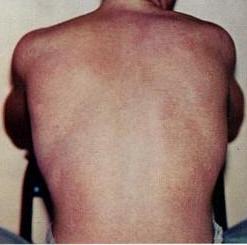
File:Denguerash.JPG · Wikimedia Commons · See Wikimedia Commons
dengue fever
Sign in to saveAlso known as dengue disease, classic dengue, classical dengue, breakbone fever, dengue, break-bone fever, classical dengue fever
tropical disease caused by the dengue virus, transmitted by mosquito
OverviewAI-generated
Dengue fever is a disease with a minimal incubation period of 3 days and a maximal incubation period of 7 days in humans. It is classified under ICD-9-CM code 061. The condition is also identified by NCI Thesaurus ID C34528 and ICPC 2 ID A77.
The subject is documented in the Commons category "Dengue" and is described at a URL provided by the CDC. It has been referenced by 1,167 other encyclopedia articles. Academic literature on the topic includes 35,924 entries in PubMed. The information is grounded in sources such as the title "登革熱 - 衛生福利部疾病管制署."
Synthesized by Vinony from 15 facts across 4 sources: Wikidata, Firecrawl, PubMed, Vinony graph. Generated from structured data (not the Wikipedia text) and checked against those facts — may still contain errors.
Research
35,924 papers- Dengue overview: An updated systemic review.Journal of infection and public health · 2023Khan MB, Yang ZS, Lin CY et al.DOI: 10.1016/j.jiph.2023.08.001
- Dengue fever in the Americas.Virulence · 2024Ly HDOI: 10.1080/21505594.2024.2375551
- Dengue fever.The Medical journal of Australia · 1977Black RHDOI: 10.5694/j.1326-5377.1977.tb99052.x
- Dengue fever in international travelers.ReviewClinical infectious diseases : an official publication of the Infectious Diseases Society of America · 2000Jelinek TDOI: 10.1086/313889
- [Dengue Fever].ReviewRinsho byori. The Japanese journal of clinical pathology · 2016Moi ML, Takasaki T
- [Fatal dengue fever].Arkhiv patologii · 2020Nadeev AP, Maltseva YG, Shishkina EY et al.DOI: 10.17116/patol20208201152
- Dengue fever.ReviewProfessional nurse (London, England) · 1997Payling KJ
- Dengue fever in Pakistan: a paradigm shift; changing epidemiology and clinical patterns.ReviewPerspectives in public health · 2015Haider Z, Ahmad FZ, Mahmood A et al.DOI: 10.1177/1757913915599019
via PubMed
Described at

登革熱 - 衛生福利部疾病管制署
cdc.gov.tw →Link to a page describing this subject · 7,478 chars · not written by Vinony
Wikidata facts
- Instance of
- symptom or sign
- Image
- Dengue.jpg
Show 17 more facts
- medical examination
- physical examination
- possible treatment
- symptomatic treatment
- has cause
- Dengue virus
- has natural reservoir
- Asian tiger mosquito
- Commons category
- Dengue
- symptoms and signs
- bleeding
- topic's main category
- Category:Dengue fever
- NCI Thesaurus ID
- C34528
- health specialty
- infectious diseases
- ICPC 2 ID
- A77
- exact match
- identifiers.org/doid/DOID:12205
- minimal incubation period in humans
- 3
- maximal incubation period in humans
- 7
- on focus list of Wikimedia project
- Wikipedia:Vital articles/Level/4
- ICD-9-CM
- 061
- has phenotype
- bone pain
- described at URL
- www.cdc.gov.tw/Disease/SubIndex/WYbKe3aE7LiY5gb-eA8PBw
Sources (10)
via Wikidata · CC0
~27 min read
Encyclopedic overview
Video summary Dengue fever is a mosquito-borne disease caused by dengue virus, prevalent in tropical and subtropical areas. Most cases of dengue fever are either asymptomatic or manifest mild symptoms. Symptoms typically begin 3 to 14 days after infection. They may include a high fever, headache, vomiting, muscle and joint pains, and a characteristic skin itching and skin rash. Recovery generally takes two to seven days. In a small proportion of cases, the disease develops into severe dengue (previously known as dengue hemorrhagic fever or dengue shock syndrome) with bleeding, low levels of blood platelets, blood plasma leakage, and dangerously low blood pressure.
Dengue is spread by several species of female mosquitoes of the Aedes genus, principally Aedes aegypti. The virus has four confirmed serotypes; infection with one type usually gives lifelong immunity to that type, but only short-term immunity to the others. Subsequent infection with a different type increases the risk of severe complications, so-called antibody-dependent enhancement. The symptoms may resemble those of malaria, influenza, or Zika. Blood tests to confirm the diagnosis including detecting viral RNA, or specific antibodies.
Excerpted from Wikipedia’s “dengue fever” article, available under the CC BY-SA 4.0 licence.
Gallery (12)
Available in 101 languages
- Español
- Français
- Deutsch
- 中文
- 日本語
- Русский
- Português
- Italiano
- العربية
- हिन्दी
- Armenian
- Assamese
- Asturian
- Awadhi
- azb
- Azerbaijani
- Bahasa Indonesia
- Bangla
Show 82 more
- Banjar
- Basque
- Bhojpuri
- Bikol
- Bulgarian
- Burmese
- Catalan
- Central Dusun
- Croatian
- Czech
- Danish
- Dinka
- Divehi
- Egyptian Arabic
- Esperanto
- Estonian
- Filipino
- Finnish
- Galician
- Georgian
- gpe
- Greek
- Guarani
- Gujarati
- Hausa
- Hebrew
- Hungarian
- hyw
- Icelandic
- Interlingua
- Irish
- Javanese
- Kannada
- Kazakh
- kge
- Khmer
- Latin
- Latvian
- Lithuanian
- Luxembourgish
- Macedonian
- Malagasy
- Malay
- Malayalam
- map_bms
- Marathi
- Nederlands
- Nepali
- Norwegian
- Occitan
- Odia
- Papiamento
- Polski
- Punjabi
- Romanian
- Serbian
- Serbian (Latin)
- Sicilian
- simple
- Sinhala
- Slovak
- Slovenian
- Sundanese
- Svenska
- Swahili
- Tamil
- Telugu
- Tetum
- Tiếng Việt
- Türkçe
- Ukrainian
- Urdu
- Uzbek
- Waray
- Welsh
- Western Panjabi
- Wu Chinese
- zh_min_nan
- zh_yue
- فارسی
- ไทย
- 한국어
via Wikidata sitelinks · CC0