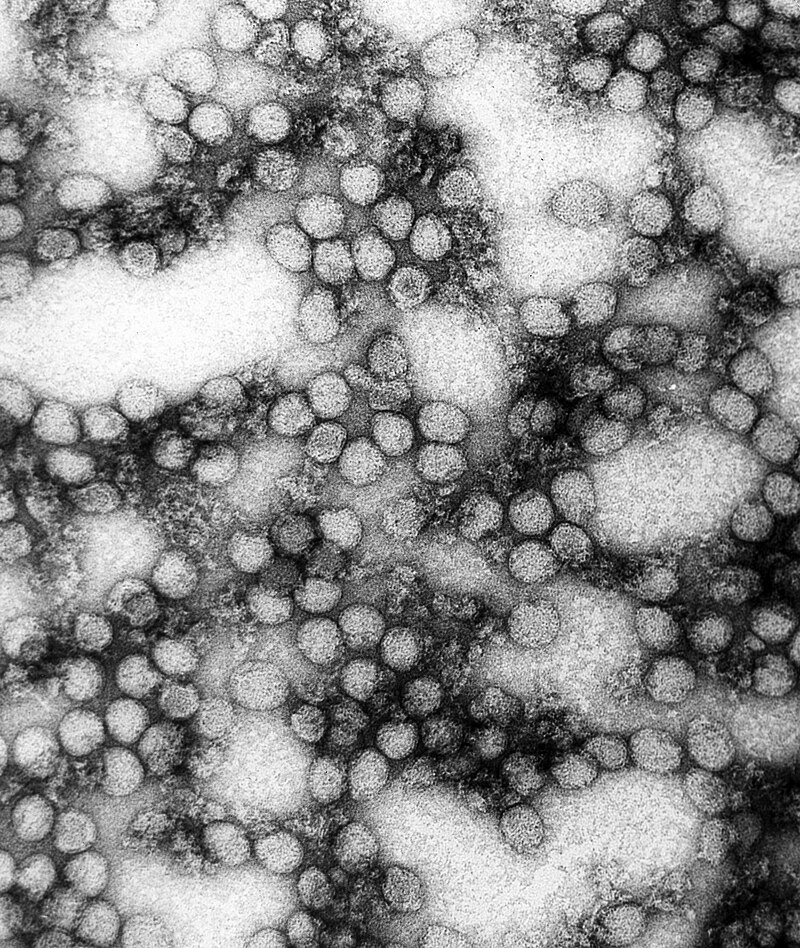
File:YellowFeverVirus.jpg · Wikimedia Commons · See Wikimedia Commons
yellow fever
Sign in to saveAlso known as Yellow jack, Yellow plague, Yellow fever virus infection, Sylvatic yellow fever, Yellow fever, Sylvan, jungle yellow fever, urban Yellow fever, Yellow fever virus infectious disease
viral disease
Yellow fever is a viral disease spread by mosquitoes that can cause fever, jaundice (yellowing of the skin), and in severe cases, organ failure and death. It matters because outbreaks can affect large populations, particularly in tropical regions of Africa and South America where the mosquitoes that carry it thrive.
AI-generated from the Wikipedia summary — may contain errors.
Research
9,836 papers- Yellow fever.Journal of clinical virology : the official publication of the Pan American Society for Clinical Virology · 2015
- Yellow Fever Virus: Knowledge Gaps Impeding the Fight Against an Old Foe.Trends in microbiology · 2018
- Yellow fever - An old foe with new developments.The Australian journal of rural health · 2024
- [Yellow Fever].Revista da Sociedade Brasileira de Medicina Tropical · 2003
- Fractional-dose yellow fever vaccination: how much more can we do with less?Current opinion in infectious diseases · 2019
via PubMed
Wikidata facts
- Image
- YellowFeverVirus.jpg
- Number of deaths
- 60000
Show 15 more facts
- symptoms and signs
- myalgia
- has cause
- yellow fever virus
- topic's main category
- Category:Yellow fever
- Commons category
- Yellow fever
- NCI Thesaurus ID
- C35547
- health specialty
- infectious diseases
- ICPC 2 ID
- A77
- exact match
- id.cabi.org/cabt/126874
- maximal incubation period in humans
- 6
- minimal incubation period in humans
- 3
- has natural reservoir
- Aedes aegypti
- number of cases
- 170000
- on focus list of Wikimedia project
- Wikipedia:Vital articles/Level/4
- ICD-9-CM
- 060
- medical examination
- viral culture
Sources (15)
via Wikidata · CC0
~40 min read
Encyclopedic overview
Yellow fever is a viral disease of typically short duration. In most cases, symptoms include fever, chills, loss of appetite, nausea, muscle pains—particularly in the back—and headaches. Symptoms typically improve within five days. In about 15% of people, within a day of improving the fever recurs, abdominal pain occurs and liver damage begins, causing yellow skin. If this occurs, the risk of bleeding and kidney problems is increased.
The disease is caused by the yellow fever virus and is spread by the bite of an infected mosquito. It infects humans, other primates, and several types of mosquitoes. In cities, it is spread primarily by Aedes aegypti, a type of mosquito found throughout the tropics and subtropics. The virus is an RNA virus of the genus Orthoflavivirus (full scientific name Orthoflavivirus flavi). The disease may be difficult to tell apart from other illnesses, especially in the early stages. To confirm a suspected case, blood-sample testing with a polymerase chain reaction is required.
Excerpted from Wikipedia’s “yellow fever” article, available under the CC BY-SA 4.0 licence.
Gallery (12)
Available in 78 languages
- Español
- Français
- Deutsch
- 中文
- 日本語
- Русский
- Português
- Italiano
- العربية
- हिन्दी
- Afrikaans
- Armenian
- Asturian
- Azerbaijani
- Bahasa Indonesia
- Bangla
- Basque
- Belarusian
Show 59 more
- Bosnian
- Bulgarian
- Catalan
- Croatian
- Czech
- Danish
- Dinka
- Divehi
- Egyptian Arabic
- Esperanto
- Estonian
- Finnish
- Galician
- Ganda
- Georgian
- gpe
- Greek
- Haitian Creole
- Hebrew
- Hungarian
- Icelandic
- Ido
- Irish
- Kashubian
- Kazakh
- Latvian
- Lingala
- Lithuanian
- Macedonian
- Malagasy
- Malay
- Malayalam
- Nederlands
- Norwegian
- Norwegian Nynorsk
- Occitan
- Odia
- Polski
- Quechua
- Romanian
- Serbian
- Serbian (Latin)
- simple
- Sinhala
- Slovenian
- Svenska
- Swahili
- Tamil
- Tiếng Việt
- Tigrinya
- Türkçe
- Ukrainian
- Urdu
- Wu Chinese
- Yoruba
- zh_yue
- فارسی
- ไทย
- 한국어
via Wikidata sitelinks · CC0