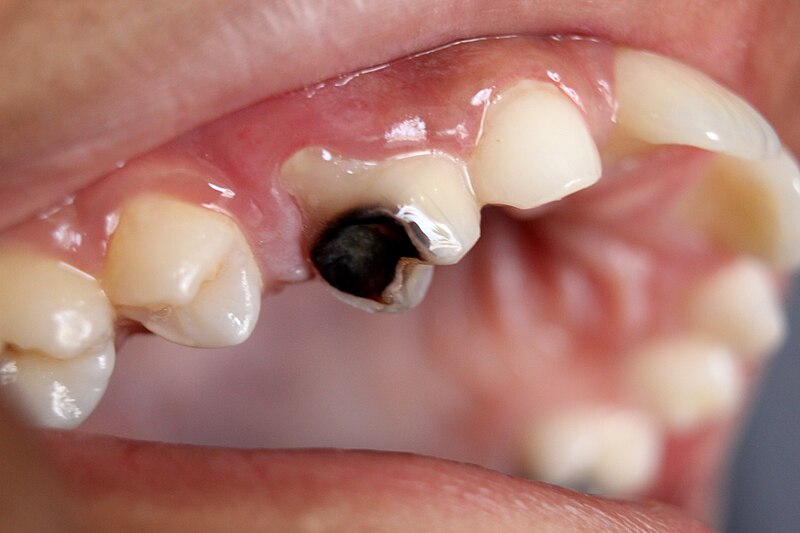
File:Dental_Caries_Cavity_2.JPG · Wikimedia Commons · See Wikimedia Commons
dental caries
Sign in to saveAlso known as dental caries extending into pulp, dental caries of smooth surface, dental caries pit and fissure, tooth decay, cavities, caries
deformation of teeth made by acids from bacteria
Dental caries is the damage to teeth caused by acids produced by bacteria in your mouth. It matters because this damage can lead to pain, tooth loss, and other serious health problems if left untreated.
AI-generated from the Wikipedia summary — may contain errors.
Research
74,620 papersvia PubMed
Wikidata facts
- Subclass of
- caries
- Image
- Tooth model.jpg
Show 12 more facts
- topic's main category
- Category:Tooth decay
- NCI Thesaurus ID
- C52593
- Commons category
- Dental caries
- health specialty
- dentistry
- ICPC 2 ID
- D82
- drug or therapy used for treatment
- tooth regeneration
- exact match
- purl.obolibrary.org/obo/HP_0000670
- afflicts
- tooth enamel
- ICD-9-CM
- 521.06
- has cause
- Streptococcus mutans
- on focus list of Wikimedia project
- Wikipedia:Vital articles/Level/4
- WordLift URL
- data.wordlift.io/wl01714/entity/dental-caries
Sources (10)
via Wikidata · CC0
~40 min read
Encyclopedic overview
Tooth decay, also known as caries (lit. 'rottenness', from Latin), is the breakdown of teeth due to acids produced by bacteria. The resulting dental cavities may be many different colors, from yellow to black. Symptoms may include pain and difficulty eating. Complications may include periodontal disease (i.e., inflammation of the tissue around the tooth), tooth loss, infection, or dental abscess formation. Tooth regeneration is a field of ongoing stem cell-based study that aims to find methods to reverse the effects of decay; current treatments are limited to symptom management.
The cause of cavities is acid from bacteria dissolving the hard tissues of the teeth (enamel, dentin, and cementum). The acid is produced by the bacteria when they break down food debris or sugar on the tooth surface. Simple sugars in food are these bacteria's primary energy source, and thus a diet high in simple sugar is a risk factor. If tooth demineralization is greater than tooth remineralization from sources such as saliva, caries results. Risk factors include conditions that result in less saliva, such as diabetes mellitus, Sjögren syndrome, and some medications, including psychostimulants, antihistamines, and antidepressants. Dental caries is also associated with poverty, poor oral hygiene, and receding gums, resulting in gingival recession (i.e., exposure of the roots of the teeth).
Excerpted from Wikipedia’s “dental caries” article, available under the CC BY-SA 4.0 licence.
Gallery (12)
Available in 85 languages
- Español
- Français
- Deutsch
- 中文
- 日本語
- Русский
- Português
- Italiano
- العربية
- हिन्दी
- Afrikaans
- Akan
- Albanian
- Armenian
- Asturian
- Aymara
- Azerbaijani
- Bahasa Indonesia
Show 66 more
- Bangla
- Basque
- be_x_old
- Belarusian
- Bosnian
- Bulgarian
- Burmese
- Catalan
- Central Kurdish
- Croatian
- Czech
- Danish
- Esperanto
- Estonian
- Filipino
- Finnish
- Galician
- gcr
- Georgian
- Greek
- Hausa
- Hebrew
- Hungarian
- Irish
- Javanese
- Kazakh
- Kyrgyz
- Latin
- Latvian
- Lithuanian
- Lombard
- Macedonian
- Malay
- Malayalam
- Marathi
- Nederlands
- Nepali
- Norwegian
- Norwegian Nynorsk
- Odia
- Polski
- Quechua
- Romanian
- Serbian
- Serbian (Latin)
- simple
- Sinhala
- Slovak
- Svenska
- Swahili
- Tajik
- Tamil
- Tatar
- Telugu
- Tiếng Việt
- Türkçe
- Ukrainian
- Uzbek
- Walloon
- Wu Chinese
- Yakut
- zh_min_nan
- zh_yue
- فارسی
- ไทย
- 한국어
via Wikidata sitelinks · CC0