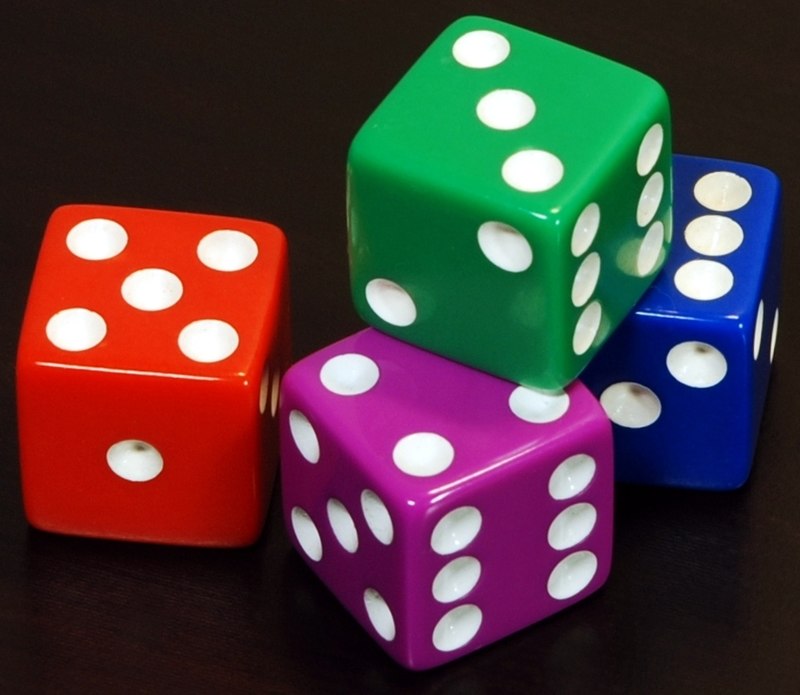
File:6sided_dice_(cropped).jpg · Wikimedia Commons · See Wikimedia Commons
dado
Sign in to saveAlso known as die, pair of dice
objeto de forma poliédrica que muestra un resultado aleatorio cuando es lanzado
Dice are small objects, typically cube-shaped with numbered sides, used to generate random results when thrown or rolled. They are important tools in games, gambling, and other activities where unpredictable outcomes are needed to determine what happens next.
AI-generated from the Wikipedia summary — may contain errors.
Wikidata facts
- Image
- Black Polyhedral Game Dice.jpg
- Has use
- game mechanic
Show 11 more facts
- hashtag
- Dice
- Unicode character
- ⚅
- Commons category
- Dice
- topic's main category
- Category:Dice
- Commons gallery
- Dice by number of sides
- shape
- cube
- different from
- Die
- described by source
- Encyclopædia Britannica 11th edition
- on focus list of Wikimedia project
- Wikipedia:Vital articles/Level/4
- maintained by WikiProject
- WikiProject Mathematics
- Stack Exchange tag
- math.stackexchange.com/tags/dice
via Wikidata · CC0
Article · Español
Un dado es un objeto preparado para mostrar un resultado aleatorio cuando es lanzado sobre una superficie horizontal, desde la mano o mediante un cubilete, en cuyo caso los resultados ocurren con una probabilidad que se distribuye mediante una distribución uniforme discreta. Fueron también muy usados en Grecia y Roma, como consta por algunas pinturas de vasijas y por los objetos mismos frecuentemente hallados en excavaciones. En Roma se llamaban álea (como dijo Julio César al cruzar el Rubicón: Alea jacta est: ‘el dado tirado está’ o «La suerte está echada». De álea proviene aleatorio, ‘al azar’. Aunque generalmente se hacían de marfil o hueso, se encuentran varios de ágata, bronce y vidrio y no faltan algunos fraudulentos que tienen o han tenido relleno de plomo en uno de sus lados. Los romanos designaban todas estas piezas con el nombre de téseras de juego (tésserae lusóriae) pero también llamaban téseras a los billetes de entradas para los teatros y las diferentes clases de bonos y medallas de premios que solían hacerse de metal, marfil o hueso con figuras grabadas.
Abstract from DBpedia / Wikipedia · CC BY-SA
Gallery (52)
Available in 86 languages
- Español
- Français
- Deutsch
- 中文
- 日本語
- Русский
- Português
- Italiano
- العربية
- हिन्दी
- Albanian
- Aragonese
- Armenian
- Asturian
- Azerbaijani
- Bahasa Indonesia
- Balinese
- Bangla
Show 67 more
- Basque
- Belarusian
- Bosnian
- Breton
- Bulgarian
- Catalan
- cdo
- Central Kurdish
- Croatian
- Czech
- Danish
- Egyptian Arabic
- Esperanto
- Estonian
- Filipino
- Finnish
- fiu_vro
- Galician
- Greek
- Hebrew
- Hungarian
- Icelandic
- Irish
- Javanese
- Kabyle
- Latin
- Latvian
- Lingua Franca Nova
- Lithuanian
- Low German
- Malay
- Marathi
- Nederlands
- Northern Frisian
- Northern Sami
- Norwegian
- Norwegian Nynorsk
- Occitan
- Polski
- Quechua
- Romanian
- Saterland Frisian
- Scots
- Serbian
- Serbian (Latin)
- Sicilian
- simple
- Slovak
- Slovenian
- Sundanese
- Svenska
- Swahili
- Tamil
- Tiếng Việt
- Türkçe
- Ukrainian
- Urdu
- Uzbek
- Welsh
- Wu Chinese
- zh_classical
- zh_min_nan
- zh_yue
- Zhuang
- فارسی
- ไทย
- 한국어
via Wikidata sitelinks · CC0