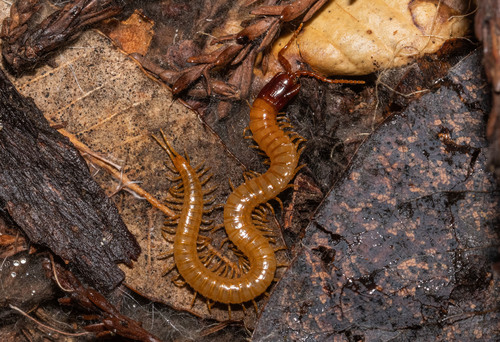
(c) Jeremiah Degenhardt, some rights reserved (CC BY), uploaded by Jeremiah Degenhardt · cc-by
Dicellophilus
Sign in to saveDicellophilus is a genus of soil centipedes in the family Mecistocephalidae. This genus was introduced by the American biologist Orator F. Cook in 1896 to contain the species D. limatus, which he explicitly designated as the type species. This genus contains five species and is notable for their highly disjunct geographic distribution.
Species
GENUS
- KingdomAnimalia
- PhylumArthropoda
- ClassChilopoda
- OrderGeophilomorpha
- FamilyMecistocephalidae
via GBIF
Wikidata facts
- Instance of
- taxon
- Parent taxon
- Mecistocephalidae
Show 2 more facts
- taxon name
- Dicellophilus
- taxon rank
- genus
Sources (1)
via Wikidata · CC0
~4 min read
Encyclopedic overview
5 sectionsContents
- Distribution
- Description
- Phylogeny
- Species
- References
Dicellophilus is a genus of soil centipedes in the family Mecistocephalidae. This genus was introduced by the American biologist Orator F. Cook in 1896 to contain the species D. limatus, which he explicitly designated as the type species. This genus contains five species and is notable for their highly disjunct geographic distribution.
== Distribution == The five species in this genus are each found in one of three limited and unusually disjunct areas. The species D. carniolensis is limited to central Europe, the species D. praetermissus and D. pulcher are both limited to the island of Honshu in Japan, and the species D. anomalus and D. limatus are both limited to the west coast of the United States. The range of each species is no more than 1,300 km in maximum diameter. These species live mostly in montane forests with moderate temperatures. While the ranges of these species all fall within a narrow band of latitude (about 35–45 °N), they are maximally separated in terms of longitude. No other group of centipedes, and no terrestrial animals in the Northern Hemisphere, are known to exhibit such a peculiar geographic distribution.
Excerpted from Wikipedia’s “Dicellophilus” article, available under the CC BY-SA 4.0 licence.