File:Simple_stellar_aberration_diagram.svg · Wikimedia Commons · See Wikimedia Commons
optical aberration
Sign in to saveAlso known as velocity aberration, astronomical aberration
phenomenon in astronomy
Wikidata facts
- Instance of
- scientific theory
- Subclass of
- optical phenomenon
Show 4 more facts
- Commons category
- Stellar aberration
- discoverer or inventor
- James Bradley
- Commons gallery
- Aberration of light
- maintained by WikiProject
- WikiProject Mathematics
Sources (1)
via Wikidata · CC0
~40 min read
Encyclopedic overview
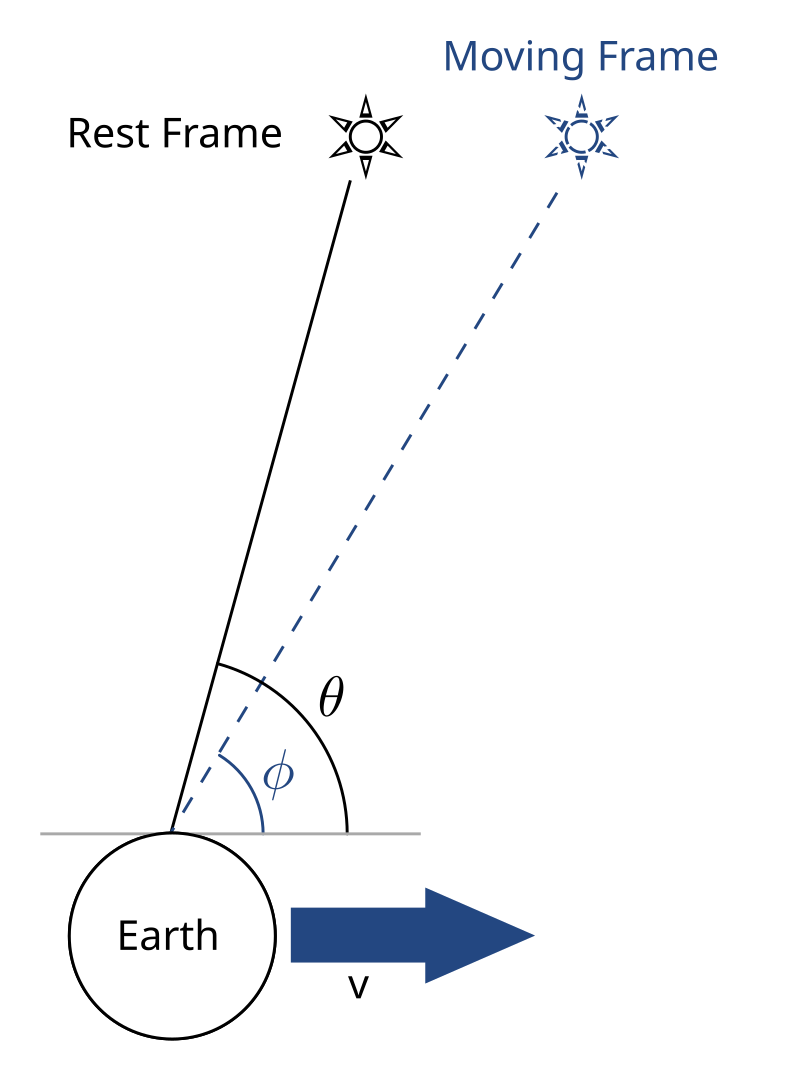
A diagram showing how the apparent position of a star viewed from the Earth can change depending on the Earth's velocity. The effect is typically much smaller than illustrated.
In astronomy, aberration (also referred to as astronomical aberration, stellar aberration, or velocity aberration) is a phenomenon where celestial objects exhibit an apparent motion about their true positions based on the velocity of the observer: It causes objects to appear to be displaced towards the observer's direction of motion. The change in angle is of the order of v/c where c is the speed of light and v the velocity of the observer. In the case of "stellar" or "annual" aberration, the apparent position of a star to an observer on Earth varies periodically over the course of a year as the Earth's velocity changes as it revolves around the Sun, by a maximum angle of approximately 20 arcseconds in right ascension or declination.
Excerpted from Wikipedia’s “optical aberration” article, available under the CC BY-SA 4.0 licence.