
에콰도르
Sign in to saveAlso known as Republic of Ecuador, Republic of the Equator, Republic of Equator, The Ecuadorian State
남아메리카의 국가
Ecuador is a South American country located on the continent's northwestern coast, bordered by Colombia and Peru, with the Pacific Ocean to its west and the Galápagos Islands as part of its territory. The country's capital is Quito, while its largest city is Guayaquil.
AI-generated from the Wikipedia summary — may contain errors.
Weather now
7-day forecast
via Open-Meteo
Country

- Capital
- Quito
- Population
- 18,103,660
- Region
- Americas · South America
- Demonym
- Ecuadorean
- Currencies
- USD ($)
- Languages
- Spanish
- Calling code
- +593
- Drives on
- Right
- Gini
- 45.7 (2019)
- FIFA code
- ECU
- TLD
- .ec
- Timezones
- UTC-06:00 · +1 more
- Borders
- COL, PER
via REST Countries
Indicators · World Bank
- GDP
- $124.7B(2024)
- Population
- 18,135,478(2024)
- Life expectancy
- 77.6 yrs(2024)
- Unemployment
- 3.3 %(2025)
- Urban population
- 63.2 %(2024)
- Internet users
- 77.2 %(2024)
- Forest area
- 49.5 %(2023)
- Renewable energy
- 18.9 %(2021)
via World Bank Open Data · CC BY 4.0
Place details
- Locality
- Simon Bolivar
- Region
- Pastaza
- Country
- Ecuador
- Population
- 17,084,357
via OpenStreetMap · GeoNames
Wikipedia views (30d)
100,568 totalvia Wikimedia Pageviews API
Key facts
- Country.conventional_long_name
- Republic of Ecuador
- Country.common_name
- Ecuador, García
- Country.image_flag
- Flag of Ecuador.svg
- Country.flag_type_article
- Flag of Ecuador
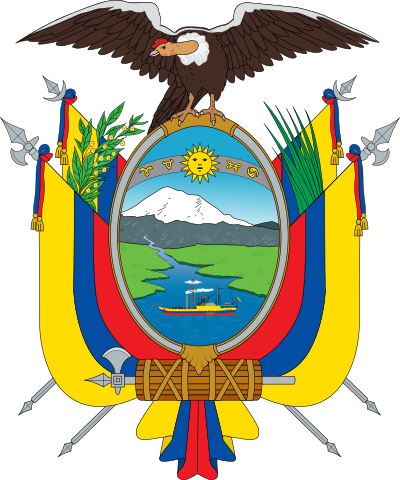
- Country.image_coat
- Coat of arms of Ecuador.svg
- Country.symbol_type
- Coat of arms
- Country.image_map
- ECU orthographic.svg
- Country.national_motto
- "Lord, homeland and freedom"
- Country.official_languages
- Spanish
- Country.recognized_regional_languages
- Kichwa, Shuar and others "are in official use for indigenous peoples"
- Country.demonym
- Ecuadorian
- Country.ethnic_groups_year
- 2022
- Country.religion_year
- 2023
- Country.capital
- Quito
- Country.largest_city
- Guayaquil
- Country.government_type
- Unitary presidential republic
- Country.leader_title1
- President
- Country.leader_name1
- Daniel Noboa
via Wikipedia infobox
Research
22,221 papers- Mycetoma in Ecuador.Transactions of the Royal Society of Tropical Medicine and Hygiene · 2024Chandler DJ, Escalante L, Maldonado A et al.DOI: 10.1093/trstmh/trad098
- Leishmaniases in Ecuador: Comprehensive review and current status.ReviewActa tropica · 2017Hashiguchi Y, Velez LN, Villegas NV et al.DOI: 10.1016/j.actatropica.2016.11.039
- [Safety and Health at Work in Ecuador].Archivos de prevencion de riesgos laborales · 2021Gómez García ARDOI: 10.12961/aprl.2021.24.03.01
- Zoonotic Ancylostoma ceylanicum Hookworm Infections, Ecuador.Emerging infectious diseases · 2022Sears WJ, Cardenas J, Kubofcik J et al.DOI: 10.3201/eid2809.220248
- Ecuador's research dream crushed by politics.Nature · 2019Reichardt JDOI: 10.1038/d41586-019-03121-2
- Ecuador.Population policy compendium · 1980United Nations. Department of International Economic and Social Affairs. Population Division, United Nations Fund for Population Activities UNFPA
- Exploring the impact of Ecuador's policies on the right to health of Venezuelan migrants during the COVID-19 pandemic: a scoping review.Health policy and planning · 2023Serrano Córdova C, Torres I, López-Cevallos DDOI: 10.1093/heapol/czad071
- Ecuador.Department of State publication. Background notes series · 1991United States. Department of State. Bureau of Public Affairs
via PubMed
Wikidata facts
- Instance of
- country
- Part of
- Latin America
- Named after
- equator
- Official name
- جمہوریہ ایکواڈور
- Demonym
- Eacuadórach
- Participant in
- Ecuadorian–Peruvian War
- Country
- Ecuador
- Contains
- El Oro Province
- Continent
- South America
- Capital
- Quito
- Official language
- Shuar
- Population
- 16938986
- Area
- 257204.27
- Head of government
- Daniel Noboa
- Head of state
- Daniel Noboa
- Form of government
- republic
- Legislature
- National Assembly
- Anthem
- Salve, Oh Patria
- Shares border with
- Colombia
- Highest point
- Chimborazo
- Official website
- www.cancilleria.gob.ec
- Image
- Ecuador Blue Marble.png
- Life expectancy
- 78
- Nominal GDP
- 115049476000
Show 65 more facts
- Unemployment rate
- 5
- Calling code
- +593
- Licence plate code
- EC
- Mains voltage
- 120
- Motto
- Duw, Mamwlad a Rhyddid
- Flag
- flag of Ecuador
- Coat of arms
- coat of arms of Ecuador
- topic's main Wikimedia portal
- Portal:Ecuador
- top-level Internet domain
- .ec
- Commons category
- Ecuador
- topic's main category
- Category:Ecuador
- inception
- 1840-02-16
- category for people who died here
- Category:Deaths in Ecuador
- category for people born here
- Category:Births in Ecuador
- category for films shot at this location
- Category:Films shot in Ecuador
- category of associated people
- Category:Ecuadorian people
- diplomatic relation
- Hungary
- history of topic
- history of Ecuador
- IPA transcription
- ɛkʋɑˈdoːɾ
- Commons gallery
- Ecuador
- mobile country code
- 740
- lowest point
- Pacific Ocean
- driving side
- right
- geography of topic
- Geography of Ecuador
- GS1 country code
- 786
- age of majority
- 18
- marriageable age
- 18
- short name
- ইকুয়েডর
- number of out-of-school children
- 658628
- office held by head of state
- President of Ecuador
- external data available at URL
- www.datosabiertos.gob.ec
- total fertility rate
- 2.21
- maritime identification digits
- 735
- native label
- República del Ecuador
- central bank
- Central Bank of Ecuador
- replaces
- Gran Colombia
- Unicode character
- 🇪🇨
- language used
- Cha'palaa
- suicide rate
- 7.7
- culture
- culture of Ecuador
- VAT rate
- 12
- BTI Status Index
- 6.23
- BTI Governance Index
- 4.88
- economy of topic
- economy of Ecuador
- demographics of topic
- demographics of Ecuador
- Democracy Index
- 5.71
- Human Development Index
- 0.740
- P11012
- tungsten
- hashtag
- Ecuador
- on focus list of Wikimedia project
- Wikipedia:Vital articles/Level/4
- Gini coefficient
- 47.3
- Happy Planet Index score
- 58.8
- Inequality-adjusted Human Development Index
- 0.604
- P12749
- Ramón Barros Luco
- office held by head of government
- President of Ecuador
- birth rate
- 16.583
- male population
- 8984602
- death rate
- 4.85
- rural population
- 6377754
- female population
- 9016398
- urban population
- 11623246
- P8168
- Kraljevec Šemnički
- located in/on physical feature
- South America
- most populous urban area
- Guayaquil
Sources (15)
via Wikidata · CC0
Travel guide
Understand
La República del Ecuador ("Republic of the Equator") was one of three countries (the others being Colombia and Venezuela) that emerged when the Gran Colombia federation fractured in 1830. Between 1904 and 1942, Ecuador lost territories in a series of conflicts with its neighbors. A border war with Peru that flared in 1995 was resolved in 1999.
Ecuador's mainstream culture is defined by its Hispanic Mestizo majority and like their ancestry, it is traditionally Spanish heritage, influenced by different degrees of Amerindian traditions with African elements.
Tropical along coast, becoming cooler inland at higher elevations; tropical in Amazonian jungle lowlands. Ecuador has a total area of 283,520 km2 and is bisected by the Equator, for which it is named.
Ecuador is a major exporter of oil, bananas, flowers, seafood and artisan crafts.
Get in
thumb|375px|A map showing the visa requirements of Ecuador, with countries in green and blue having visa-free access thumb|Ecuador was indeed named after the Equator
See
Loma Alta, a 2428-hectare cloud forest. Tigua, for its bright paintings. The village of Calderon is known for its folk art. Agua Blanca, an indigenous territory of the Manta. Chimborazo, highest peak in Ecuador. La Mitad del Mundo on the Equator Central and South American wildlife
Do
thumb|(Grapsus grapsus) in the Galapagos. thumb|(Spheniscus mendiculus) - A juvenile Galapagos Penguin before it has banding markings. The capital Quito, is a city with a lot of history where you can walk in downtown, enjoying the beautiful colonial buildings. There is also the "Teleférico" (cable-car) which takes passengers from the highest mountain in Quito to see the whole city from the sky. Admission is $9.00 per person (July 2025). There are many welcoming cafes as well as many dancing clubs open every weekend, often until 05:00.
In Guayaquil, an excellent place to visit is the Malecón 2000, which is very similar to Navy Pier in Chicago, Illinois, offering food, shopping, boat rides and a beautiful view of the river. Except for electronics, prices are quite low; however, almost everything sold with any sort of brand name is a knockoff. This area is very well patrolled and quite safe. For a real adventure, it is possible to visit the more authentic, less expensive, and far more dangerous Bahía or "Informal Market". It is not advisable to visit it without a native. It is possible to purchase a knockoff of almost anything here. Pirated video games and movies also abound; it is possible to purchase game systems modified to play such games as well. Make the proprietors prove to you that any movies or games you might purchase actually work before buying though. In the Bahía, it is necessary to haggle for all items.
Baños is the perfect city for the outdoors or extreme sport…
Eat
There is a lot of variety as to what is typically eaten, depending on the location. In the Sierra, potatoes almost always accompany lunch and dinner, and in the coast rice is popular. Soup is also a big part of lunch and dinner. Breakfasts often consist of toast, eggs, and juice or fruit. Batidos, or fruit shakes, are popular breakfast items or snacks. Especially on the coastline, Ecuadorians make a variety of breakfast meals based on green or sweet plantain and yuca, such as bolonoes, empanadas, patacones, corviches, muchines, pan de yuca, humitas and others. They are cooked with either cheese, pork or fish. They are very filling and inexpensive meals.
thumb|300px|Locro de Papa Restaurants run the gamut in terms of menu, quality, hygiene, hours and price. Basic meals cost less than $2, or it is possible to pay close to U.S. prices in the tourist areas, especially for food from the American chains.
If you're on a budget, your best bet for a good and local meal is to order an almuerzo (lunch) or a merienda (dinner). These normally consist of a soup, a meat main course and a dessert for $1-2.
More expensive restaurants (say, ones that charge $4 per meal or more) often add a 12% sales tax and a 10% service fee.
Coffee or tea (including many herbal varieties) is typically served after the meal unless you ask for it sooner.
Except at places that cater to foreigners, it is the custom not to present the diner with the bill until it is requested. While many servers are used to…
Drink
Bottled water is very common and is safe to drink; it comes con gas (carbonated) and sin gas (non-carbonated). Water from the tap is unsafe to drink. Even Ecuadorians generally only drink bottled (or boiled) water.
Coffee is widely available in cafes and restaurants, and also sold in bean form. Tea is also common, usually with a good selection including herbal.
Fruit juice is plentiful and good, and you will often have many options: piña (pineapple), mora (blackberry), maracuyá (passion fruit), naranja (orange), sandía (watermelon), naranjilla (a jungle fruit), melon, taxo, guanabana, guava, etc. If you'd like it made with milk, sort of like a less-frozen milkshake, ask for a batida. Note that often juices are served lukewarm.
Aguardiente, often made from fermented sugar cane, is the local firewater. If possible, have some ground freshly into your cup from the sugarcane.
Sleep
There are many low-cost hostels throughout Ecuador. Often, the hostels in smaller towns are actually privately owned homes that welcome travellers. As with most things, natives can help you find an excellent hotel at a very low price ($6-14). Large groups will be able to bargain for lower prices. Air conditioning is an amenity which often comes at an extra cost of a dollar or two a night.
Ecuador is also home to an increasing number of Eco Lodges, including many renovated, traditional haciendas.
Haciendas of Ecuador
Stay safe
thumb|Mountaineering is a popular activity here, though it can be dangerous in many ways
Tourists should use common sense to ensure their safety. Avoid problems by not flashing large amounts of money, not visiting areas near the Colombian border, staying away from civil disturbances and not using side streets in big cities at night. Probably the biggest threat in most places is simple thievery: belongings should not be left unguarded on the beach, for example, and pickpockets can be found in some of the more crowded areas, especially the Trolébus (Metro) in Quito, in bus terminals and on the buses themselves. Buses allow peddlers to board briefly and attempt to sell their wares; however, they are often thieves themselves, so keep a close eye out for them. Hotel personnel are generally good sources of information about places that should be avoided.
You can always ask tourist police officers, police officers or in tourist information centers for the dangerous regions.
Ecuador offers great opportunities for hiking and climbing; unfortunately, some travelers have been attacked and robbed in remote sections of well known climbs and several rapes have also been reported, so female hikers and climbers need to be extremely careful. Travelers are urged to avoid solo hikes and to go in a large group for safety reasons.
Stay healthy
Ecuador is widely considered to be a developing country and health hazards are a significant issue. Of the most significant are foodborne illnesses, though they can easily be treated with digestive drugs such as antacids or antidiarrheals.
Bottled water is key in Ecuador if you don't want to get sick. This doesn't only apply to foreigners who don't have the stomach for Ecuadorian food but also Ecuadorians who know that if they don't boil their water or drink it from the bottle that they can get very sick. As a result, it can be purchased almost everywhere (even in the most remote places) for well under $0.25-0.50. Water bottles are sometimes provided by hostels and hotels, which can be used for brushing teeth.
It is advisable to receive a typhoid vaccination, and possibly a yellow fever vaccination, depending on your specific area of travel.
Outside the major cities and tourist areas, malaria can be a problem along the coast during the rainy season.
Ecuador has a high altitude terrain in many regions, which may cause altitude sickness or breathing difficulties for some travelers. It is recommended to acclimatize slowly and avoid excessive physical exertion in high altitude areas.
Respect
The common greetings are "buenos días", "buenas tardes" or "buenas noches", (Good morning, Good afternoon, and Good evening, respectively). It is usually complemented by a handshake, between men, and by a kiss on the cheek between women or between a man and a woman. "Hola" is the most common greeting between friends and acquaintances. As in most Latin American countries, it's considered normal and polite to stand quite close to the other person while talking.
If you speak Spanish with Ecuadorians, take note of the difference between the two forms for the pronoun "you": the informal "tú" and the formal "usted". It's customary to address older people and people with whom you're not familiar with "usted". Ecuadorans are generally forgiving of non-native speakers, but use "usted" when in doubt.
Among many other cultural idiosyncrasies, in the Sierra regions it is considered impolite to use a downward-facing palm as a reference for the height of a person. Instead, the hand is held on its side, and the measurement taken from the lower edge to the floor. Gesturing with the palm down is appropriate for animals only.
When motioning for someone to "come here", it is impolite to motion your hand with the palm facing up. Instead, use a downward swipe of the hand with the palm facing down.
Acceptable clothing varies by region of the country. In the mountainous Sierra region, including Quito, clothes are usually warmer because of the weather. On the coast, meanwhile, more casual cloth…
Travel guide from Wikivoyage (CC BY-SA 4.0)
Gallery (59)
On the map
6 mapped locations
Available in 258 languages
- Español
- Français
- Deutsch
- 中文
- 日本語
- Русский
- Português
- Italiano
- العربية
- हिन्दी
- Abkhazian
- Achinese
- Adyghe
- Afrikaans
- Albanian
- Albanian
- Amharic
- ami
Show 239 more
- Angika
- Aragonese
- Armenian
- Arpitan
- Asturian
- Awadhi
- Aymara
- azb
- Azerbaijani
- Bahasa Indonesia
- Balinese
- Bangla
- Bashkir
- Basque
- bat_smg
- Batak Toba
- Bavarian
- be_x_old
- Belarusian
- Betawi
- Bhojpuri
- Bikol
- Bishnupriya
- Bislama
- blk
- Bosnian
- Breton
- Bulgarian
- Buriat
- Burmese
- Catalan
- cbk_zam
- cdo
- Cebuano
- Central Kurdish
- Chechen
- Cherokee
- Chuvash
- Cornish
- Corsican
- Crimean Tatar
- Croatian
- Czech
- Danish
- Divehi
- dty
- Dzongkha
- Egyptian Arabic
- Esperanto
- Estonian
- Ewe
- Extremaduran
- Faroese
- Fiji Hindi
- Filipino
- Finnish
- fiu_vro
- Friulian
- Fula
- Gagauz
- Galician
- gcr
- Georgian
- Gilaki
- Goan Konkani
- Gothic
- Greek
- Guarani
- Gujarati
- Haitian Creole
- Hakka Chinese
- Hausa
- Hawaiian
- Hebrew
- Hungarian
- hyw
- Icelandic
- Ido
- Igbo
- Iloko
- Inari Sami
- Interlingua
- Interlingue
- Irish
- Jamaican Creole English
- Javanese
- Kabyle
- Kannada
- Kanuri
- Kara-Kalpak
- Karachay-Balkar
- Kashmiri
- Kashubian
- Kazakh
- kbp
- Khmer
- Kikuyu
- Kinyarwanda
- Kotava
- Kurdish
- Kyrgyz
- Ladino
- Lao
- Latgalian
- Latin
- Latvian
- Lezghian
- Ligurian
- Limburgish
- Lingala
- Lingua Franca Nova
- Lithuanian
- lld
- Lojban
- Lombard
- Low German
- Lower Sorbian
- Luxembourgish
- Macedonian
- Madurese
- Malagasy
- Malay
- Malayalam
- Maltese
- Manipuri
- Manx
- Māori
- map_bms
- Marathi
- Mari
- Mazanderani
- Minangkabau
- Mingrelian
- Mirandese
- Moksha
- Mongolian
- Moroccan Arabic
- nds_nl
- Nederlands
- Nepali
- Newari
- Northern Frisian
- Northern Sami
- Norwegian
- Norwegian Nynorsk
- Novial
- Occitan
- Odia
- Old English
- olo
- Oromo
- Ossetic
- Pampanga
- Pangasinan
- Papiamento
- Pashto
- Picard
- Piedmontese
- Polski
- Punjabi
- Quechua
- roa_rup
- Romanian
- Romansh
- Romany
- Rusyn
- Samoan
- Sanskrit
- Santali
- Sardinian
- Saterland Frisian
- Scots
- Scottish Gaelic
- Serbian
- Serbian (Latin)
- Shan
- Shona
- Sicilian
- Silesian
- simple
- Sindhi
- Sinhala
- Slovak
- Slovenian
- Somali
- Southern Sotho
- Standard Moroccan Tamazight
- Sundanese
- Svenska
- Swahili
- szy
- Tajik
- Talysh
- Tamil
- Taroko
- Tatar
- tay
- Telugu
- Tetum
- Tibetan
- Tiếng Việt
- Tigrinya
- Tok Pisin
- Toki Pona
- Tongan
- Tumbuka
- Türkçe
- Turkmen
- Udmurt
- Ukrainian
- Upper Sorbian
- Urdu
- Uyghur
- Uzbek
- Venetian
- Veps
- Volapük
- Walloon
- Waray
- Wayuu
- Welsh
- West Flemish
- Western Frisian
- Western Mari
- Western Panjabi
- Wolof
- Wu Chinese
- Yakut
- Yiddish
- Yoruba
- Zaza
- Zeelandic
- zh_classical
- zh_min_nan
- zh_yue
- Zhuang
- فارسی
- ไทย
- 한국어
via Wikidata sitelinks · CC0