
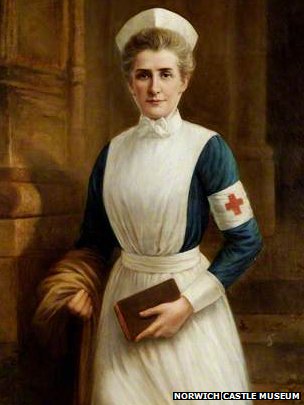
File:Edith_Cavell.jpg · Wikimedia Commons · See Wikimedia Commons
OverviewAI-generated
Edith Louisa Cavell was a British nurse, matron, governess, and writer. Born in Swardeston in 1865, she worked at The Royal London Hospital and for the International Red Cross and Red Crescent Movement. She spoke English and French. Her notable works include *Nurse Cavell* and *Edith Cavell's Short Story from "Heroes among Us"*.
Cavell participated in World War I. She was convicted of treason and executed by gunshot wound in Schaerbeek on October 12, 1915. Her manner of death was capital punishment. She was an Anglican. She is buried at Norwich Cathedral. Her feast day is October 12.
Synthesized by Vinony from 36 facts across 4 sources: Wikidata, Open Library, Firecrawl, VIAF. Generated from structured data (not the Wikipedia text) and checked against those facts — may still contain errors.
Person · Open Library
- Works
- 2
Top works
- Edith Cavell's Short Story from "Heroes among Us"
- Nurse Cavell, dog lover
via Open Library + Wikidata
Authority record · VIAF
- Lifespan
- 1865–1915
- Nationality
- GB, BE
- Role / Field
- Pielegniarki, Opieka pielegniarska
- Language
- eng
- Gender
- Female
Recorded by 18 libraries
via VIAF · OCLC
Key facts
- Born
- Edith Louisa Cavell, 4 December 1865, Swardeston , Norfolk , England
- Died
- 12 October 1915 (1915-10-12) (aged 49), Tir national , Schaerbeek , Brussels , German-occupied Belgium
- Cause of death
- Execution by firing squad
- Venerated in
- Church of England
- Feast
- 12 October (Anglican memorial day)
via Wikipedia infobox
Official website
Edith Cavell 1865-1915 | Commemorating Edith Cavell, the World War I British nurse who is celebrated for saving the lives of soldiers in Brussels from all sides without distinction.
Welcome to edithcavell.org.uk, commemorating Edith Cavell, the World War I British nurse who is celebrated for saving the lives of soldiers in Brussels from all sides without distinction. She and Belgian and French colleagues helped over 200 Allied soldiers escape from German-occupied Belgium. She was arrested, tried with 33 others by a German military court,…
edithcavell.org.uk →Link to the official site · 2,171 chars · not written by Vinony
Wikidata facts
- Instance of
- human
- Gender
- female
- Citizenship
- United Kingdom of Great Britain and Ireland
- Place of birth
- Swardeston
- Place of death
- Schaerbeek
- Occupation
- matron
- Languages spoken
- French
- Native language
- English language
- Religion
- Anglicanism
- Conflict
- World War I
- Official website
- www.edithcavell.org.uk
- Image
- Edith Cavell.jpg
- Convicted of
- treason
Show 10 more facts
- place of burial
- Norwich Cathedral
- Commons category
- Edith Cavell
- date of death
- 1915-10-12
- date of birth
- 1865-12-04
- cause of death
- gunshot wound
- manner of death
- capital punishment
- name in native language
- Edith Louisa Cavell
- birth name
- Edith Louisa Cavell
- feast day
- October 12
- P12749
- Heide Rosendahl
Sources (6)
via Wikidata · CC0
~32 min read
Encyclopedic overview
Edith Louisa Cavell (/ˈkævəl/ KAV-əl; 4 December 1865 – 12 October 1915) was a British nurse. She is celebrated for treating wounded soldiers from both sides without discrimination during the First World War and for helping some 200 Allied soldiers escape from German-occupied Belgium. Cavell was arrested, court-martialled under German military law, and sentenced to death by firing squad. Despite international pressure for mercy, the German government refused to commute her sentence and she was shot. The execution received worldwide condemnation and extensive press coverage.
The night before her execution, she said, "Patriotism is not enough. I must have no hatred or bitterness towards anyone." These words were inscribed on the Edith Cavell Memorial opposite the entrance to the National Portrait Gallery near Trafalgar Square. Her strong Anglican beliefs propelled her to help all those who needed it including both German and Allied soldiers. She was quoted as saying, "I can't stop while there are lives to be saved." The Church of England commemorates her in its Calendar of Saints on 12 October.
Excerpted from Wikipedia’s “Edith Cavell” article, available under the CC BY-SA 4.0 licence.