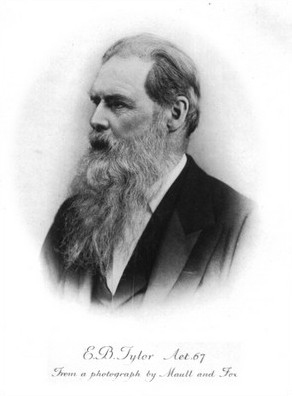
Edward Burnett Tylor
Also known as E. B. Tylor, E. B. T., Sir Edward Burnett Tylor, Edward B. Tylor, Edward Burnet Tyler
English anthropologist (1832–1917)
AI overview
Edward Burnett Tylor was a 19th-century English anthropologist who is widely considered one of the founders of anthropology as a modern academic discipline. His work, particularly his theories about culture and how societies evolve, shaped how scholars study and understand human societies and continues to influence anthropology today.
AI-generated from the Wikipedia summary — may contain errors.
Recent publications · Crossref
5 total works indexed
- Equation of State Calculations by Fast Computing Machines
· 1953 · cited 29,737x
- Self-determination theory and the facilitation of intrinsic motivation, social development, and well-being.
· 2000 · cited 27,752x
- Adsorption of Gases in Multimolecular Layers
· 1938 · cited 24,351x
- The "What" and "Why" of Goal Pursuits: Human Needs and the Self-Determination of Behavior
· 2000 · cited 23,826x
- THE USE OF LEAD CITRATE AT HIGH pH AS AN ELECTRON-OPAQUE STAIN IN ELECTRON MICROSCOPY
· 1963 · cited 18,950x
via Crossref · CC0
Wikidata facts
- Image
- Edward Burnett Tylor.png
Show 1 more fact
Article
Sir Edward Burnett Tylor FRAI (2 October 1832 – 2 January 1917) was an English anthropologist, and professor of anthropology.
Tylor's ideas typify 19th-century cultural evolutionism. In his works Primitive Culture (1871) and Anthropology (1881), he defined the context of the scientific study of anthropology, based on the evolutionary theories of Charles Lyell. He believed that there was a functional basis for the development of society and religion, which he determined was universal. Tylor maintained that all societies passed through three basic stages of development: from savagery, through barbarism to civilization. Tylor is a founding figure of the science of social anthropology, and his scholarly works helped to build the discipline of anthropology in the nineteenth century. He believed that "research into the history and prehistory of man [...] could be used as a basis for the reform of British society".
Gallery (4)
Connections
Categories
1832 births1917 deaths19th-century MesoamericanistsAnthropologists of religionCross-cultural studiesCultural anthropologistsEnglish anthropologistsEnglish MesoamericanistsEnglish QuakersFellows of the Royal Anthropological Institute of Great Britain and IrelandFellows of the Royal SocietyMesoamerican anthropologists