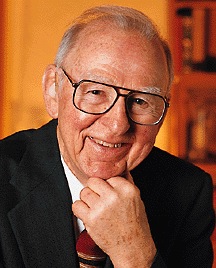
File:Edwin_G._Krebs.jpg · Wikimedia Commons · See Wikimedia Commons
Person · Open Library
- Born
- 1918
- Died
- 2009
- Works
- 3
Top works
- Metabolic Interconversion of Enzymes 1973
- Intracellular Signal Transduction
- Protein phosphorylation
via Open Library + Wikidata
Key facts
- Born
- ( 1918-06-06 ) June 6, 1918, Lansing, Iowa , U.S
- Died
- December 21, 2009 (2009-12-21) (aged 91), Seattle, Washington , U.S
- Education
- University of Illinois Urbana–Champaign ( B.S. ) , Washington University in St. Louis ( M.D. )
- Awards
- Louisa Gross Horwitz Prize (1989) , Welch Award in Chemistry (1991) , Nobel Prize in Physiology or Medicine (1992)
- Fields
- biochemistry
- Institutions
- University of Washington, Seattle , University of California, Davis , Washington University School of Medicine
via Wikipedia infobox
Nobel Prize
- The Nobel Prize in Physiology or Medicine1992
“for their discoveries concerning reversible protein phosphorylation as a biological regulatory mechanism”
Shared · 1/2 portion
Wikidata facts
- Instance of
- human
- Given name
- Edwin
- Family name
- Krebs
- Gender
- male
- Citizenship
- United States
- Place of birth
- Lansing
- Place of death
- Seattle
- Occupation
- physician
- Employer
- University of Washington
- Languages spoken
- English language
- Field of work
- biochemistry
- Residence
- Seattle
Show 8 more facts
- date of birth
- 1918-06-06
- date of death
- 2009-12-21
- member of
- Royal Academy of Medicine of Belgium
- Erdős number
- 6
- name in native language
- Edwin Gerhard Krebs
- writing language
- English language
- ancestral home
- Germany
- interested in
- biochemistry
Sources (15)
via Wikidata · CC0
~5 min read
Encyclopedic overview
Edwin Gerhard Krebs (June 6, 1918 – December 21, 2009) was an American biochemist. He received the Albert Lasker Award for Basic Medical Research and the Louisa Gross Horwitz Prize of Columbia University in 1989 together with Alfred Gilman and, together with his collaborator Edmond H. Fischer, was awarded the Nobel Prize in Physiology or Medicine in 1992 for describing how reversible phosphorylation works as a switch to activate proteins and regulate various cellular processes.
Early life and education
Excerpted from Wikipedia’s “Edwin G. Krebs” article, available under the CC BY-SA 4.0 licence.