File:Elam_Map-en.svg · Wikimedia Commons · See Wikimedia Commons
Elam
Sign in to saveAlso known as Elamites, Susiana
Elam () was an ancient civilization centered in the far west and southwest of what is today Iran, stretching from the lowlands of Ilam and Khuzestan as well as a small part of modern-day southern Iraq. The modern name Elam stems from the Sumerian transliteration elam(a), along with the later Akkadian elamtu, and the Elamite haltamti. Elamite states were among the leading political forces of the Ancient Near East. In classical literature, Elam was also known as Susiana ( ; Sousiānḗ), a name derived from its capital Susa.
Elam was an ancient civilization located in what is now southwestern Iran and parts of Iraq that played a major role in the politics and power dynamics of the Ancient Near East. Known in classical times as Susiana after its capital city Susa, Elam was one of the leading political forces of its era and gave its name to the Elamite people and language.
AI-generated from the Wikipedia summary — may contain errors.
Key facts
- Archaeological culture.name
- ElamHaltamti
- Archaeological culture.map
- Elam Map-en.svg
- Archaeological culture.mapcaption
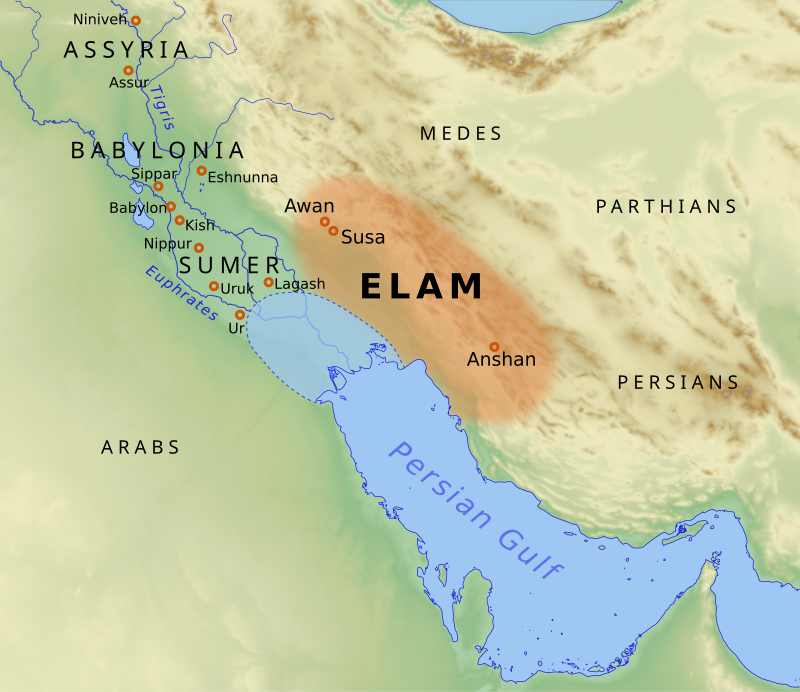
- Map showing the area of the Elamite Empire (in orange) and the neighboring areas. The approximate Bronze Age extension of the Persian Gulf is shown.
- Archaeological culture.period
- Pre-Iranic
- Archaeological culture.dates
- 3200–539 BC
- Archaeological culture.precededby
- Proto-Elamite
- Archaeological culture.followedby
- Achaemenid Empire
- Archaeological culture.mapalt
- d
- Archaeological culture.region
- Iran and Iraq
- Archaeological culture.altnames
- Elamites, Susiana
via Wikipedia infobox
Wikidata facts
- Instance of
- historical country
- Demonym
- Elamitish
- Continent
- Asia
- Capital
- Susa
- Followed by
- Achaemenid Empire
- Follows
- Proto-Elamite period
Show 9 more facts
- Commons category
- Elam
- topic's main category
- Category:Elam
- time period
- Chalcolithic
- inception
- 2700-00-00
- dissolved, abolished or demolished date
- 0539-00-00
- language used
- Elamite
- on focus list of Wikimedia project
- Wikipedia:Vital articles/Level/4
- replaces
- Proto-Elamite period
- located in/on physical feature
- Iran
via Wikidata · CC0
~47 min read
Encyclopedic overview
34 sectionsContents
- Etymology
- Geography
- History
- Proto-Elamite (c. 3200 – c. 2700 BC)
- Old Elamite period (c. 2700 – c. 1500 BC)
- Awan dynasty
- Shimashki dynasty
- Sukkalmah dynasty
- Trade with the Indus Valley Civilization
- Middle Elamite period (c. 1500 – c. 1100 BC)
- Anshan and Susa
- Kassite invasions
- Elamite Empire
- Neo-Elamite period (c. 1100 – 540 BC)
- Neo-Elamite I (c. 1100 – c. 770 BC)
- Neo-Elamite II (c. 770 – 646 BC)
- Neo-Elamite III (646–539 BC)
- Elymais (187 BC – 224 AD)
- Art
- Statuettes
- Seals
- Statue of Queen Napir-Asu
- Stele of Untash Napirisha
- Religion
- List of Elamite gods
- Language
- Suggested relations to other language families
- Legacy
- See also
- Notes
- References
- Sources
- Further reading
- External links
Elam () was an ancient civilization centered in the far west and southwest of what is today Iran, stretching from the lowlands of Ilam and Khuzestan as well as a small part of modern-day southern Iraq. The modern name Elam stems from the Sumerian transliteration elam(a), along with the later Akkadian elamtu, and the Elamite haltamti. Elamite states were among the leading political forces of the Ancient Near East. In classical literature, Elam was also known as Susiana ( ; Sousiānḗ), a name derived from its capital Susa.
Elam was part of the early urbanization of the Near East during the Chalcolithic period (Copper Age). The emergence of written records from around 3000 BC also parallels Sumerian history, where slightly earlier records have been found. In the Old Elamite period (Middle Bronze Age), Elam consisted of kingdoms on the Iranian plateau, centered in Anshan, and from the mid-2nd millennium BC, it was centered in Susa in the Khuzestan lowlands. Its culture played a crucial role during the Persian Achaemenid dynasty that succeeded Elam, when the Elamite language remained among those in official use. Elamite is generally considered a language isolate or unrelated to any other languages.
Excerpted from Wikipedia’s “Elam” article, available under the CC BY-SA 4.0 licence.
Gallery (52)
On the map
3 mapped locations
Available in 83 languages
- Español
- Français
- Deutsch
- 中文
- 日本語
- Русский
- Português
- Italiano
- العربية
- हिन्दी
- Afrikaans
- Albanian
- Amharic
- Armenian
- Asturian
- azb
- Bahasa Indonesia
- Bashkir
Show 64 more
- Basque
- be_x_old
- Belarusian
- Bulgarian
- Catalan
- Cebuano
- Central Kurdish
- Chuvash
- Croatian
- Czech
- Danish
- Esperanto
- Estonian
- Filipino
- Finnish
- Galician
- Georgian
- Greek
- Hebrew
- Hungarian
- Icelandic
- Kazakh
- Kurdish
- Kyrgyz
- Latin
- Latvian
- Lingua Franca Nova
- Lithuanian
- Macedonian
- Malagasy
- Malay
- Malayalam
- Mingrelian
- Nederlands
- Newari
- Norwegian
- Norwegian Nynorsk
- Occitan
- Pashto
- Polski
- Romanian
- Serbian
- Serbian (Latin)
- simple
- Slovak
- Slovenian
- Somali
- Svenska
- Swahili
- Tajik
- Tamil
- Tiếng Việt
- Türkçe
- Ukrainian
- Urdu
- Uzbek
- Waray
- Wu Chinese
- Zaza
- zh_min_nan
- zh_yue
- فارسی
- ไทย
- 한국어
via Wikidata sitelinks · CC0