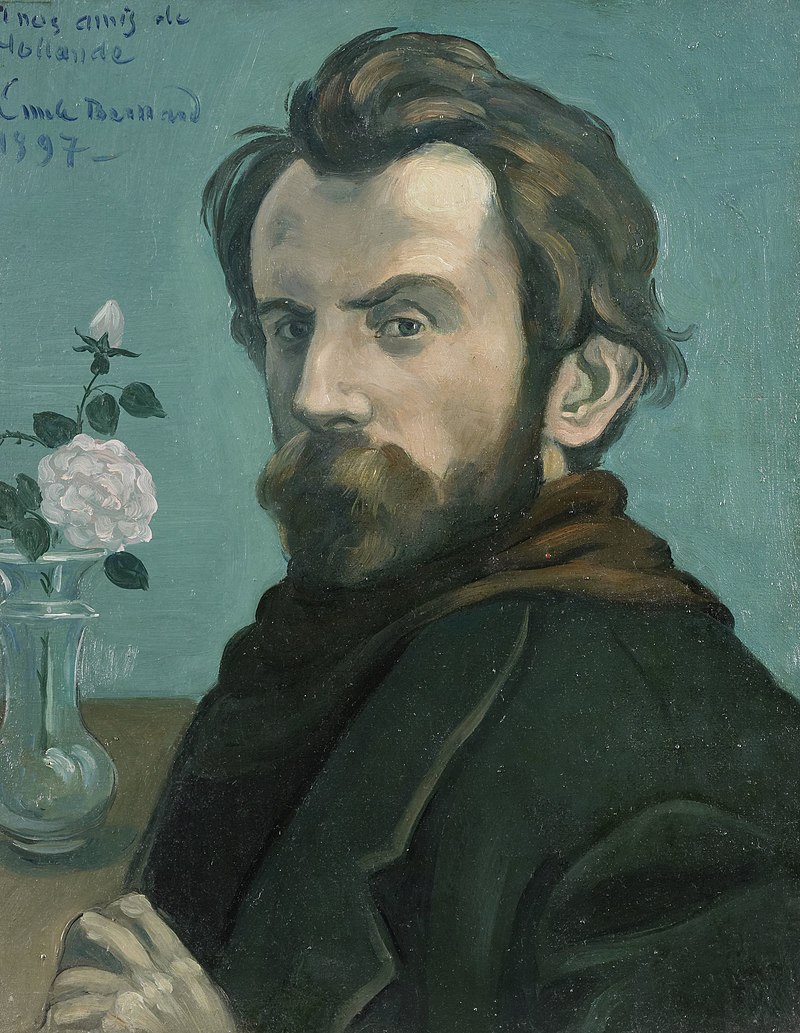
File:Zelfportret_Rijksmuseum_SK-A-3263.jpeg · Wikimedia Commons · See Wikimedia Commons
Émile Bernard
Sign in to saveAlso known as Emile Bernard, Jean Dorsal, Jean Dorsal (ps.), Henri Lebreton, Henri Lebreton (ps.), Lepeseur (ps.), Monguerre (ps.), Ludovic Nemo
French painter (1868-1941)
Key facts
- Born
- Émile Henri Bernard , ( 1868-04-28 ) 28 April 1868, Lille , France
- Died
- 16 April 1941 (1941-04-16) (aged 72), Paris , France
- Education
- École des Arts Décoratifs , Atelier Cormon
- Known for
- Painting
- Notable work
- Breton Women in a Green Pasture (1888)
- Movement
- Post-Impressionism , Synthetism , Cloisonnism
- Patrons
- Count Antoine de La Rochefoucauld , Andries Bonger , Ambroise Vollard
via Wikipedia infobox
Wikidata facts
- Instance of
- human
- Given name
- Henri
- Family name
- Bernard
- Gender
- male
- Citizenship
- France
- Place of birth
- Lille
- Place of death
- Paris
- Educated at
- Académie Julian
- Languages spoken
- French
- Native language
- French
- Participant in
- The Volpini Exhibition, 1889
- Student of
- Fernand Cormon
- Movement
- synthetism
- Image
- Henri de Toulouse-Lautrec - Portrait de Émile Bernard.jpg
- Work location
- Paris
Show 13 more facts
- Commons category
- Émile Bernard
- Commons Creator page
- Émile Bernard
- date of birth
- 1868-01-01
- date of death
- 1941-04-16
- birth name
- Émile Henri Bernard
- name in native language
- Émile Bernard
- Commons gallery
- Émile Bernard
- student
- Pierre Daura
- has works in the collection
- The Elms
- different from
- Émile Bénard
- ethnic group
- French
- start of work period
- 1884-01-01
- end of work period
- 1941-01-01
via Wikidata · CC0
~16 min read
Encyclopedic overview
Émile Henri Bernard ( French pronunciation: [emil ɑ̃ʁi bɛʁnaʁ]; 28 April 1868 – 16 April 1941) was a French Post-Impressionist painter and writer, who had artistic friendships with Vincent van Gogh, Paul Gauguin and Eugène Boch, and at a later time, Paul Cézanne. Most of his notable work was accomplished at a young age, in the years 1886 through 1897. He is also associated with Cloisonnism and Synthetism, two late 19th-century art movements. Less known is Bernard's literary work, comprising plays, poetry, and art criticism as well as art historical statements that contain first-hand information on the crucial period of modern art to which Bernard had contributed.
Biography
Excerpted from Wikipedia’s “Émile Bernard” article, available under the CC BY-SA 4.0 licence.