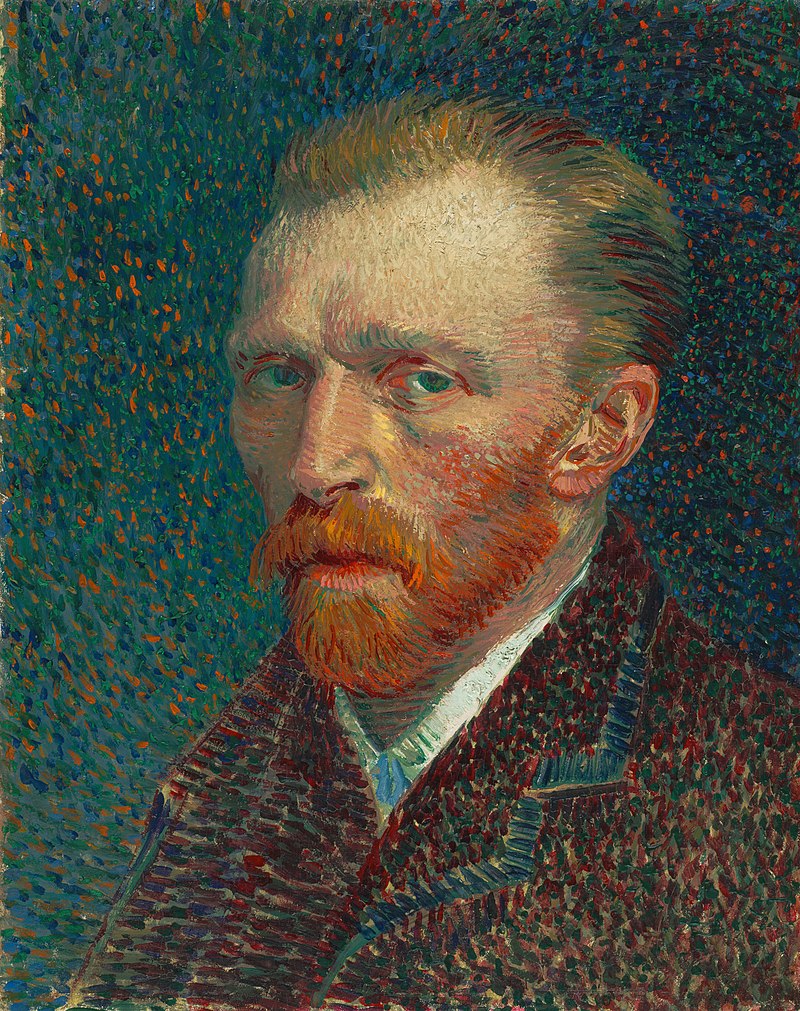
File:Vincent_van_Gogh_-_Self-Portrait_-_Google_Art_Project_(454045).jpg · Wikimedia Commons · See Wikimedia Commons
Vincent van Gogh
Sign in to saveDutch painter (1853–1890)
OverviewAI-generated
Vincent Willem Van Gogh was a male painter, draftsperson, printmaker, and etcher born in Zundert in 1853. A citizen of the Kingdom of the Netherlands, he was associated with the Post-impressionism and Expressionism movements. His notable works include The Potato Eaters, Café Terrace at Night, The Starry Night, and Bedroom in Arles. He studied under Anton Mauve and Constantinus Cornelis Huysmans and was influenced by Anton Mauve, Paul Gauguin, Willem Roelofs, and Paul Cézanne.
Van Gogh worked in Tilburg, The Hague, London, and Paris. He resided at the Monastery of Saint-Paul-de-Mausole, Cuesmes, and Maison Van Gogh. He suffered from epilepsy and depression. His unmarried partners were Sien Hoornik and Margot Begemann. He died in 1890 from a gunshot wound sustained by suicide. He spoke Dutch and French.
Synthesized by Vinony from 38 facts across 5 sources: Wikidata, Firecrawl, TMDb, Europeana Sparql, VIAF. Generated from structured data (not the Wikipedia text) and checked against those facts — may still contain errors.
Film & TV
Zundert, Netherlands
Vincent Willem van Gogh was a Dutch Post-Impressionist painter who is among the most famous and influential figures in the history of Western art. In just over a decade he created about 2,100 artworks, including around 860 oil paintings, most of them in the last two years of his life. They include landscapes, still lifes, portraits and self-portraits, and are characterised by bold colours and…
Known for
- Van Gogh - Schüsse im Weizenfeld — Self (archive footage)2022
- Van Gogh vs. Gauguin — Self (archive footage)2022
- Vincent van Gogh — Self (archive footage)2021
- Sunflowers — Self (archive footage)2021
- Vincent van Gogh Superstar — Self (archive footage)2019
- Van Gogh & Japan — Self (archive footage)2019
- Van Gogh: Painted with Words — Self (archive footage)2010
- Vincent van Gogh: A Life Devoted to Art — Self (archive footage)2009
- Vincent van Gogh: A Stroke of Genius — Self (archive footage)1997
- Omnibus — Self1967
via TMDB
Authority record · VIAF
- Lifespan
- 1853–1890
- Nationality
- NL, FR, NLD
- Role / Field
- Painter, Peintres, Painters, Artists, Printmaker, Post impressionism art
- Language
- dut, fre, nld
- Gender
- Male
Recorded by 46 libraries
via VIAF · OCLC
Described at
In april 1888 verhuisde de moeder van Vincent van Gogh naar een kleine woning aan de nieuwe Haagdijk in Breda. Omdat er maar weinig ruimte was in het nieuwe huis, besloot ze de schilderijen en tekeningen die haar zoon enkele jaren eerder bij zijn vertrek naar Antwerpen had achtergelaten, niet mee te nemen. De werken werden opgeslagen. Ze belandden op de zolder van een timmerman aan de Ginnekenstraat. Moeder keek er verder niet meer naar om. De stapel tekeningen, aquarellen en schilderstukken bleef jarenlang onaangeroerd, maar uiteindelijk vond de collectie, vrijwel het gehele oeuvre van Van Gogh uit de Nederlandse periode, toch zijn weg naar een groter publiek. In eerste instantie gebeurde dat via de ambulante straathandel in ongeregelde goederen, maar al snel hingen de werken in galerieën en musea verspreid over het hele land en ver daarbuiten. Het is een complexe onderneming om de verspreidingsgeschiedenis van het vroege werk van Van Gogh te reconstrueren, temeer daar men zich begeeft op een grotendeels onontgonnen terrein. Zo is bijvoorbeeld nooit terdege onderzocht om welke tekeningen, schilderijen en aquarellen het nu precies gaat of hoeveel het er zijn. Op 29 juli 1890, overleed Vincent van Gogh in het Noord-Franse dorpje Auvers-sur-Oise en zes maanden later, op 25 januari 1891, stierf te Utrecht ook zijn broer Theo. Welbeschouwd waren zij de enigen die uitsluitsel hadden kunnen geven over het oeuvre dat Vincent in zijn Nederlandse jaren had voortgebracht. Met hun verscheiden lieten de broers - afgezien natuurlijk van hun uitgebreide correspondentie - als het ware een kunsthistorisch vacuum achter en daarmee een vruchtbare voedingsbodem voor romantische beeldvorming en mythologisering. Naargelang het werk van Van Gogh grotere bekendheid verwierf, leken kunstminnaars en goudzoekers van diverse pluimage in toenemende mate behept met een soort magie. Een beduimeld envelopje met wat potloodstreken, een op het oog onbeduidend krabbeltje op een oud vel papier, het kon van grote betekenis zijn, vooral als er & 39;Vincent& 39; onder stond. Van lieverlee ontspon zich rond de nalatenschap van de grote schilder een kat en muis spel, waarin zowel de naaste familie als talloze handelaren, verzamelaars, vervalsers en gerenommeerde kunsthistorici verstrikt raakte. Een donker doolhof van conflicterende belangen en wankelende reputaties, waaruit na verloop van tijd zelfs de meest doorgewinterde Van Goghkenner niet meer wist te ontsnappen. Om de weg uit dit labyrint te vinden, moet men welhaast een duivelskunstenaar zijn en dat is natuurlijk teveel gevraagd. Wel is een eerste aanzet gemaakt om de vele facetten van de Bredase verspreidingsgeschiedenis nu eindelijk eens in kaart te brengen. Dat is van belang omdat juist de obscuriteit van deze geschiedenis heeft gezorgd voor grote onzekerheid over wat Van Gogh nu precies heeft gemaakt gedurende de jaren dat hij in Nederland woonde. Immers, toen zijn tekeningen en schilderijen in Breda werden uitgevent, was dat werk nog door niemand geïnventariseerd of gecatalogiseerd. De toewijzingspractijk van individuele experts en gevestigde kunstinstellingen bleef bij gebrek aan solide herkomstgegevens niet zelden een arbitraire aangelegenheid. Meerdere malen ontstond grote beroering over werken, die door deskundigen aanvankelijk wel en later weer niet aan Van Gogh werden toegeschreven en vice versa. Was het eigenlijk wel mogelijk te achterhalen wat er op die zolder aan de Ginnekenstraat had gelegen? Zowel de goudkoorts van de ontdekkers als de twijfels van de experts zijn geworteld in het vacuüm dat de gebroeders van Gogh meer dan een eeuw geleden hebben achtergelaten. Dit ongewisse is vervolgens nog in hoge mate versterkt door de wijze waarop in Breda met Vincents erfenis werd omgesprongen. Reden te meer voor een grondige verkenning. In december 1883 verliet Vincent van Gogh de provincie Drenthe, waar hij drie maanden had gewerkt. Hij was berooid en trok in bij zijn ouders te Nuenen. Zijn studie
Excerpt from a page describing this subject · 40,000 chars · not written by Vinony
Wikidata facts
- Instance of
- human
- Given name
- Willem
- Gender
- male
- Citizenship
- Kingdom of the Netherlands
- Place of birth
- Zundert
- Place of death
- Auberge Ravoux
- Mother
- Anna Carbentus van Gogh
- Occupation
- art dealer
- Educated at
- Royal Academy of Fine Arts
- Languages spoken
- French
- Notable work
- Sunflowers
- Participant in
- Documenta III
- Student of
- Constantinus Cornelis Huysmans
- Field of work
- painting
- Hair colour
- red hair
- Genre
- Christian art
- Movement
- Expressionism
- Image
- Self-portrait - Vincent van Gogh.jpg
- Work location
- Maison Van Gogh
- Residence
- Maison Van Gogh
- Significant event
- self-injury
Show 25 more facts
- Commons category
- Vincent van Gogh
- date of birth
- 1853-03-30
- date of death
- 1890-07-29
- topic's main category
- Category:Vincent van Gogh
- Commons gallery
- Vincent van Gogh
- medical condition
- depression
- Commons Creator page
- Vincent van Gogh
- manner of death
- Suicide
- birth name
- Vincent Willem Van Gogh
- unmarried partner
- Margot Begemann
- influenced by
- Katsushika Hokusai
- cause of death
- gunshot wound
- ethnic group
- Dutch
- on focus list of Wikimedia project
- Wikipedia:Vital articles/Level/4
- name in native language
- Vincent van Gogh
- sponsor
- Theo Van Gogh
- owner of
- The Night Café in Arles
- archives at
- Van Gogh Museum
- has works in the collection
- Museum of Art Collections
- writing language
- French
- described at URL
- keeswouters.files.wordpress.com/2015/12/gek-van-van-gogh1.pdf
- P12749
- Max Wilms
- topic has template
- Template:Vincent van Gogh
- present in work
- Self-portrait
Sources (15)
via Wikidata · CC0
Works in European collections
36 objects attributed to Vincent van Gogh, held across European museums, libraries & archives · via Europeana
Village angle in Scheveningen
Field with sower in the rain/sower in the rain/La pluie
La Berceuse, Portrait of Madame Roulin
Portrait of a Woman
Poplar Alley with a Figure
Winter
Sheep shearer
Street builder
Still Life with Defeated Bible
Portrait of a Girl (Mademoiselle Ravoux)
Field behind l 'Asilo Saint-Paul
Old man with cylinder and stick
haystack
La Berceuse/Madame Roulin
Olive trees in front of Alpillen/Olive grove
Olive harvest
Still Life
Farmhouse with two figures
Wheat field with ravens
Farmhouse in Nuenen
Pietà
Blooming peach tree
Mountain workers in the snow
The student
The Sower
Winter Landscape with Walkers
The Sailor
Vase with sunflower
Landscape with trees and houses
White lilies
Old peasant woman sitting near the window
Farmer
Still Life with Book Stacks
Farmer at Pea Peel
The Railway Bridge
Farmer digging
~40 min read
Encyclopedic overview
Vincent Willem van Gogh ( Dutch: [ˈvɪnsɛnt ˈʋɪləɱ vɑŋ ˈɣɔx] ; 30 March 1853 – 29 July 1890) was a Dutch Post-Impressionist painter who is among the most famous and influential figures in the history of Western art. In just over a decade he created about 2,100 artworks, including around 860 oil paintings, most of them in the last two years of his life. They include landscapes, still lifes, portraits and self-portraits, and are characterised by bold colours and dramatic, impulsive and expressive brushwork that contributed to the foundations of modern art. His suicide at 37 followed years of mental illness and poverty.
Born into an upper-middle-class family, Van Gogh drew as a child and was serious, quiet and thoughtful. As a young man he worked as an art dealer, often travelling, but became depressed after he was transferred to London. He turned to religion, and spent time as a Protestant missionary in southern Belgium. He drifted in ill health and solitude before taking up painting in 1881, having moved back home with his parents. His younger brother Theo supported him financially, and the two kept up a long correspondence by letter. His early works, mostly still lifes and depictions of peasant labourers, contain few signs of the vivid colour that distinguished his later work. In 1886, he moved to Paris, where he met members of the avant-garde, including Émile Bernard and Paul Gauguin, who were reacting against the Impressionist sensibility. As his work developed he created a new approach to still lifes and local landscapes. His paintings grew brighter in colour as he developed a style that became fully realised during his stay in Arles in the south of France in 1888. During this period he broadened his subject matter to include series of olive trees, wheat fields and sunflowers.
Excerpted from Wikipedia’s “Vincent van Gogh” article, available under the CC BY-SA 4.0 licence.
Gallery (13)
Available in 217 languages
- Español
- Français
- Deutsch
- 中文
- 日本語
- Русский
- Português
- Italiano
- العربية
- हिन्दी
- Abkhazian
- Afrikaans
- Albanian
- Albanian
- Amharic
- Aragonese
- Aramaic
- Armenian
Show 198 more
- Arpitan
- Assamese
- Asturian
- Avaric
- Aymara
- azb
- Azerbaijani
- Bahasa Indonesia
- Balinese
- Bangla
- Bashkir
- Basque
- bat_smg
- Bavarian
- be_x_old
- Belarusian
- Bhojpuri
- Bikol
- Bishnupriya
- Bosnian
- Breton
- btm
- Bulgarian
- Buriat
- Burmese
- Catalan
- cdo
- Cebuano
- Central Kurdish
- Chechen
- Chuvash
- Colognian
- Cornish
- Corsican
- Crimean Tatar
- Croatian
- Czech
- dag
- Danish
- Egyptian Arabic
- eml
- Esperanto
- Estonian
- Extremaduran
- Faroese
- Fiji Hindi
- Filipino
- Finnish
- fiu_vro
- Galician
- Gan Chinese
- gcr
- Georgian
- Goan Konkani
- Gothic
- Greek
- Guarani
- Gujarati
- Haitian Creole
- Hausa
- Hawaiian
- Hebrew
- Hungarian
- hyw
- Icelandic
- Ido
- Igbo
- Iloko
- Interlingua
- Interlingue
- Irish
- Jamaican Creole English
- Javanese
- Jju
- Kabardian
- Kabyle
- Kannada
- Kanuri
- Kara-Kalpak
- Kazakh
- kbp
- Khmer
- Kotava
- Kurdish
- Kyrgyz
- Lao
- Latin
- Latvian
- Lezghian
- Limburgish
- Lingala
- Lingua Franca Nova
- Lithuanian
- lld
- Lombard
- Low German
- Luxembourgish
- Macedonian
- Madurese
- Malagasy
- Malay
- Malayalam
- Maltese
- Manx
- Māori
- Marathi
- Mari
- Mazanderani
- Minangkabau
- Mingrelian
- Mirandese
- mnw
- Mongolian
- Moroccan Arabic
- nah
- nds_nl
- Neapolitan
- Nederlands
- Nepali
- Newari
- Northern Frisian
- Northern Sami
- Norwegian
- Norwegian Nynorsk
- Nyanja
- Occitan
- olo
- Ossetic
- Pampanga
- Pangasinan
- Papiamento
- Picard
- Piedmontese
- Polski
- ppl
- Punjabi
- Quechua
- Romanian
- Rusyn
- Santali
- Sardinian
- Saterland Frisian
- Scots
- Scottish Gaelic
- Serbian
- Serbian (Latin)
- Sicilian
- simple
- Sindhi
- Sinhala
- Slovak
- Slovenian
- Somali
- Southern Altai
- Sundanese
- Svenska
- Swahili
- Tajik
- Talysh
- Tamil
- Tatar
- Telugu
- Tibetan
- Tiếng Việt
- Toki Pona
- Tsonga
- Tumbuka
- Türkçe
- Turkmen
- Tuvinian
- Tyap
- Udmurt
- Ukrainian
- Upper Sorbian
- Urdu
- Uyghur
- Uzbek
- Venetian
- Veps
- Volapük
- Walloon
- Waray
- Welsh
- Western Frisian
- Western Mari
- Western Panjabi
- Wu Chinese
- Yakut
- Yiddish
- Yoruba
- Zaza
- Zeelandic
- zh_min_nan
- zh_yue
- Zulu
- فارسی
- ไทย
- 한국어
via Wikidata sitelinks · CC0