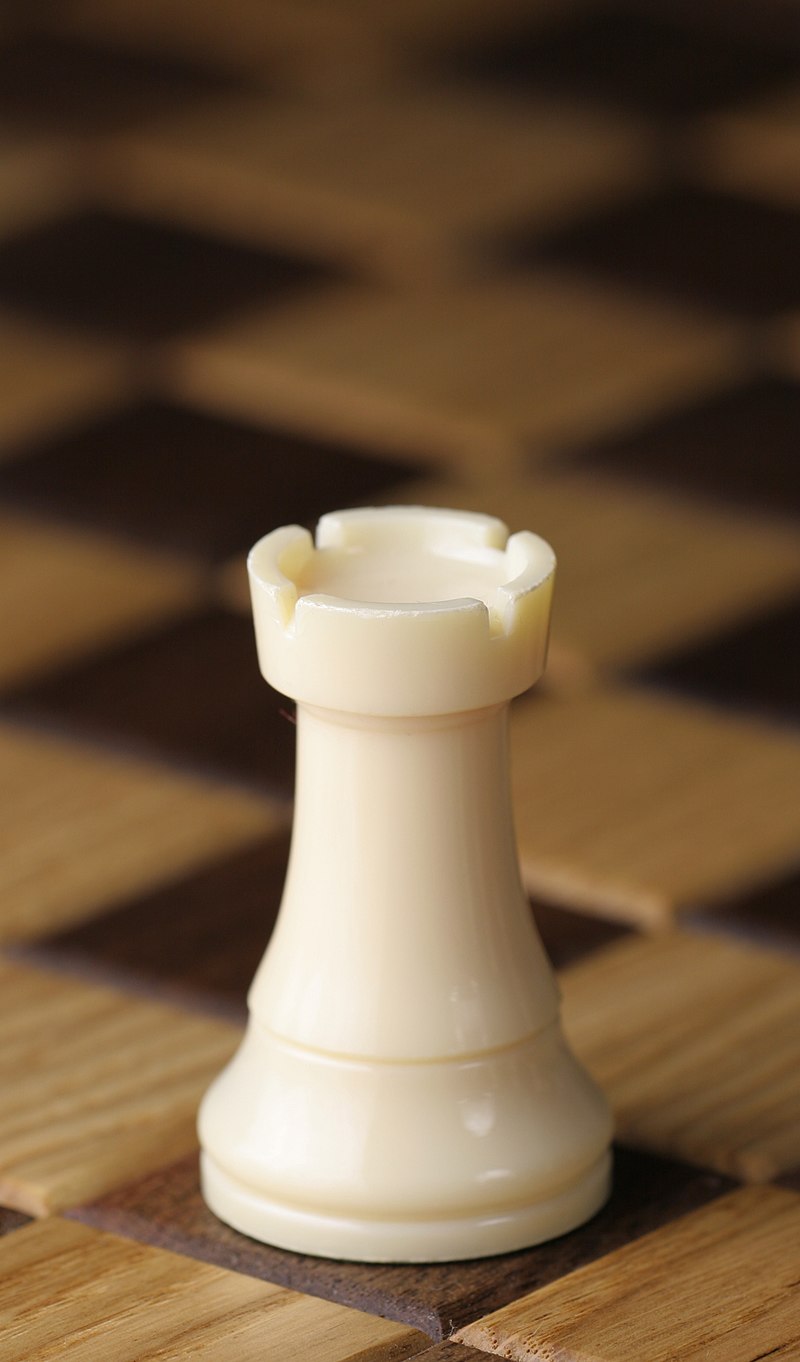
File:Chess_piece_-_White_rook.JPG · Wikimedia Commons · See Wikimedia Commons
A rook is a chess piece shaped like a castle tower that moves in straight lines across any number of unobstructed squares horizontally or vertically. It is one of the most powerful pieces in chess because of its ability to control long distances on the board, making it valuable for both attacking and defending.
AI-generated from the Wikipedia summary — may contain errors.
Wikidata facts
Show 6 more facts
- Unicode character
- ♜
- short name
- V
- Stack Exchange tag
- chess.stackexchange.com/tags/rooks
- described by source
- Brockhaus and Efron Encyclopedic Dictionary
- Commons category
- Chess rooks
- Portable Game Notation
- R
Sources (1)
via Wikidata · CC0
~12 min read
Encyclopedic overview
The rook (/rʊk/; ♖, ♜) is a piece in the game of chess. It may move any number of squares horizontally or vertically without jumping, and it may capture an enemy piece on its path; it may participate in castling. Each player starts the game with two rooks, one in each corner on their side of the board.
Formerly, the rook (from Persian: رخ, romanized: rokh/rukh, lit. 'chariot') was alternatively called the tower, marquess, rector, and comes (count or earl). The term "castle" is considered to be informal or old-fashioned.
Excerpted from Wikipedia’s “rook” article, available under the CC BY-SA 4.0 licence.
Gallery (7)
Available in 83 languages
- Español
- Français
- Deutsch
- 中文
- 日本語
- Русский
- Português
- Italiano
- العربية
- हिन्दी
- Afrikaans
- Albanian
- Armenian
- Azerbaijani
- Bahasa Indonesia
- Bangla
- Basque
- be_x_old
Show 64 more
- Belarusian
- Betawi
- Bosnian
- Bulgarian
- Catalan
- Corsican
- Croatian
- Czech
- Danish
- Esperanto
- Estonian
- Faroese
- Finnish
- Galician
- Georgian
- Greek
- Hebrew
- Hungarian
- Ido
- Interlingua
- Irish
- Kannada
- Kashmiri
- Kurdish
- Latin
- Latvian
- Lithuanian
- Low German
- Luxembourgish
- Macedonian
- Malay
- Malayalam
- Marathi
- Mingrelian
- Mongolian
- Nederlands
- Norwegian
- Norwegian Nynorsk
- Polski
- Romanian
- Serbian
- Serbian (Latin)
- simple
- Slovak
- Slovenian
- Somali
- Svenska
- Swahili
- Tajik
- Tamil
- Tatar
- Tiếng Việt
- Türkçe
- Turkmen
- Ukrainian
- Urdu
- Uzbek
- Welsh
- Wu Chinese
- zh_min_nan
- zh_yue
- فارسی
- ไทย
- 한국어
via Wikidata sitelinks · CC0